先说一个数字:人类向外界输出信息的速度,一天平均不到 1 比特每秒。
一天有 86400 秒。除极少数人整天不停说话或打字,绝大多数人一天输出的信息总量,不超过 86400 比特。马斯克在 Neuralink 2025 夏季发布会上,先把这个数字摆在所有人面前。
这不是个修辞。它直接点明了这家公司存在的理由。
我们脑子里正在发生的事,远比我们表达出来的复杂。一个念头传到嘴边,要经过压缩:你试图在对方脑中重建一个心智状态,把一个可能包含画面、场景、情绪的复杂想法,压成几句话、几个词、几次敲击。这个过程必然高度有损。表达的天花板,卡在你说话的语速、打字的速度上。
Neuralink 想拆掉这个天花板。目标是从 1 比特每秒,先到兆比特,再到吉比特。马斯克给这件事起了个名字:概念性心灵感应(conceptual telepathy)。
你脑子里其实已经有三层结构
发布会开场,马斯克花了不少时间讲意识。这不像一家医疗器械公司该有的开场,但他有他的道理。
他说,如果把宇宙拉回起点,假设标准模型成立,那就从大爆炸开始,物质聚成恒星,恒星爆炸,你身体里现在的大部分原子,曾经就在某颗恒星的核心。那些恒星爆炸、重新凝聚,13.8 亿年过去了,才有了我们。而在这条漫长的路上某个位置,意识出现了,或者说,分子开始相互对话。
意识到底从哪一刻开始存在?马斯克承认没人答得上来。“沿着这条线,你很难找到一个清晰的点,说这里意识不存在,那里突然存在了。”
“你可以做心脏移植,可以做肾脏移植,但我没听说过谁做过大脑移植。所以你就是你的大脑。”(马斯克)
从这个前提出发,他给出一个我觉得整场发布会最值得琢磨的判断:人类早就是赛博格了。
他把人的认知拆成三层。最底层是边缘系统,管本能;中间是皮层系统,管高级规划和思考;最上面还有第三层,也就是你手机里的那些 App、你用的电脑。这一层数字设备已经是你身体的一部分了。检验方法很简单:出门忘带手机,那种焦虑感几乎像缺失综合征。手机某种程度上就是你自己的延伸。
问题在于,皮层和这层数字设备之间的带宽,被你的嘴巴和手指死死卡住了。你想想,数字层的信息量可以无限大,你接入它的速度却只有每天 86400 比特。
这为什么重要?马斯克的答案跟 AI 有关。他说,为了让人类的集体意志有能力匹配 AI 的意志,我们必须解决这个输入输出带宽的瓶颈。“至少这是我的直觉判断。”
这句“至少这是我的直觉判断”挺诚实。他没有假装这是个已经被证明的结论。整个发布会的基调也是这样:很多事我们还不确定,但我们正在往前走,而且会走得很小心。
7 个人,平均每周用 50 小时
联合创始人兼总裁 DJ 接过了技术进展的部分。他站在一台机器人中间,这台机器人正在被组装,是下一代手术机器人之一。
他先划了条时间线。两年前那轮融资时,公司对外画了一条通往“第一例人类植入”的路线图。现在回头看:临床试验已经在美国跑起来,产品叫 Telepathy(心灵感应),让用户纯靠意念控制手机或电脑。
截至发布会当天,参与者不是 1 个,是 7 个。并且拿到了加拿大、英国、阿联酋的试验批准。
现场放了一段视频,前五位参与者第一次线上碰面。这段对话信息量不大,但很真实。Nolan(P1)、Alex(P2)、Brad(P3,ALS)、Mike(P4)、RJ(P5)互相打招呼,聊各自最喜欢的功能。有人说是玩 Web Grid 玩到停不下来;有人说是用 Fusion 360 设计零件,给自己球队的帽子做 logo;有人写代码遥控一架 RC 飞机;有人说,最喜欢的,是终于能自己打开电视,那是两年半以来第一次。
Brad 说了句很重的:“能继续养家、继续工作,是我最喜欢 Neuralink 的地方。”
DJ 给了一组硬数据。公司追踪的核心指标是每月“独立使用时长”,也就是在诊所之外、在真实生活里用 BCI 的时间。这张图上,7 位参与者过去一年半的使用曲线,平均每周 50 小时,峰值超过 100 小时,基本等于醒着的每一刻。这个数字比任何宣传语都有说服力:这些人在真实生活里离不开它了。
手术节奏也在加快。目前 4 位脊髓损伤参与者、3 位 ALS 参与者,最后两台手术是在同一周内完成的。DJ 说这还只是冰山一角。
路线图摆出来了:从 1000 个电极到 25000 个
Neuralink 的北极星指标有两个:能接入的神经元数量,以及能触达的脑区数量。
围绕这两个指标,产品演进路线被摊开来讲,具体到年份:
- 现在:运动皮层的 1000 个电极,位置是控制手部的那一小块区域,叫“手结节”(hand knob)。参与者用它控制光标和游戏主机。
- 本季度:开始植入语言皮层,直接解码“想说的话”变成语音。
- 2026 年:电极数从 1000 翻到 3000,同时迎来第一位盲视(Blindsight)参与者,让他能重新导航行走。
- 2027 年:通道数再翻三倍到 10000,第一次做“多植入体”,不只运动皮层,语言皮层、视觉皮层同时上。
- 2028 年:单个植入体要超过 25000 通道,多个植入并存,能抵达大脑任何区域,用于精神类疾病、疼痛、神经失调,并开始演示和 AI 的整合。
这条线上有三个产品分支。已经落地的 Telepathy 负责“输出”,帮失去身体控制能力的人重新拿到数字独立性和身体独立性。Blindsight 负责“输入”,给完全失明的人重建视觉,包括那些眼球或视神经已经没了、甚至天生看不见的人。第三条是往深处走,把电极插进皮层之下的结构,包括边缘系统,去处理神经性失调、精神疾病和神经病理性疼痛。
DJ 说了一句容易被忽略的话:这家公司从第一天起做的就是读写双向能力,只是 Telepathy 阶段先聚焦“读”。
第一天就破了纪录
BCI 团队的人上台讲了三个具体场景,每一个都很能说明问题。
第一个是 Nolan。他对着普通的、市面买得到的 MacBook Pro,不靠眼动追踪,不靠别的传感器,纯靠意念移动光标。这段视频的特别之处在于,这是人类第一次用 Neuralink 完全控制光标。第一天,就打破了数十年来脑机接口研究的控制纪录。视频里他自己都震惊了,反复说“我以为我得练到第五次才行”。
第二个是游戏。五位用户连线一起玩马里奥赛车。再往后是 Alex 和 RJ 打《使命召唤》,一个人用一个摇杆移动、另一个摇杆瞄准,按钮开枪。这是第一次有人用脑机接口打第一人称射击。视频里 Alex 一枪爆头,对面惨叫。
第三个是 Brad。他是 ALS 患者,不能说话。确诊六年来,他靠眼球追踪设备沟通,而很多眼球追踪设备只能在暗房里用,所以他基本出不了门。有了植入体之后,视频里他和孩子在公园。“能出门对我而言是巨大的恩赐,而且我可以用意念控制电脑。”他儿子在旁边说,“爸爸在看镜头呢。”
15 分钟,从零控制到流畅用电脑
机器学习工程师 Harrison 讲了校准这件事,这是整个体验能不能成立的关键。
他先泼了盆冷水:Neuralink 不是读心术,它读的是和运动意图对应的神经元激活。所以有个有趣的工程难题:游戏里两个摇杆,分别该映射到哪两个动作?
团队一开始想的是左手拇指和右手拇指。很快发现优势手会压制非优势手。后来有个参与者的方案特别有意思:左手摇杆想象“走路”,右手摇杆想象“瞄准”。游戏里做的都是自然动作,像《头号玩家》里那样。最后定下来的方案是:左摇杆用拇指,右摇杆用手腕。Harrison 现场让观众自己试试这个动作组合,因为真的很难。
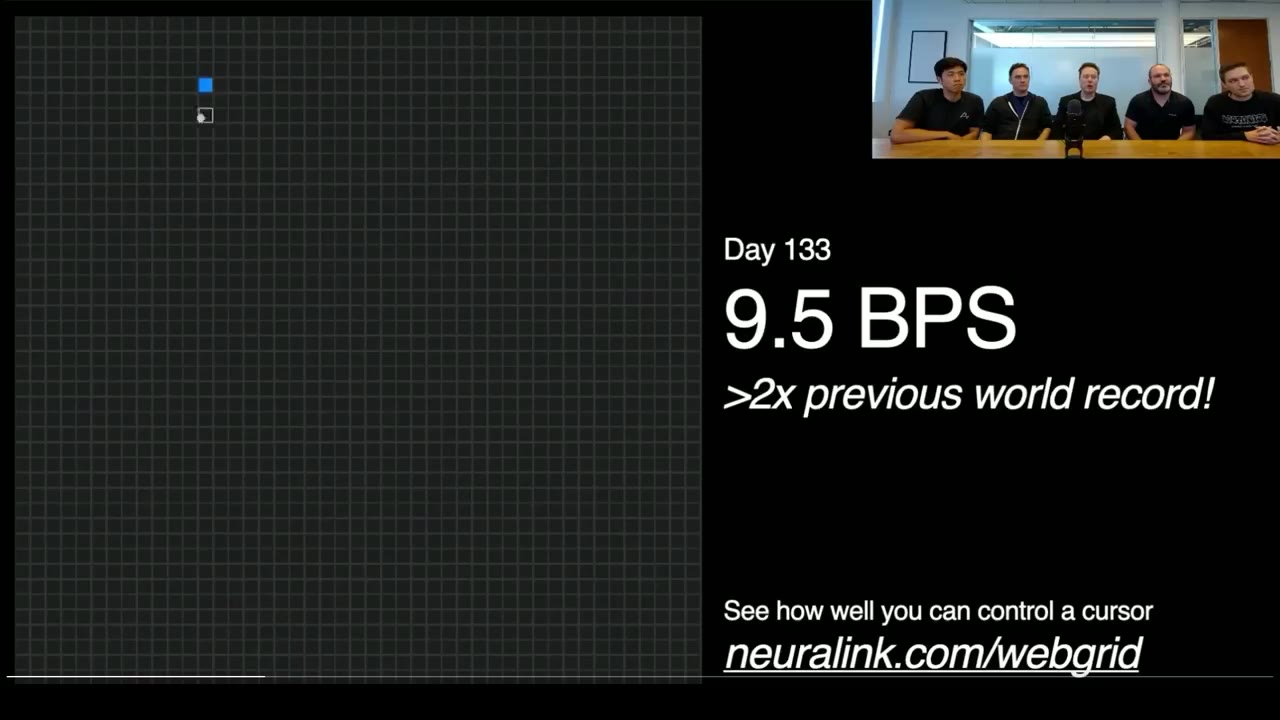
然后是校准的进步。RJ 完成第一次光标校准,从零控制到流畅操作,总共花了 15 分钟。对比一年半前的 P1,那时候要花好几个小时,几个工程师围着桌子抓头发。现在工程师基本不用在场,这几乎是个开箱即用的体验。RJ 在第一天就打到了 7 BPS(比特每秒)的早期纪录。
Harrison 还讲了一个很美的点:神经信号会漂移,这在工程上是麻烦,他的解读是另一回事。
“如果你的神经信号不漂移,你就无法成长。第二天醒来,你已经不是昨天的你,你学了新东西,你变了。所以你的神经数据也必须变。”(Harrison)
这句话把“神经非平稳性”这个技术难题,讲成了人的本质。
盲视:往大脑更深处插线
Blindsight 项目的负责人 Joey 讲了视觉重建的原理:用户戴一副嵌了摄像头的眼镜,视觉皮层里有植入体,摄像头拍到的画面被转成刺激模式,送进大脑,产生视觉感知。
难点在于解剖结构。视觉皮层表面的区域,只代表视野正中央很小的一个角度。更大的视野,映射在大脑皮层褶皱深处的一个叫“距状沟”(calcarine fissure)的地方。Neuralink 的细线能扎进这些深层结构,这才让“恢复有功能意义的视野”成为可能。
硬件上,新的 S2 芯片是为刺激从头设计的:超过 1600 个电刺激通道,高动态范围记录能力,宽范围的微刺激电流和电压。因为公司自己做芯片设计和制造,这些都能自己迭代。电极也重新设计了,用于刺激的触点更大一些,阻抗更低,电荷输送更安全有效。
校准方式很直接:刺激阵列上三个通道,用户看到三个光点,用手去指,系统追踪手臂和眼动,一个个通道重复。
为了把线插得更深,需要顶级医学影像。Neuralink 找了西门子,拿到地球上最好的一批扫描仪。从一片空地到影像中心建成,只用了四个月。上线以来已经扫了 50 多位内部参与者,建起人体结构与功能解剖的数据库。这套影像能力现在支持手术规划:从功能图像一键生成机器人插入靶点,轨迹方案直接发送给机器人,中间几乎不需要人。
机器人提速 11 倍,一根针的成本从 350 美元降到 15 美元
然后是硬核的工程部分。机器人团队负责人 John 讲了 R1 机器人的问题:太慢。每插一根线,最好情况 17 秒,遇到外界干扰还要重插。
下一代机器人换了思路:把植入体直接握在机器人头部前方,省掉中间环节,每根线的循环时间降到 1.5 秒,提升 11 倍。还删掉了独立操作台和植入体支架。针的兼容性从“部分人群”扩展到 99% 以上的人类,插入深度超过 50 毫米。
耗材成本的优化更惊人。当前的针筒,制造周期约 24 小时,零件成本约 350 美元。工艺极其手工化:技师要把 150 微米直径的套管粘到线切割加工的不锈钢基板上,把 40 微米的丝电解抛光成尖锥,再手动穿过套管上 60 微米的孔,最后激光焊接全部零件。
下一代:周期 30 分钟,零件成本 15 美元。方法是用嵌件注塑的基板替代线切割基板,一盒上千个、单价几美元;改针尖几何形状,去掉电解抛光;改个漏斗结构,去掉手动穿丝;用压接替代激光焊接。
John 讲这些时语气很平,但这就是把一项实验室技术变成量产产品的路径。
“摩尔定律的神经元版本”
植入体团队负责人 Julian 讲了一段我觉得整场最有洞察的话。
他说,人类输出信息用手和嘴,接收信息用耳朵和眼睛。而这个植入体特殊的地方在于,它是第一次给大脑加了一条全新的数据传输通道。
“表面上看,这个设备只是在采样大脑里的电压,用无线电发出去。但如果你把系统从这头看到那头,你看到的是:我们在把左边的生物神经网络,接到右边的硅基神经网络上。”
他补了一句:右边这个机器学习模型,本来就是受左边的神经元启发的。所以某种意义上,我们是在延伸大脑这个基础载体。
他还摆了几代设备的实物。最早那批是有线的,上面还带着 USB-C 接口,他自嘲“这实在不太适合植入人体”。后来才进化成无线版本,加了电池、天线、无线电,做成完全植入、外观隐形、模块化的通用平台。这中间跨过的工程难关包括:做气密封装、让 1000 多根独立导线穿过壳体、解决无缝充电、在极小面积里控制热约束,以及把测试体系扩展到能支撑大规模生产。
他提到一个说法:“我们经常在想摩尔定律的神经元版本。”摩尔定律推动了后来所有的计算革命,他们相信,能接入的神经元越来越多,同样会重新定义人和计算机、人和现实的关系。
最后他讲了个比喻。他小时候用 56K 调制解调器上网,打开一个网页,图片一行一行往下刷,像素一点点加载。那就是带宽受限的感觉。现在拿同一个调制解调器去用今天的互联网,根本不可能。
“宽带互联网对 56K 调制解调器做的事,就是这套硬件要对大脑做的事。”(Julian)
Optimus 的手,和重新接通的脊椎
发布会中间有几个片段,是马斯克在讲更远的事。
Alex 用脑信号控制机械手写草书、和人猜拳,靠的是实时解码手指、手腕、手部所有肌肉。屏幕上的机械手不够用,于是有了和特斯拉的合作:把 Alex 的神经信号接到 Optimus 的手上,在真实世界里控制它。
马斯克接着往下推:不只是手,是全身。你可以“精神上远程进入一个 Optimus 机器人”,获得它的全身控制和传感器。他说了句很马斯克的话:“未来会很怪。但也挺酷。”
再往下是假肢。失去手臂或腿的人,未来可以接上 Optimus 的手臂或腿。他举了《星球大战》里卢克被光剑砍断手、装上机械手的例子。
然后是整场最打动我的一段。桥接。把脑部的植入体和脊髓的植入体连起来,从大脑取信号,越过受损或断裂的神经元,传到身体其余部分。这样,即使颈椎断了,人也能重新走路,恢复全身功能。
马斯克说:“显然,这才是人们更想要的。我们很清楚那才是首选结果。我现在相当有信心,未来某个时候我们能做到。”
这场发布会不是来融资的
马斯克在开场就说明白了:这不是募资发布会,公司资金充足,投资人里有世界上最聪明的一批人。这场发布会的主要目的是招募聪明人来做这个难题。
他也反复强调节奏:这件事会慢慢发生,你会看到它一步步来。不会突然之间到处是 Neuralink 植入体,你会看着它在几年里慢慢铺开。每一步都走完整的监管审批,全程和政府监管机构密切合作。
“我们对人体里的 Neuralink 非常谨慎。我们之所以没有走得更快,就是因为我们对每一个个体都极其小心,确保永远不出错。到目前为止我们没出过错,我希望未来一直如此。”(马斯克)
7 个植入体,全部工作正常,而且工作得不错。这个数字现在还很小,但它是这句话的底气。
如果你只记三件事
- 看带宽。以后评估任何脑机接口的进展,先问两个数:能接入多少神经元,能触达哪些脑区。Neuralink 自己的路线图是 1000 → 3000 → 10000 → 25000 通道,2028 年目标多植入体并存。其他公司也可以拿这两个数去比。
- 看使用时长,不看演示视频。发布会上最有价值的数字不是任何一段炫技视频,是那张“每周平均 50 小时、峰值 100 小时”的曲线。这项技术有没有用,用户醒着的时间会投票。以后看任何医疗或消费硬件的发布,去找这类“真实场景里的使用数据”,不要被剪辑过的几分钟打动。
- 关注工艺成本,那是量产的信号。一根针从 24 小时、350 美元做到 30 分钟、15 美元,这种数字比“我们做到了”更能说明一项技术什么时候能真正铺开。判断任何前沿硬件能否走向大众,去看它的耗材成本曲线和手术循环时间,而不是看它最厉害的那一次演示。
0:03Hello everybody, my name is Alex Todling. I'm the second participant in the Neuralink Study, and I'm here to count us down to the demo. In five, three, two, one.
0:31Hi everyone. Welcome to the Neuralink presentation. This is an update for the Progress from the Neuralink Team. It's been an incredible amount of progress. This is, we're gonna start off high level. that generally describing what Neuralink's doing, and then we're going to have a very deep technical dive.
0:55So you can actually get an understanding of what exactly we're doing at a granular level, and what we can do to enhance human capabilities, and ultimately build a great future for humanity. So that's a neuron-spiring. It's funny to think that me talking right now is a bunch of neurons firing that then result in speech
1:20that you hear, of course, neurons to fire in your brain. Part of this presentation is about demystifying the brain. It is a remarkable organ. I mean, we are the brain, basically. When you say you, that really is you're the brain. like you can get a heart transplant, you can get a kidney transplant, but I don't know anyone who's gotten a brain transplant.
1:50So you are your brain, and your experiences are these neurons firing with trillions of synapses that somehow lead to conscious comprehension of the world. This is something that we have only begun to understand. we're really just barely at the beginning of understanding of what is the nature of consciousness.
2:18And I've thought a lot about what is consciousness? Where does consciousness arise? Because if you start at the beginning of the universe, assuming physics is true, the standard model of physics is true, then you have this big bang, the matter condensing into stars, those stars exploding.
2:43A lot of the atoms that are in your body right now were ones at the center of stars. Those stars exploded, re-condensed, fast forward, 13.8 billion years, and here we are. And somewhere along that very long journey to us, at least, consciousness arose. Or the molecules started talking to each other.
3:14And it begs the question of what is consciousness? Is everything conscious? Maybe. It's hard to say where along that line there's no sort of discrete point where consciousness didn't exist and then suddenly does exist. It seems to be maybe you have a condensation of matter that has a density of, like we don't
3:44know what, the real answer is we don't know what. consciousness is. But with the Neuralink and the progress of the company's making will begin to understand a lot more about consciousness. And what does it mean to be? Along the way we're going to solve a lot of brain issues where the brains get injured or damaged in
4:16in some way or didn't develop in quite the right way. But there's a lot of brain and spine injuries that build so along the way. And I do want to emphasize that this is all going to happen quite slowly. Meaning you'll see it coming. Sometimes people think that suddenly there will be vast numbers of neural lengths all over the place.
4:40This is not going to be sudden. You'll be able to watch it happen over the course of several years. And we go through exhaustive regulatory approvals. So this is not something that we're just doing by ourselves without a government oversight. We work closely with the regulators every step of the way.
5:02We're very cautious with the neurolinks in humans. That's the reason we're not moving faster than we are, is because we're taking great care with each individual to make sure we never miss. And so far we haven't, and I hope that continues into the future. Every single one of our implants in humans is working and working quite well.
5:24And you'll get to hear from some of the people that have received the implants and cared in their words. So what we're creating here with a Neuralink device is a generalized input output technology for the brain. So it's how do you get information into or out of the brain and do so in a way that does not damage the brain or you know cause any negative
5:55side effects. It's a very hard problem and generally the reactions I've seen to this range from it's impossible to it's already been done before. Those people should meet, actually. The reality is that there actually have been limited brain to computer interfaces for several decades on a very basic basis.
6:24Just what we're doing with Neuralink is dramatically increasing the bandwidth by Mayors and magnitude. So a human bandwidth output is less than one bit per second over the course of a day. So there's 86,400 seconds in a day. It's very rare for a person to do more than 86,400 bits
6:49of output per day. You'd have to be really talking a lot or typing all day, and you might exceed that. So what we're talking about here is going from maybe one bit per second to ultimately megabits, and then gigabits per second. And the ability to do conceptual telepathy. Now, the input to the brain is much higher, especially because of vision.
7:19Depending upon how you count it, it might be on the order of a megabit or in the megabit range for input primarily due to sight. But even for input, we think that can be dramatically increased to the gigabit plus level. And a lot of the thinking that we do is we take a concept in our mind and we compress
7:49that into a small number of symbols. So when you're trying to communicate with somebody else, you're actually trying to model their mind state and then take quite a complex idea that you have, maybe even a complex image or scene or kind of mental video and try to compress that into a few words or a few key
8:11strokes. And it's necessarily going to be very lossy. Your ability to communicate is very limited by how fast you can talk and how fast you can type. And what we're talking about is unlocking that potential to enable you to communicate, like I said, thousands, perhaps millions of times faster than is currently possible.
8:32This is an incredibly profound breakthrough. This would be a fundamental change to what it means to be a human. So we're starting off with reducing human self-rank or addressing issues that people have, if they've been in an accident or they have some neural disease that's degenerative
8:58so they're losing capability to move their body or some kind of injury essentially. So enabling our first product is called telepathy and that enables someone who has lost the ability to command their body to be able to communicate with the computer and move the mouse and actually operate a computer with roughly the same dexterity, ultimately much
9:22more dexterity than a human with working hands. Then our next product is blind sight, which will enable those who have total loss of vision, including if they have lost their eyes or the optic nerve, or maybe have never seen, were even blind from both to be able to see again. initially low resolution but ultimately very high resolution and and then in multiple wavelengths.
9:49So you could be like Jordy LeFarge in Star Trek and you can see in radar, you can see an infrared, ultraviolet, superhuman capabilities, cybernetic enhancement essentially. And then along the way this should help us understand a lot more about consciousness. What What does it mean to be a conscious creature?
10:13We'll understand vastly more about the nature of consciousness as a result of this. And then ultimately, I think this helps mitigate the civilizational risk of artificial intelligence. We are actually already sort of have three layers of thinking. There's the limbic system, which is your instincts, the cortical system, which is your higher level of planning
10:41and thinking, and then the tertiary layer, which is the computers and machines that you interact with, like your phone, all the applications you use. So people actually are already a cyborg. You can maybe have an intuitive sense for this by how much you miss your phone if you leave it behind.
11:03Leaving your phone behind is almost like missing syndrome. Your phone is somewhat of an extension of yourself as is your computer. So you already have this digital tertiary layer, but the bandwidth between your cortex and your digital tertiary layer is limited by speech and by how fast you can move your fingers and how fast you can
11:26consume information visually. So, but I think it's actually very important for us to address that input output bandwidth constraint in order for the collective will of humanity to match the will of artificial intelligence. That's my intuition at least. So let's see. And what this presentation is mostly about is attracting smart humans to come and work
12:04with us on this problem. So this is not a presentation to raise money or anything like that. We're actually very well funded. We have a lot of great investors. of the smartest people in the world are invested in Neuralink. But we need smart humans to come here and help solve this problem.
12:25So with that, let's proceed. Hey, everyone. My name is DJ. I'm a co-founder and president of Neuralink. And as Elon mentioned, well, actually, we're standing in the middle of our robot space. We have a stage set up, but this is actually where some of the next generation, most advanced the vertical robots are being built.
12:59So welcome to our space. It's important to highlight that this technology is not being built in the dark. This is not a secret lab where we're not sharing any of the progress. In fact, we're actually sharing the progress very openly, as well as also telling you exactly what we're going to be doing.
13:24And we're hoping to progress on that as diligently and as safely and as carefully as possible. So to start off, two years ago, when we did our previous fundraising round, we outlined this path and timeline to First Human. And we currently have a clinical trials in the US for a product that we call telepathy,
13:46which allows users to control phone or computer purely with their thoughts. And you're going to see how we do this and what the impact that this has had. And not only have we launched this clinical trial, but as of today, we have not just one, but seven participants. And we have an approval.
14:12And we also have an approval to launch the trial in Canada, UK, and the UAE. So I guess before we dive into what this technology is and what we built, but I wanted to quickly share a video with you guys of when our first five participants met each other for the first time. So here you go.
14:39All right, we have everyone together. What's up, guys? Thanks everybody joining. Definitely want to use all of you. Yeah, I'm Nolan AKA P1. My name is Alex. I am the second participant in the Neural Link Study. I am Brad Smith, the ALS cyborg P3. My name is Mike P4. I have ALS like fried rice.
15:07Yeah, I'm RJ, I'm B5. And I guess I'm kind of the newest one of the team here. So yeah, I appreciate it. No trailblazer. You know, somebody's got to get first, man. That was you appreciate that. What's been your favorite thing you've been able to do with the Neuralink so far? I've just had a good time being able to use it as I travel, flying and drawing a little mustache on a cat.
15:31Had a lot of fun doing that. I mean, I've just had a good time playing around with it. Oh, you know what? I do know what my favorite BCI feature is. Probably not a feature, but I just, I love Web Grid more than I love anything in my life, probably. I think I can play that game nonstop forever.
15:49Has to be Fusion 360 being able to design parts, design the hat logo with the BCI. That's what's up. Pretty sweet. That's sweet. Yeah. Yeah. I have a little Arduino that takes input from my quad stick, converts it into a PPM signal to go to a RC truck, little rock crawler. Well, with the BCI, I room code to drive the plane with the quad stick.
16:26That's awesome. The best thing I like about our length is being able to continue to provide for my family and continue working.
16:42I think my favorite thing is probably been able to turn on my TV. Yeah, like the first time in two and a half years I was able to do that. So it's pretty sweet with all these sheeting all these sets. That's kind of nice. Excited to see what BCIs got going on. I got a question, what's your shirt say?
17:00I said, I do a thing on whatever I want. Yeah. Yeah. Yeah. Now, one of the major figure merits that we have is to keep track of monthly hours of independent BCI use. Effectively, are they using the BCI? And not at the clinic, but at their home. And what we have noticed, and this is a plot of all of the different participants, first
17:32participants and their usage per month over the course of the last year and a half. And we're averaging around 50 hours a week of usage. And in some cases, peak usage of more than 100 hours a week, which is pretty much every waking moment. So I think it's been incredible to see all of our participants demonstrating greater
17:58independence through their use of BCI. Not only that, we've also accelerated our implantation cadence as we've amassed evidence of both clinical safety as well as value to our participants. So to date, we have four spinal cord injury participants as well as three ALS participants
18:17with the last two surgeries happening within one week of each other. And we're just beginning. This is just tip of the iceberg. Our end goal is to really build a whole brain interface. And what do we mean by a whole brain interface? We mean being able to listen to neurons everywhere, be able to write information to neurons anywhere,
18:41be able to have that fast data wireless transfer to enable that high bandwidth connection from our biological brain to the external machines and be able to do all of this with fully automated surgery as well as enable 24 hours of usage. And towards that goal, we're really working
19:03on three major product types. Elon mentioned earlier that our goals to build a generalized input output platform and technology to the brain. So to afford the output portion of it, which is extremely slow through our meat sticks, as Elon calls them, meat hands that are holding the mics.
19:25We're starting out with helping people with movement disorders, either through where they lost the mind body connection, either through a spinal cord injury, ALS, or stroke, be able to regain some of that digital, as well as physical independence, through a product that we're building called telepathy.
19:41And this is our opportunity to build a high-channel read and output device. On the input side of things, there's opportunities for us to help people that have lost the ability to see, be able to regain that site again, through a product that we're calling Blind Sight. And this is our opportunity to build high-channel write capabilities.
20:04And last but not least, be able to also help people that are suffering from neurological, debilitating dysregulation or psychiatric conditions or neuropathic pain by inserting our electrodes in reaching any brain regions to be able to insert them, not just on the cortical layer, but into the salt guys, as well as deeper parts of the brain,
20:29the so-called limbic system, to really enable better opportunities to just regain some of that independence. Our north star matrix is one, increasing the number of neurons that we can interface with, and second, to expand to many diverse area, any parts of the brain, starting with microfabrication or lithography to change the way in which we can actually increase the number of neurons that we can see from a single channel, and also doing mixed signal chip design
21:00to actually increase the physical channel to increase more neurons that we can interface to sort of allow more information from the brain to the outside world. And then, you know, everything we built from day one of the company has always been read and write capable. And with Tel Aviv, our first product, the focus has been on the read capabilities or the output.
21:25And we want to hone in on our write capability and also show that through accessing deeper regions regions within the visual cortex that we can actually achieve functional vision.
21:49So now just to step you through what the product evolution is going to look like in the next three years, today what we have is 1000 electrodes in the motor cortex, the small part of the brain that you see in this animation called the hand knob area that allows participants control computer cursors as well as gaming consoles.
22:08quarter we're planning to implant in the speech cortex to directly decode attentive words from brain signals to speech and in 2026 not only are we going to triple the number of electrodes from 1000 to 3000 for more capabilities we're planning to have our first blindside participant to enable navigation and in
22:442027 we're going to continue increasing channel counts probably another triple So, 10,000 channels. And also, enable, for the first time, multiple implants. So, not just one in motor cortex, speech cortex, or visual cortex, but all of the above. And finally, in 2028, our goal is to get to more than 25,000
23:09channels per implant, have multiple of these, have ability to access any part of the brain for psychiatric conditions, pain, dysregulation, and also start to demonstrate what it would be like to actually integrate with AI.
23:32All this is to say that we're really building towards set of fundamental foundational technology that would allow us to have hundreds of thousands if not millions of channels with multiple implants for whole-bin interfaces that could actually solve not just these devilitating neurological conditions but be able to go beyond the limits of our biology.
23:51This vertical integration and the talented team that we have at Neuralink has been and will continue to be the key recipe for rapid progress that we will be making. Just to recap real quick, Neuralink is implanted with precision surgical robot. It's physically invisible. And one week later, users are able to see their thoughts transform into actions.
24:12And to share more about what that experience is like, I'd like to welcome Sahedge to the station.
24:32What's up, guys? My name is Sahedge. I'm from the brain computer interface team here at Neuralink. And I'm going to be talking about two things today. The first thing is what exactly is a Neuralink device capable of doing right now? And the second one is how does that actually impact the day to day lives of our users?
24:50Very simply put, what the Neuralink device does right now is it allows you to control devices simply just by thinking. Now to put that a bit more concretely, I'm about to play a video of our first user. His name is Nolan, if you remember from DJ section. And what Nolan is doing is he's looking at a normal off the shelf
25:11MacBook Pro. And with his Neuralink device, as you're going to see, he's going to be able to control the cursor simply with his mind, no eye tracking, no other sensors. And what's special about this particular moment is this is the first time someone is using a Neuralink device to fully control their cursor.
25:32This is not your ordinary brain-controlled cursor. This is actually a record-breaking control, literally on day one, beating decades of brain computer research. And I'm about to show you the clip on day one, Nolan breaking the BCI world record. Whoa! Oh! Oh! You need to build records.
25:54Yeah, yeah! Oh, shit. Yeah! Yeah! Oh, my gosh! Oh, well, Doug, man. How's that? Hey, put it on there. He's a new world record holder. I thought it was higher. I thought I would have to get the five or something. Oh my gosh, that's crazy. It's pretty cool. Yeah, another really fun thing you could do with the
26:33Neuralink device outside of controlling a computer cursor is you could actually plug it plug it in through USB through a lot of different devices. And here, we actually have Nolan playing Mario Kart. Now, what's special about this particular clip is, Nolan is not the only cyborg playing Mario Kart in this clip.
26:50We actually have a whole community of users, as mentioned earlier. And this is literally five of our first users of New Orleans playing Mario Kart together over call. Yeah. Yeah. Yeah. Mario Kart is cool. You're using one joystick. and then you're clicking like a couple of buttons to throw items.
27:15What would be even cooler is what if you could control two joysticks at once simultaneously with your mind? When I'm about to show you, and I think this is for the first time someone playing a first person shooter game with a brain computer interface, this is Alex and RJ playing
27:31Call of Duty, controlling one joystick to move and then the other joystick to like point your gun and then shooting people as a button. Here's Alex. Here's Alex shooting another person. Right. Oh dear God. Oh, that was kind. I don't know what to do, but I want him to freak out you.
27:51What am I going to do? Are you going to do that? Alex, I got you. I know it is shot in the face. Now that we have a bit of a sense of what the BCI can do, a very important question to answer is how does this impact the day-to-day lives of the people that use it every day? So I'm about to show you a clip going back to Nolan for a second, where he talks.
28:14We simply just asked him randomly during a day how he enjoys using the BCI a couple months ago. And this is his candid reaction. I work basically all day from when I wake up, trying to wake up at like 6 or 7 a.m. I'll do work until session, I'll do session, and then I'll work until, you know, 11, 12
28:40PM or 12 AM. I'm doing like, I'm learning my languages, I'm learning my math, I'm like relearning all of my math. I am writing, I am doing a class that I signed up for. I wanted to point out that this is not something I would be able to do without the NERL. Next, I want to talk a bit about Brad.
29:13You guys may already know him as the ALS cyborg. Brad also has ALS, and what separates him from our other users is he's actually non-verbal, so he can't speak. why this is pretty relevant is he relies, at least before the near link on an eye gaze machine to communicate. And a lot of eye gaze machines, you can't use outdoors.
29:32you really need like a dark room. so what this means is for the last six years since Brad's been diagnosed with ALS, he's really unable to leave his house. Now with the near link device, we're going to show you a clip of him with his kids at the park, Shopeye, Ashley Vance and the team.
29:48You guys ready? I'm so speaking. I am absolutely doing more with Norlinx than I was doing with EyeGaze. I have been a Batman for a long time, but I go outside now. Going outside has been a huge blessing for me, and I can control the computer with telepathy. Dad's watching. Look, he's watching on the camera.
30:12Is he really one of the arms? The last user I want to talk about is Alex. You've seen some clips of him earlier. What's special about Alex to me is he's a fellow left-handed guy who writes in cursive all the time. And what he mentioned is since his spinal cord injury from like three, four years ago, he's been able, unable to just like draw or write.
30:35And he always brags about how good his handwriting was. So we actually got to put it in the test. We gave him a robotic arm. And I think this is the first time you tried using the robotic arm to write anything. And this is a sped up version of writing at the convoy trial and drawing something.
30:49Now, yeah, controlling a robotic arm is cool, but this one has a clamp.
31:02And what would be cooler is if you could decode the actual fingers, the actual wrist, all the muscles of the hand in real time. Just in the past couple of weeks, we were able to do that with Alex, and you're about to see him and his uncle playing again. Rock paper scissors shoot. Rock paper scissors shoot. Rock paper scissors shoot.
31:30Rock paper scissors shoot. That was scissors thought. That was his bullshit. He was so scared. Is that more? Can I do it? Whoa! Cool. Controlling. Yeah, that's pretty dope. I don't know. And controlling a robotic hand on screen is obviously not super helpful for most people. Fortunately, we have connections with Tesla who have the Optimus hand and we're actually actively working on giving Alex an Optimus hand so that you can actually control it in his real life.
32:22And here's actual replay of the end of that video using Alex's neural signals on an Optimus hand. Sean, if you want to play that? Yeah. Actually, let me add a few things to that, which is... So, as we advance the neural link devices, you should actually have full body control and sensors from an Optimus robot.
32:58So you could basically inhabit an Optimus robot. So not just the hand, the whole thing. So you could basically, mentally, remote into an Optimus robot and be kind of cool. The future's gonna be weird. But, but, but pretty cool. And then, now I was, another thing that could be done also is like for people that have say lost a limb, lost an arm or a leg or something like that, then we think in the future we'll be able to attach
33:37an Optimus arm or legs. And so you kind of like, I don't know if you're seeing from Star Wars where Luke Skywalker gets his hand, you know, chopped over the lightsaber and he gets kind of a robot hand. And I think that's the kind of thing that we'll be able to do in the future working with the Neuralink and Tesla.
33:58So it goes far beyond just operating a robot hand but replacing limbs and having kind of a whole body robot experience. And then I think another thing that will be possible, I think, is very likely in the future, is to be able to bridge the, where the damaged neurons are. So you can take the signal from the brain and transmit that signal past where the neurons are damaged
34:23or strained to the rest of the body. So you could reanimate the body. So that if you have a neural link implant in the brain and then one in the spinal cord, then you can actually bridge the signals and you could walk again and have full body functionality. Obviously, that's what people would prefer to be clear.
34:43We realized that would be the preferred outcome. And so that even if you have a broken neck or you can still we believe, I'm actually at this point, I'd say fairly confident that at some point in the future we'll be able to restore full body functionality. Yes, hello, everyone. My name is Nia, and I am leading the BC application group.
35:12And I think the video is just that I just shared with you. I probably watch them maybe thousands of time, but still I get the goose bump every time I watch them. And I think this is one of the cool perks here at Neuralink when you get the job is that you might get goose bump every week, or maybe every few days in good weeks.
35:30And this is really fun. As an engineer, it's really cool because you can build a new feature, you can build a new machine learning model and your software feature and test it, understand that they were the participant and get feedback. And you already saw with our first device, telepathy,
35:50that we can address a very diverse needs of the different users that we have for moving a cursor, to playing games, to move your body calm with multiple fingers. And we could not have done it without the New Orleans device. The New Orleans device gives us something that no other device can give us, which is a single new recording from thousands of channels
36:13simultaneously. that telepathy products is basically recording the neural activity from the small area and the motor cortex that involve an execution of hand in arm movements. But if we go only about two or three inches below, there's another brain area that's involved in execution of
36:29speech. And with the same device, with the same machine learning model architecture, the same software pipeline, the same surgical robot, we can have a new application and we can do it very quickly. It's really interesting that if we can decode someone's intention to speak silently and on vocal communication, we can use that to
36:49revolutionize the way we interact with computers, with technology, and with information. Instead of typing with your finger or like moving the mouse or talking to your phone, you'll be able to interact with computer with a speed of thought. It will make this interaction much faster and much more intuitive. The
37:08computers will understand what you want to do. And we can also expand that to AI. We can now build an interface with AI that you will be able to achieve information, will be able to store our thoughts anywhere, anytime, privately and silently. Again, because we build a fundamental technology, a platform, and we do everything in-house, we own the entire stack from neurons to pixels on the user's computer.
37:36Now I'll pass it to Ruth to talk about UI for this year. Each spike that our implant detects goes on a fairly remarkable journey to ultimately form a pixel on a participant's display. And that experience starts with, of course, unboxing the very first time that a participant pairs to and meets their implant, this invisible part of their body,
38:10and seize their own spikes materialized across the display. From there, they'll go into body mapping and actually imagine moving their arm again and get a feel for what feels natural to them and what doesn't. And they'll take that into calibration. Using one of those motions to actually move a cursor again.
38:34Iteratively refining their control as they go throughout this process until finally they're teleported back to their desktop and can experience the magic of neural control for the very first time. And our control interfaces is where the OS integration that we do really shines, letting us adapt both control and feedback for every interaction.
39:02So for familiar interactions like scrolling, we can surface an indicator over the scrollable parts of the display, add a touch of gravity to automatically pop a participant's cursor onto that indicator as they approach, show the actual velocities that we decode inside of it, and add a bit of momentum to those velocities to carry them forward as they glide across the page.
39:26There are also unique interactions that we need to solve for in this space. For example, when a participant is watching a movie or just talking to somebody next to them, the brain is very active still. and then activity can actually induce motion in the cursor, distracting them from that moment.
39:43So when a participant wants to just get their cursor out of the way, they can push it into the edge of the display to park it there. And of course, we add gravity to sort of hold it still, but they can push it out with either just a firm push or in this case, a gesture. And of course, it's with it goes without saying that all of these control interfaces are designed hand in hand with our participants.
40:07So huge shout out to both Nolan and Brad for helping us design these two. And those control interfaces, of course, extend typing. We have a great software keyboard that does everything you'd expect it to, popping up, one of our distinct clicks on a text field, giving them feedback about the click along the surface of the key and supporting both dictation and swipe.
40:33Hi, everyone. I'm Harrison, an ML engineer here at Neuralink. And I must say, being an ML engineer at Neuralink is a bit like being a kid in a candy store. When you think of the inputs to most ML systems out there, you might think of pixels, of tokens, or of a user's Netflix watch history.
40:51The input to our systems is a little different. It is pure raw brain power. And when we think about the ML systems we can build here at Neuralink, really we're limited by our imagination and our creativity. There's no reason our ML systems can't do anything that the human brain can do, such as controlling a phone, typing, or even gaming.
41:14Right here to my left is actual footage of Alex, one of our participants playing at first person shooter against RJ, another one of our participants. Now for those unfamiliar with first person shooters, this is not a trivial feat. It requires two fully independent joysticks or four continuous degrees of control as well as multiple reliable buttons.
41:36Now contrary to popular belief, the Neuralink does not simply read people's minds. It's simply reading neuronal activations corresponding to motor intent. So one of the fun challenges with this project was figuring out which motions were going to be about to the joystick. We started with the typical left thumb and right thumb, but quickly found that the dominant hand overshadowed the non-dominant hand.
41:58My personal favorite is we had one of our participants imagine walking for the left joystick and aiming for the right joystick. So in-game, they were simply doing naturalistic motions, like you might do in virtual reality in Ready Player One. And that was a really cool to watch.
42:13What we ended up on was the thumb for the left joystick and the wrist for the right joystick. And I challenged the audience to try to replicate their motions. I'm really in awe of them being able to pull this off. I wanna talk a bit about the progress to our cursor calibration experience.
42:28To my left here, you can see RJ completing his first ever cursor calibration with a redesigned open-loop flow where he first gathered information about his intent and how to map the neural activity to the first time he controls a cursor, to the final product where he has smooth and fluid control of his computer.
42:44And most remarkably, this experience took only 15 minutes from start to finish, 15 minutes from not, 15 minutes from no control to fluid computer use. Contrast that to a year and a half ago with P1, where that was multiple hours to get to the same level of control and several engineers standing around a table, pulling their hair out.
43:10There was virtually no need for neural and engineering to even be at this session. This was basically an out-of-the-box experience for our participant. And even more remarkably, we're continuing to smash day one records with RJ being able to achieve 7 BPS on his very first day with an early.
43:34Now, such an effective and efficient calibration process is only made possible by high fidelity estimations of a user intention or labels. And to briefly illustrate just how challenging of a problem that is, this is an animation of myself trying to draw circles on my desktop with a mouse.
43:51Now the task was simple, draw uniform circles at a constant speed repeatedly. And as you can see by that animation, I am horrible at that. Even though my intent was pretty obvious, unambiguous, the execution was really poor. There was a ton of variation in both speed and the shape
44:09itself. To visualize this a little differently, each row here is one of those circles unwound in time with synchronized starts. And you can just see how much variation there is in the timing of each circle, as well as what I'm doing at any given point in time. Orthogonal to the labeling problem is neural non-stationarity, or the tendency of neural signals to drift over time.
44:32And I think that's honestly a beautiful thing, right? If your neural signals didn't drift, you couldn't grow. When you wake up the next day, you're not the same person you were the day before. You've learned. You've grown. You've changed. And so too, must your neural data change.
44:46This animation here is a simple illustration with the learned representation by the decoder, and how it drifts the further away we get from the day it was trained on. This is one of the key challenges we need to solve here at Neuralink to unlock fluid and a product level experience for our users.
45:08Hey, everyone. Hey, everyone. My name is Joey. Blind Sight is our project to build a visual prosthesis to help the blind see again. Users would wear a pair of glasses with an embedded camera and receive an implant in their visual cortex. Scenes from the environment are recorded by the camera and processed in the patterns of stimulation, delivered to the brain, causing visual perception
45:43and restoring functionality. Now, blind sight will be enabled by placing her implant into visual cortex. This is a new brain area for us, and this brings new opportunities and challenges. So the surface of the brain for visual cortex represents just a few degrees of angle in the
46:00center of the visual field. Larger fields of view are represented deep within the cortical folds of the calcurine fissure. Our threads are able to access these deeper structures, providing the possibility of restoring vision over a functionally useful visual field. So the N1 implant has had experimental stimulation capabilities for quite some time.
46:24But our new S2 chip is designed from the ground up for stimulation. It provides over 1,600 channels of electrical stimulation, high dynamic range recording capabilities, and a wide range of microstimulation currents and voltages. We can achieve these capabilities because we are vertically integrated and we design this
46:46custom basic in-house. Similarly, we design and fabricate our electric threads in house. And here you can see one of our standard threads designed for recording in an electron micrograph. For blind sight, our requirements are a little different. And our vertical integration allows us to rapidly iterate on the design and manufacturing of these
47:07threads for this new purpose. So here, I'm using red arrows to highlight the electrode contacts, which are optimized for stimulation. And as you can see, they're a little bit larger, which results in a lower electrical impedance for safe and effective charge delivery, which is important for blind sight.
47:27Now how can we calibrate our implant for blind sight? So here's one way. We stimulate on the array picking, say, three different channels. The user perceives something, say, three spots of light, somewhere in their visual field, and points at them. We track their arm and eye movements and repeat this process for each of the channels on the
47:47And here's what a simulated example of a blind sight vision could look like after calibration.
48:07Now I showed you how for blind sight we need to insert threads deeper into the brain than we have previously, and doing this requires state-of-the-art medical imaging. So we worked with Siemens to get some of the best scanners on Earth. We built out our imaging core from scratch in the past year.
48:24Actually, it was faster than that. It was about four months from dirt to done. Since bringing the scanners online, we've scanned over 50 internal participants building out a database of human structural and functional anatomy. What can we do with the imaging information from these scanners?
48:40So medical imaging can be used for surgical placement. It lets us parsulate our brain regions by their function. And we use our imaging capabilities to refine the placement for telepathy. It also gives us the capability to target new brain regions for future products such as blind sight or speech press thesis.
48:57And we're working towards more capabilities. So one-click automated planning of surgery from functional images to robot insertion targets. Here you can see a screen capture from one of our in-house tooling to do end-to-end surgical planning. You can see a region of motor cortex known as hand knob and the thread trajectory plans
49:15that will be sent directly to the robot. This is a really incredible degree of automation that's only possible because we're controlling the system from one end to the other. My name is John and I lead the robot mechanical team. This is our current R1 robot. It was used to implant the first seven participants.
49:38This robot works really well, but it has a few flaws, one of which is the cycle time is rather slow. So to insert each thread, it takes, in a best case scenario, 17 seconds. And many cases, external disturbances cause us to have to retry to reinsert grass-fed thread and then reinsert it.
49:55To scale our number of neurons access through higher channel count, increased numbers of threads, need to have a much faster cycle time. So let me introduce our next generation robot, which is right here. Through rethinking the way that we hold the implant in front of the robot by holding it directly in front on the robot head, we will achieve an 11 times cycle
50:25time improvement. So each thread takes one and a half seconds. We also scale up a lot of surgery, workflow process improvements through deleting the separate operator station and implant stand. Now, the outside of the robot looks pretty similar between the two, but it's what's inside that really counts.
50:43Each system has been redesigned from the ground up with a focus on reliability, manufacturability, service ability, and using a lot of our vertical integration techniques, it's enabled us to have a lot more control of the system end to end. Now, that fast cycle time doesn't mean much if it's not compatible with a significant portion of the human population.
51:04Prior to each surgery, we scanned our participants' anatomy and ensure that they will be compatible with the robot and vice versa. Unfortunately, the robot isn't compatible with everyone, so we had to extend the reach of the needle in the next generation robot, and now we're compatible with more than 99% of the human population.
51:21We've also increased the depth that the needle can insert threads. Now we can reach more than 50 millimeters from the surface of the brain, accessing and enabling new indications. We have to produce a ton of custom sterile components for each surgery. We actually supply more than 20 of these parts.
51:37Many of these parts are made through traditional CNC manufacturing capabilities, which we do just on the other side of this wall, actually. And some custom-developed processes, like this femtosecond laser milling, used to manufacture the tip of the needle. Now, these processes take quite a bit of time, effort, and cost.
51:54So let's take a look at how we're going to reduce costs and time for one of the components. So the current needle cartridge has a total cycle time of about 24 hours, and the machine components cost about $350. The final assembly is performed by a set of highly skilled technicians.
52:10They have to glue a 150 micron diameter cannula onto this wire EDM machined stainless steel base plate. They have to electropolish a 40 micron wire into a sharp taper. And then they have to thread that 40 micron wire into a 60 micron hole in the cannula. This is done manually. And then they finally have to laser weld all the components together.
52:33Next generation needle cartridge takes only 30 minutes of cycle time and $15 in component. We were able to delete the wire EDM machined base plate and the kenio gluing step by switching to an insert mold it component. So we get a box of these base plates with the kenio was already installed for like 1,000 of them for like a couple of $5, 10 a piece.
52:52We also deleted the electro polishing step with the revised needle tip geometry, which is also compatible with inserting the threads through the dura. We have a few revised manufacturing techniques to delete the manual threading through basically a funnel, rather simple, but it has been a big impact.
53:08And then we're able to delete the laser welding through using crimping. Hi. Hi, I'm Julian. I'm one of the leads on the implant team. So the way humans communicate today, if they want to output information, is by using their hands and their voice, as I'm doing right now. And if you want to receive information, you use your ears and your eyes.
53:38And of course, that's how you're receiving this very talk. But we've built this implant. And this implant is very special, because it is the first time that we're able to add a completely new mode of data transfer into and out of the brain. If you look at this device in a nutshell, it's really just sampling voltages in the brain and sending them over radio.
54:02But if you zoom out and look at the system from end to end, what you actually see is that we're connecting your brain or a biological neural net to a machine learning model or a silicon neural net on the right-hand side. And I actually think this is really elegant, because the machine learning model on the right-hand side is, in fact, inspired by neurons on the left-hand side.
54:27And so in some sense, we're really extending the fundamental substrate of the brain. For the first time, we're able to do this in a mass-market product. That's a very, very special piece of hardware. So these are some of the first implants that we ever built. There are electrodes that were made with our in-house lithography tools.
54:54We have custom Asics that we also designed in-house. And this was really a platform for us to develop the technology that allows us to sense micro-level volts in the brain across thousands of channels simultaneously. We learned a lot from this, but as you'll notice in the right two images, there are USBC connectors on these devices.
55:14These are not really the most implantable implants. This next set of images are the wireless implants. And there was a complete evolution that we went through to add the battery, the antenna, the radio, and to make it actually fully implantable. Once it's implanted, it's completely invisible.
55:33It's very compact, it's modular, and it's a general platform that you can use in many places in the brain. Going from that top row to the bottom row is very challenging. The implant you see on the bottom right here is in fact the device that we have working in seven participants today, and it's augmenting their brain every day and restoring their autonomy.
55:55But getting to that point involved a huge number of formidable engineering challenges. We first had to make a hemetic enclosure passing a thousand separate conductors through the enclosure of the device. We had to figure out how to make charging seamless and work with very tight thermal constraints in a very, very small area.
56:13And then we also had to scale up our testing infrastructure so that we could support large scale manufacturing and very safe devices have confidence in our iteration cycle. So what's next? We're going to be increasing our manufacturing so that we don't just produce a certain, like, a small number of implants per year, but thousands and then eventually millions of implants per year.
56:34We're also going to be increasing channel count. More channels means more neurons are sensed, which means more capabilities. In some sense, we often think a lot about the Moore's law of neurons that we're interacting with. And in the same way that Moore's law propelled forward, many subsequent revolutions in computing, we think that sensing more and more neurons will also completely redefine how we interact with computers and reality at large.
57:02I wanna leave you with one final thought. When I was a child, I used a 56 kilobit modem to access the internet. If you remember what it's like, you would go to a website. You're lucky. You're lucky bastard. Yeah, I was a child. We had acoustic couplers. Oh, yeah, OK. So just beep it to just beep it each other.
57:24Yeah, the first modem was the acoustic coupler. Incredible device, honestly. But then if you, I guess, if you're my age, you started with 56 k-bit modem. Oh, yeah. And you would go to a website and there would be an image. And it would scroll. Slowly, it was loading pixel by pixel on the screen.
57:48So that's what it's like to be bandwidth limited. Now imagine using the current internet with that same modem. It's inconceivable. It would be impossible to do. So what broadband internet did to the 56-helibut modem is what this hardware is going to do to the brain. We are trying to drastically expand the amount of bandwidth that you have access to to have a much richer experience and superhuman capabilities.
58:15So I guess just to kind of close out and to recap, today, Neuralink is working reliably
58:29and has already changed the lives of seven participants and making a real impact. And our next milestone is to go to market and enable scaling of this technology to thousands of people, as well as expand functionalities beyond just the movement to enable robotic sophisticated robotic arm control, speech, vision,
58:52give sight back, and even getting to the speed of thought. I hope you got a good sort of sample of our technology stack and the challenges that we have. And I'd like to hand over the mic to Elon for any closing remarks. Well, we're trying to give you a sense of the depth of talent at Neuralink.
59:15There's a lot of really smart people working on a lot of important problems. This is one of the most difficult things to actually succeed in creating and have it work and work at scale and be reliable and available for millions of people at an affordable price. So super hard problem and we'd like to have you come join and help us solve it. Thank you.
所以你就是你的大脑,你的体验就是这些神经元以数万亿个突触放电,不知怎地产生了对世界的有意识理解。
So you are your brain, and your experiences are these neurons firing with trillions of synapses that somehow lead to conscious comprehension of the world.
我们用 Neuralink 设备打造的,是一种面向大脑的通用输入输出技术。
So what we're creating here with a Neuralink device is a generalized input output technology for the brain.
所以,按一天来算,人类的输出带宽不到每秒一比特。
So a human bandwidth output is less than one bit per second over the course of a day.
所以人类其实已经是赛博格了。
So people actually are already a cyborg.
未来会很奇怪。
The future's gonna be weird.
所以你可以让身体重新动起来。也就是说,如果大脑里有一个 Neuralink 植入物,脊髓里也有一个,你就能桥接信号,重新行走,恢复全身功能。
So you could reanimate the body. So that if you have a neural link implant in the brain and then one in the spinal cord, then you can actually bridge the signals and you could walk again and have full body functionality.
你不用再用手指打字、移动鼠标或对着手机说话,你将能以思维的速度与计算机交互。
Instead of typing with your finger or like moving the mouse or talking to your phone, you'll be able to interact with computer with a speed of thought.
如果你的神经信号不漂移,你就无法成长。第二天醒来时,你已不是前一天的那个人。
If your neural signals didn't drift, you couldn't grow. When you wake up the next day, you're not the same person you were the day before.
所以某种意义上,我们确实在扩展大脑的基本基质。
And so in some sense, we're really extending the fundamental substrate of the brain.
我们正试图大幅扩展你能访问的带宽,从而获得更丰富的体验和超人的能力。
We are trying to drastically expand the amount of bandwidth that you have access to to have a much richer experience and superhuman capabilities.
资源与出处
- 视频在 YouTube 收看
- 视频在 B 站收看UP 主「环球新知」搬运,标题注明带中文字幕
- 视频原始视频文件
- 档案silicon-valley.tech 档案页本页视频与文稿数据来自 Elon Musk Archive
- 精读本篇精读 Markdown 版
相关视频
同频道、同主题或相邻年份 20201:13:30
 202439:13
 202311:40