洛杉矶到悉尼,不到半小时。纽约到新加坡,半小时。横跨大西洋,十分钟。这些时间表是马斯克在这次访谈里随口报出来的,载体是星舰(Starship),前提是它得先做成一件人类从来没做成的事:完全、快速、便宜地重复使用。
采访地点在得克萨斯州星舰基地(Starbase)的 Star Factory 里,窗外立着一枚火箭,旁边还有一座塔。主持人开场就问了个很朴素的问题:你们到底为什么在这儿折腾这个?
马斯克的回答没绕弯子。他说自己从小就想看到载人星舰在群星之间探索宇宙,这是最原始的动机。说完这句,他把话头转向了更硬的部分:让人类成为多行星物种,把意识延伸到地球之外。
为什么非得去火星:给生命买一份保险
他给了两个理由。第一个是防御性的:人类如果只待在地球上,长期存活和繁荣的概率会低很多。一旦成为多行星物种,最终再成为分布在群星之间的多恒星物种,文明能延续的时间尺度会被拉长很多。
原话是这样的:
“我们想成为多行星物种,把意识延伸到地球之外。我认为主要有两个原因。第一是确保我们已知的生命和意识的长期生存与繁荣。如果我们是多行星物种,最终是散布在群星之间的多恒星物种,那么存活概率会高得多。这算是防御性的一面,是给生命集体买的一份保险。”(马斯克)
第二个理由更感性。他说生活不能只是一件接一件地解决悲剧问题,人还需要有早上愿意起床、对未来兴奋的理由。一个拥有太空飞行能力的文明,比一个没有的文明要有意思得多。
这两条理由是理解星舰所有设计取舍的钥匙。它造得这么大、这么频繁、这么执着于复用,根子都在这里。
从沙洲到火箭工厂:一块本不该建工厂的地
Bill Riley(SpaceX 星舰工程副总裁)在访谈里回忆了这块地方的变化。2019 年初星舰项目搬过来,当时只有一辆双拼拖车和一个帐篷,Star Hopper 就是在帐篷里造出来的。之后是第一批亚轨道试飞。到这次访谈时,发射台后面第一次同时立着两座塔,第二座塔预计年底执行首次正式任务。
马斯克补了个地理细节:这里以前是个沙洲,海拔只比海平面高大概 1 米,紧挨着格兰德河入海口和一片公共海滩。他说在这地方建火箭工厂是极其不可能的事。看延时摄影,从沙洲到两座发射塔再到巨型火箭工厂,整个过程像是外星科技。
“外星科技”这个词他用了不止一次。他形容这里的制造设施远超历史上任何火箭制造厂。他们还在建一个叫 Gigabay 的东西,马斯克说它会成为地球上最大的封闭空间之一,一个用来建造和存放巨型火箭的“博格立方体”。
有意思的是这地方对外开放。工厂紧挨公共高速公路和公共海滩,任何人都可以开车经过,近距离看火箭停在发射台上。发射期间不行,有安全问题。平时火箭就那么杵在那儿,全世界的人都能来瞧。
这一点值得多想一层。航天工业过去是高度封闭、高度机密的领域,星舰基地却活像个景点。这种透明本身就说明他们对技术路线有底气。
一年造一千艘:量产比单次复用更重要
Bill Riley 提到一个细节。访谈前一天,飞船从工厂旁的公路运过去,路边有家庭在周日散步,迎面撞见一艘星舰缓缓经过。
他说星舰和猎鹰(Falcon)以及其他火箭最大的不同,在于它从设计之初就按大规模量产来做。目标落在持续、快速地产出上,造一艘船上一次轨道远远不够。
马斯克给了具体数字:最终目标是每年造上千艘飞船。这个量级听着疯狂,可它是火星自给自足城市的必要条件。
为什么需要这么多?因为把一座城市搬到火星,本质上要在火星上重建一整套工业体系。
马斯克解释得很清楚。关键节点是火星城市能不能在来自地球的补给中断之后继续存活。中断的原因可能是灾难性事件,也可能是地球文明自己衰退了。他说历史上一直在争论文明是轰然终结还是悄然消退,哪种方式都无所谓,重要的是火星必须撑得住。
而撑得住的标准比很多人想的高得多。
“光是建一个芯片厂不够,你需要的是有建造芯片厂的能力。”(马斯克)
这句话很关键。自给自足的含义是拥有复制整条产业链的能力,光存够物资远远不够。这意味着要送上火星的吨位极大。马斯克的估计是至少一百万吨物资落到火星表面,也许能少一点,但绝对是个天文数字。
宇宙尺度下的文明:5500 年只是一闪而过
访谈里有一段话,把话题从工程拉到了宇宙尺度,听着有点冷,却很能说明他在想什么。
他说,如果真能走到其他恒星系统,可能会遇到外星文明。这些文明可能现在还活着,也可能曾经繁荣了几百万年,几百万年前就消亡了。想到这里会生出一种谦卑感。
标准物理模型下宇宙年龄大约 138 亿年。一百万年放进这个数里,只是小数点后三位的变化。
人类文明从最早的文字算起,大约 5500 年。这个时长放进地球存在的历史,只有百万分之一。用马斯克自己的话说,是一闪而过。
把这段话塞回火星计划的语境,逻辑就串起来了:文明在宇宙尺度上极其脆弱,极其短暂,给自己留第二个落脚点是基本的风控,谈不上什么浪漫主义。
为什么飞船一半黑一半银:不锈钢的胜利
主持人问了个很具体的观众问题:为什么星舰一半是黑色,一半是银色?
马斯克解释:从轨道再入的方向看,飞船底部贴满隔热瓦,所以那一半发黑。另一半闪亮的银色部分是火箭主体结构,用的一种特殊不锈钢合金。
选钢材而不用铝材,核心原因是耐热。大气再入的高温和发动机的热量足以轻松熔化铝,钢的承受力强得多。尤其是再入加热这一关,铝根本扛不住。
还有个不太被提到的实际好处:钢不用喷漆。一个要反复经历低温循环的巨大物体,想让表面的漆不掉,难度极高。不锈钢直接把这个麻烦省了。
这个细节很说明 SpaceX 的工程思路:每一项设计都在给“快速复用”让路,连外观都是被复用逻辑决定的。
猛禽发动机:站在前面会被瞬间汽化
主持人把话题转到动力上。他形容猛禽(Raptor)发动机是地球上最先进的发动机,马斯克接了一句玩笑:像一把巨型光剑。然后补了一句认真的:站在猛禽前面,不到一秒就烧成焦炭。
玩笑归玩笑。他接下来讲的是一段硬逻辑。
要造出完全可复用的轨道火箭,火箭每个部分都得推到现有技术水平之上。发动机要比历史上任何发动机都强,结构要比任何结构都强,得有把火箭送回发射台的手段,还得有一个完全可复用的轨道隔热罩。
最后这一项,从来没人做成过。他拿航天飞机举例:隔热罩每次回来都部分损坏,需要九个月翻修才能再飞。星舰要做的是回来后立刻能飞。
为什么用塔架夹住火箭,不装着陆腿
这是整场访谈里技术上最有信息量的一段。
星舰的回收方式是用发射塔的机械臂把助推器和飞船直接夹住。很多人问过为什么不装着陆腿,毕竟猎鹰助推器和早期的星舰试验都用过腿。
马斯克把账算了一遍。如果装腿,火箭就得在别的地方着陆,然后要用起重机吊起来,收起腿,运回发射台,再被塔臂抬进发射架。对一个这么巨大的物体来说,这套流程极其笨重,会严重拖慢复用节奏,着陆腿本身还会带来大量死重。
用塔臂夹住的好处在于同一套机械臂既负责把火箭放上发射架,也负责把它从空中接住。这样一来,助推器从起飞到重新就位可以压进一小时以内。
更具体地说,助推器分离后大概五到六分钟就回来。剩下的时间主要花在加注推进剂上,这个过程可以压到三四十分钟。理论上,同一枚助推器一小时内能再次起飞。
Bill Riley 打了个很贴切的比方:这就像客机停在登机口,乘客下机、新乘客登机,然后直接飞走。你不会希望飞机落在另一个机场,再拖到登机口来。操作上更简单,也更快。
他还提到助推器回收的成绩:三次尝试三次成功,其中一枚已经复用飞行过。飞船的复用还在攻关,隔热罩是核心难题。
可复用隔热罩:一百个变量,只能靠飞出来
马斯克说星舰还剩几千个工程难题,如果只能挑一个最大的,那就是可复用的轨道隔热罩。
他对能不能做成有信心,也承认这需要大量飞行和迭代。得先弄清楚隔热瓦的薄弱点在哪里,是加固瓦片,还是改变瓦片之间的缝隙大小,还是换掉瓦片底下的材料。他说这类可调的变量有一百个。
唯一能知道该调哪个的办法,是反复飞、反复在着陆后检查飞船。他们已经多次成功把飞船带回大气层并软着陆,说明这条路走得通。问题在于过程中会掉落大量隔热瓦,目标是在不掉瓦的前提下重复做到这件事。
访谈里插了一段 CG 动画,演示飞船像助推器一样被塔臂夹住。Bill Riley 点出了额外的难点:飞船滑进机械臂的时候,不能把隔热瓦刮掉。马斯克补了一句:不能震坏隔热瓦,也不能压坏飞船。
飞船在地球上可以用塔架回收,因为有塔。到了火星和其他星球的首次着陆,还是需要着陆腿。Bill Riley 提到星舰 15 号那次亚轨道试验验证了精确下降着陆,飞船被完整回收,现在就摆在星舰基地的火箭花园里。
轨道加注:把两级火箭变成多级火箭
另一项关键技术是轨道推进剂加注,计划明年演示。
马斯克用一个很直观的场景解释:飞船带着满满一货舱的货物到达轨道,燃料和氧气却基本见底,等于在 fumes 上跑。这时候其他飞船上来对接,把推进剂转移过去。一枚两级火箭就此变成多级火箭,性能全部释放出来,满载的货舱可以飞向任何地方。
他拿空中加油做类比,说这是把大量载荷送往火星的必要条件。飞船从地球轨道点火飞向火星,还得留够推进剂用于着陆。
这项技术以前也没人演示过。SpaceX 在国际空间站上做过大量对接,对接本身不新鲜,某种意义上还更容易,因为对接双方都是自家飞船。但轨道上的大规模推进剂转移,据他们所知,人类还没做成过。
完全复用加上轨道加注,这两项技术凑齐,火星城市的工程基础才算成立。
把地球变小:40 分钟到任何地方
访谈快结束时,话题转到了星舰对普通人的意义。
Bill Riley 说,除了火星,星舰能做的事还有一大批。用更少的钱把更多的人和物资送上太空,本身就会带来很多变革性的应用。
马斯克接过话头,说星舰能让人更好地理解地球,也能让人在地球上移动得更快,把世界变得更小、更可达。地球上任何两点之间的飞行时间,基本都能压到 40 分钟以内。他把星舰比作物理世界的连接器,就像星链(Starlink)连接信息一样。
然后就是开头那串时间:洛杉矶到悉尼不到半小时,洛杉矶到东京不到半小时,纽约到新加坡半小时。有些航线可能只要十分钟。横跨大西洋十分钟。
主持人开玩笑说,请给我报名。
速度是音速的 25 倍,比商业客机快 30 倍。马斯克还补了一句:窗外的景色也好得多。
这段对话听着轻松,指向的问题却很实际。如果星舰的复用成本真能降到足够低,它对航空业的冲击可能比对航天业还大。当然,前提还是那几项关键技术全部跑通。
行动建议
这篇访谈信息密度不低,能带走的判断不多,下面几条可以立刻用起来:
- 看星舰新闻时先分清说的是哪一层进展:助推器回收、飞船回收、隔热罩、轨道加注。这四件事的难度和意义完全不同,混在一起看容易高估或低估。
- 盯隔热罩的迭代数据,别只盯发射次数。马斯克自己说这是剩下最大的单点难题。每次飞行后掉了多少瓦、掉在什么位置,才是真正的进度指标。
- 把轨道加注当成独立的观察对象。它和可复用隔热罩是两码事,任何一件没跑通,火星时间表都得往后推。明年如果加注演示成功,分量比再回收一次助推器重得多。
- 企业决策者盯住的核心变量是单位公斤入轨成本。这个数字的变化,比火箭外形和发射画面有用得多。成本降到某个阈值,现在不成立的商业模式会突然成立。
- 普通读者不妨记住“每年一千艘”和“一百万吨”这两个数。它们是判断所有火星时间表的锚点,任何声称火星城市很快就成的说法,都可以拿这两个数去对一对。
采访最后,马斯克和 Bill Riley 说要回到控制台,希望天气配合当晚的发射。整场对话没有煽情,没有宏大叙事,只有一堆具体的工程数字和一个非常朴素的判断:把所有鸡蛋放在一个星球上,长期看风险太高。
0:00I've got some special guests crashing the webcast today. Joining me now in Star Factory, Elon Musk, chief engineer at SpaceX. Bill Riley, our VP of Starship Engineering. Thanks for being here, guys. I know we got a rocket about to get off the bat, but you know, let's start people off like high level, like why are we here? What the hell are we doing here? Well, I don't know about everybody, but I'm here to try to build into the future that I imagined and dreamed of as a child where starships with people are out among the stars exploring the universe.
0:30Yeah. So the the the why it's always important to explain the why of things and the the why of starship is that we want to be a multilanet species to extend consciousness beyond earth I think for two main reasons. One is to ensure the long-term survival and prosperity of life as we know it in consciousness. which if we are a multilanet species and ultimately a multi-stellar species out there among the stars the probability of survival is much much longer. that's kind of the you know defensive aspect or life insurance for life collectively. But then there's also they also need to be things that are inspiring and exciting and that give you reason to live. Life
1:16cannot just be about solving one tragic problem after another. There must be also reasons to get get up in the morning and be excited about the future. And a future where we are a space fairing civilization is infinitely more exciting than one where we are not. And we're doing it all pretty unique location. I mean the pads behind us. We got rocket on the tower. We got another tower with it. We're sitting inside Star Factory. And I mean it wasn't like this for very long. This is all pretty brand new. Yeah. I think we moved Starship here in about the early part of 2019.
1:47And so we've been coming that entire time and seeing the site evolve from a double wide trailer and a tent where we built Star Hopper to the first suborbital test flights and now we have behind us two towers for the first time as as we build towards the first operational flight from the second tower at the end of this year and this beautiful building million square feet where we're able to work towards a production line of starships. Yeah, this the the SpaceX team has done an incredible job of building out really the the most advanced rocket manufacturing facility that has ever existed. This this is far beyond any rocket fabrication facility that has
2:28ever been built. This is essentially alien level technology and it was all built here basically down by the rear Grand River and close to the beach. It's an incredibly improbable location. And this used to be a sandbar. I think we're about, you know, 3 feet or about a meter above sea level. so
2:50it's it really was was nothing. If you see the time lapse from Sandbar to two two launch towers and a gigantic rocket factory with with high bays and we're going to be building something called the gigabay which is like a one of the the largest enclosed volumes on Earth. so so it's sort of like a gigantic Borg cube that we're going to be building here for you know for
3:19for building and storing these gigantic rockets. it's really spectacular and anyone can come and visit. So the because we're on a public highway and we're literally by a public beach you can actually come and see the rocket. You can you quite close up. I mean, you can drive past it and and you can also look at the factory and anyone could do this from anywhere in the world. So, if you just you can come and visit and and check it out. I think it's pretty cool that it's just not right now.
3:48Just not right. Just not right now.
3:50Just not when we're launching because there's some safety issues, but
3:53but the but the rocket's often just just sitting on the pad without any propellant in it and then you can just
3:59you can just come here and visit. It's very easy.
4:01Yeah, I think it's a really special place. Yesterday this the ship went down the road behind us and I saw families outside going for their or was on Sunday going for their Sunday stroll and they were greeted by Starship going down. And I think that from the very beginning the thing about Starship different than Falcon and other rockets that I'm aware of is we designed it to be mass-produced and mass-produced at scale. And it's not about building one Starship and getting to orbit once. It's about doing it in a sustained and rapid way. Yeah, we're aiming for ultimately thousands of ships to be built per year, which is what's needed in order to construct a city
4:38on Mars that is self- sustaining. And the the major fork in the road of destiny will be when the Mars city is capable of surviving even if the resupply shifts from Earth stop coming for any reason. And that reason could be something cataclysmic or it could be that it that civilization simply subsided. there's always this debate throughout history of will civilization end with a a bang or a whimper. But either way if the the critical thing is to get to the point where Mars is self- sustaining and can survive even if the resupply ships stop coming for any reason which means that you need to build an entire base of industry on Mars in order for Mars to survive. for
5:19example, it's not simply enough to build a chip you know like a computer like a computer chip factory, but you need the ability to build computer chip factories. so this this is going to really take a lot of tonnage. I mean my my guess is at least a million tons to the surface of Mars and maybe it takes less than that but it's going to be it's going to be a lot. but this is this is a very exciting future. it's one which will ensure the long-term survival and prosperity of of life and consciousness and and it's the critical stepping stone to get from this solar system to other star systems and perhaps go out there and explore and and perhaps we'll encounter alien
6:05civilizations that maybe they're alive now but or maybe they enjoyed a period of prosperity for millions of years and but also died out millions of years ago. So it's humbling to think of the age of the universe according to the standard model of physics being approximately 13.8 billion years old. So an incremental million years would would be three digits past decimal point. And if you look at say our civilization and measure our civilization by the first evidence of writing which is about 5,500 years ago civilization as measured from the first writing is only 1 millionth of Earth's existence or blip. Yeah. Flash in the pan so far. Yeah.
6:52Well, we're getting some cool shots rocking out on the pad right now. We we tell people like come down see it. It's hard to get like a sense of scale of just how massive this thing is. And we were able to catch somebody working on it a little while ago. And like part of the reason you said we're we're sending millions of tons. That's kind of why this
7:13I think in this image, Dan, you can actually see the person working at the bottom of the ship. And as we zoom out, you see the full ship that sort of two-tone silver and black and then the booster below it, right? And it really sets the scale which doesn't come across I think other than in person. And I when I do tours I like to say Starship is real. Starship is big and Starship is really big. And I think you can see there and with the factory shots you saw earlier again it's we've got flight 10 on the pad but we got many more behind it.
7:43Yeah. So there's I posted a video yesterday of just a a brief scan of part of the Starship factory and you can get a sense of this the scale of the factory. and yeah, I guess we could talk a bit about why Starship is the way it is. you like for example, what why is half of the ship black and half of it is silver colored and that's because the bottom half of the ship the bottom as seen from orbital entry is has a a heat shield on it. So the the black there is the is the heat shield and the and then the the core structure of the rocket is a special alloy of stainless steel. and and that's where you see that the sort of shiny silver parts are stainless steel.
8:27the reason for steel over aluminum is that the heat of of atmospheric entry and the heat of the the rocket engines is enough to melt easily easily melt aluminum but steel is much more resilient against both ascent heating but especially the re-entry heating and you don't have to paint it which is actually very difficult at to paint a large object that is going through cryogenic cycles and have the paint stay on. It's quite challenging.
9:00And so we've talked about it. It It's massive. It obviously takes a whole lot of energy to make that thing move. And that's where Raptor really starts to come in. Most advanced engine on the planet. Giant lightsaber.
9:16No, that's a lightsaber and a half. you would get vaporized in an instant if you were standing in front of rafter. So yeah. Burnto crisp in a in a like a less than a second. so yeah, so in order for in order to create a fully reusable orbital rocket, you have to advance the state-of-the-art in every part of the rocket. That means the engines have to be better than any engine ever. The structures got to be better than any structure ever.
9:49You've got to you've you've got to have a means of bringing the rocket back to the launch pad. You've got to have a fully reusable orbital heat shield and that no one has ever made a a fully reusable orbital heat shield. The space shuttle, for example, required 9 months of refurbishment between flights. So the the the space shuttle heat shield would come back essentially partially broken and would require many months of of re refurbishment in order to fly again.
10:22What we're trying to achieve here with Starship is to have a heat shield that can be flown immediately. So the ship both both the ship and the booster would be caught by the tower arms. and the the the booster would be placed immediately back on the launch stand and the ship the ship's got to orbit Earth at least once.
10:44and but but then could be back potentially in one orbit, but in most cases several orbits. so the ship would come back several hours later, but then be caught by the arms and placed on top of the booster. You could also have multiple ships ready so that a single booster could service five or more ships so that you you could be flying the booster every in theory every hour.
11:08this is a kind of a profoundly fast speed obviously for the largest flying object by far ever made. but it's the reason why we catch the tower we catch the the booster with the tower arms and the ship also will be caught with the tower arms because that's the fastest way to get the the booster and the ship back to flight. if we had instead put put landing legs, which we've done before for the the the ship tests, we actually had landing legs that flipped out and the the ship would ship we've we've successfully demonstrated landing with legs. but if you do that, if we were to do that with the booster and the ship, here we'd have to, land somewhere else with the
11:56legs, then lift the rocket, stow the legs, transport the rocket back to the pad with, which is, very unwieldy when you've got a gigantic thing. Then it would be picked up by these tower arms and placed in the launch mount. that would that would delay the reusability dramatically and would add a lot of mass with the landing legs. So that's why we catch the rocket with the tower arms because it's the same tower arms that put the rocket in the launch mount are used to catch the rocket.
12:30and that means that we can put the booster back in the launch mount in less than an hour after liftoff. In fact, the booster is going to come back very fast like you know five or six minutes later this boost is coming back one way or another or not coming back. so so then you really have propellant fill time which can be brought down to about 30 40 minutes and that means you it is theoretically possible to fly the booster again in less than an hour.
12:58I think when the when I think about it it's the jet drives up to the jetway the people get off new people get on and it leaves. You don't want to land the jet on a different airfield and then tow it over to the jetway. So, it's just operationally simpler and faster.
13:11Yeah, we've had a lot of success with the booster. Three for three on the catch attempts. When we bring it back, we've refflown one. So, awesome. And then the again Starship Superpowers, the whole thing is reusable. So, ship reusability is like what we're working on right now. We've been able to get some really spectacular re-entries on a couple of flights, hoping to get this one for re-entry on the V2 ship. but
13:35yeah, that that fully reusable heat shield, that thing that has just never been done before. That's that's one of the things we're really looking for that data on.
13:42Yeah, I mean there are thousands of engineering challenges that remain for both the ship and the booster, but the single maybe the single biggest one is is the reusable orbital heat shield. we're all confident in in making a fully reusable opal heat shield, but it will require many flights, many iterations to figure out where the weak points are in the heat shield. where we need to change the design. either strengthening the tile or ch or changing the the the thick the
14:13how big the gap is between tiles. changing what's underneath the tile. There there's there's a there there's a you know a 100 different variables that we could tweak with the with the ship the ship tiles the heat shield heat shield tiles. but the only way to know exactly what we should be adjusting is to fly repeatedly and be able to examine the ship upon landing. And
14:41we we have successfully brought the ship back through the atmosphere and achieved a soft landing multiple times. so we know that this is possible, but we have in the process shed many heat shield tiles. So we need to be able to do this without shedding heat shield tiles and and do so repeatedly.
15:01And and I think what you're seeing now is the Starship. This is CG of it coming in and landing on the tower much like the booster. But there's some additional challenges there where we need to make sure we don't scrape the tiles off as we slide along the
15:14We can't shuck the heat shield. Don't crush the ship. Rapid reusability.
15:18If we shock the if if we shock the shock the tiles, then that's obviously going to fail the reusability test.
15:23So ships can use the tower to land and catch like like the booster here on Earth where towers are available. And for our initial landings on Mars and other planets, we'll need landing legs that deploy much like what you're seeing here with ship 15 when we did our suborbital test to prove out the precision descent landing. which was a successful test. We actually landed two was it we were able to actually recover it and it's you can see it here in the rocket garden if you visit Starbase.
15:50yeah, so the rocket garden that that Bill mentioned we have a actually a whole bunch of boosters and ships and we'll be adding to them over time. So you can see an evolution of Starship just by driving down the highway.
16:03Yeah. So reusability is key. There's some other technologies we're still looking to prove out. Really big one is going to be the onorbit refilling. Looking to do to do that next year. And that's really what's going to kind of unlock, you know, Starship going everywhere else. Going everywhere everywhere beyond Earth. And that's something that's again never been done before. kind of like that reusable orbital heat shield, but it's going to be something that that's kind of some of the other secret sauce to Starship where we're going to be able to send hundreds of tons per ship to Mars.
16:36Yeah. I like to think of it as if we get to orbit with a full cargo bay, but we're empty on fuel and oxygen. So basically we we're running on fumes then we send other ships to dock transfer propellant and now we made our two-stage rocket look like a many many multi-stage rocket and we get all of that performance and we can take that full cargo bay now wherever we want to go.
16:57Yeah. So a crucial technology that we hope to demonstrate next year is this orbital refilling. Much like aerial refueling it's essential for being able to send significant payload to Mars. So you essentially send you send a ship to orbit with a few hundred tons of payload, sort of a filled payload bay. but the once it gets to orbit, the the tanks will be mostly empty. And then you send up additional tanker ships to refill the the Mars ship's tank so that when it so it can thrust from Earth orbit to Mars and have enough propellant left for landing. So this is orbital refilling is also not something that's ever been demonstrated before. So that
17:40would be a brand new technology. we we have we obviously have at SpaceX figured out how to dock repeatedly with the space station. So in a lot of ways this is like docking. and in some ways it's easier in that we're the ship where SpaceX is docking with its with its own craft. but no one has ever demonstrated propellant transfer in orbit to the best of our knowledge.
18:04And and so this would be propellant transfer at very large scale. And but with full reusability and propellant transfer we those are the the key technologies needed for building a city on Mars. And I'm confident that the SpaceX team, which is incredibly talented, will achieve this this these goals and we will be landing ships on Mars in the future and building life on Mars, building green houses and and life on Mars and ensuring the long-term survival of life as we know it. And it's important to note here that obviously you know we are effectively stewards of life here on earth that the other creatures cannot build space spacecraft and get to get to other
18:51planets. So if there were to be a cataclysmic event like a giant meteor that destroyed the dinosaurs or ultimately the sun will expand to envelop earth and destroy all life. We know this this is this is an undisputed fact. then if we don't take life to another planet all life will be destroyed. So, it's incumbent upon us to ensure that we do bring life to other planets and ensure the long-term survival of life as we know it on planet Earth.
19:19And I mean, aside from that, there's so much that Starship unlocks by being able to do these things. Like, we'll be able to go to Mars, but there are other just transformational things by being able to take that many people, that much stuff to space for that much less money.
19:34Yeah. I mean, I think like understanding our planet better, being able to move people around the planet, make the make it feel smaller and more accessible. You could go anywhere on the Earth, you know, in less than 40 minutes basically in terms of flight time. So, I I really do see Starship as being this thing that can connect us just like Starling connects our information, this can connect us more physically.
19:56Yeah. So, there's there's really nothing faster than a rocket really. The an orbital rocket is the fastest thing that we know of that that of the fastest means of transport. So like you could go from LA to Sydney in less than half an hour.
20:15you could go LA to Tokyo in less than half an hour. You go from New York to Singapore in half an hour.
20:22Everything's probably half an hour basically.
20:25Some things might be 10 minutes. Yeah, it's true.
20:27I mean, yeah, sign me up for that, please. all right.
20:30Cross the Atlantic in 10 minutes. No problem. Please. Yes. Sign me up.
20:34You're going 25 times the speed of sound. So that's 30 times faster than than a commercial aircraft.
20:39And it's a whole hell of a lot better view.
20:41Yeah, it's a hell of a view.
20:42Yeah. All right, cool. anything else, guys? Anything else?
20:47I mean, we could say a lot more, I suppose.
20:50I just Maybe we should go check in on the rocket and get on.
20:53We're going to go back on console to hopefully the weather supports a launch tonight. and yeah, thanks for tuning in and yeah, thanks for your support.
21:05Thanks for crashing, guys. All right.
资源与出处
- 视频在 YouTube 收看
- 档案silicon-valley.tech 档案页本页视频与文稿数据来自 Elon Musk Archive
- 精读本篇精读 Markdown 版
相关视频
同频道、同主题或相邻年份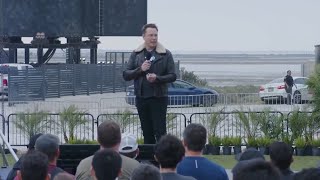 202458:53
 202539:58
 20239:55