美国全国的平均用电量,大约是 460 吉瓦。有人算过一笔账:如果人工智能每年要吃掉 300 吉瓦的算力,相当于全美发电量的三分之二。这个量级的电厂,地球上没有哪个国家建得出来。
马斯克在利雅得的台上给出了他的解法:那就别在地球上建。
2025 年 12 月,沙特利雅得,美沙投资论坛。特朗普来了,马斯克来了,黄仁勋也来了。主持人是沙特通信与信息技术大臣阿卜杜拉·斯瓦哈(Abdullah Alswaha)。半小时的对话里,几个人给出了三种时间尺度上的判断:能立刻算账的生意、五年尺度的技术路线、二十年尺度的人类社会形态。
后面特朗普的演讲是另一套内容,一半是招商广告,一半是政绩清单。两部分连着看,恰好构成当下 AI 热潮的两个切面:一边在讨论算力该建在哪,一边在讨论批文该由谁签。
从炼油厂到 AI 工厂
主持人的开场设定很清楚:沙特过去帮美国建的是能源经济,给工业时代供油;现在要转到智能时代,给 AI 工厂、机器人、电动车供电。
黄仁勋接得很顺,他说沙特正在把石油炼厂改造成 AI 工厂。这个比喻有工程依据,他给了一个具体解释。
过去的计算基本上是检索式的。有人写好一个故事,有人画好一幅画,有人做出四个版本的广告图,全部预先做好,系统负责把合适的那一版找出来给你。哈杜普(Hadoop)和过去那些框架、操作系统,都是为了检索。(黄仁勋)
今天的软件是实时生成的。根据上下文、根据场景、根据你是谁、根据你提的问题和提示词,为每一个人生成独一无二的内容。你用 Grok,每次的结果都不一样。(黄仁勋)
既然是生成式的,每次都不一样,你就需要在全世界建 AI 工厂,实时把内容生成出来。这就是为什么需要 AI 工厂。(黄仁勋)
这段解释值得停下来想想。检索式计算的成本结构是:内容做一次,缓存起来,被调用一亿次,边际成本趋近于零。生成式计算的成本结构是:每一次回答都要现算一遍,没法复用,边际成本跟着调用量线性上涨。
打个生活化的比方。过去的互联网像一个中央厨房配餐,菜是提前做好的,你点单,系统把那一份端出来。现在是在你点单的那一秒开火现炒,每个人的菜都不一样。厨房必须开在离人近的地方,而且要开很多家。
这就是「AI 是基础设施」这句话的物理依据。盖房子、修路、建电厂那一套逻辑,现在套到算力上:需求分散在全球,供应就得分散在全球。沙特把自己定位成这个网络里的发电厂,用资本、土地、能源换算力节点。
电池、火箭、机器人,同一套算法
主持人问马斯克的那个问题很具体:电池成本从每千瓦时 1000 美元降到 100 美元以下,现在又在机器人执行器、伺服电机上重复同一件事,这种「一阶思维」是怎么运作的。
马斯克的回答先纠了一个词。
大部分算不上颠覆,是从零开始创造。可回收火箭之前,世界上根本没有可回收的火箭。可回收是让太空旅行发生革命的根本。如果每次都把火箭扔掉,进入太空的成本会高得离谱。(马斯克)
我们开始造电动车的时候,市面上基本没有电动车,据我所知你买不到。特斯拉的目标是让电动车有吸引力,而且买得起。(马斯克)
到现在为止,没有一台真正有用的人形机器人。有一些算玩具的东西,但没有一台真正有用的。我认为特斯拉会造出第一台真正有用的人形机器人。(马斯克)
三次都是从零开始,三次都用了同一个动作:先把「这东西的单位成本由什么决定」拆开,把最贵的那一项拿掉。火箭最贵的是扔掉的那一节,那就让它飞回来。电池最贵的是材料和生产规模,那就用产能把成本压下去。机器人最贵的是执行器和关节,现在正在做的就是这个。
他接着给出一个相当大胆的市场判断。
谁不想要一个自己的 C-3PO 或者 R2-D2 呢?(马斯克)
人形机器人会成为人类历史上最大的产业,或者最大的单一产品,比手机还大。因为每个人都想要一台,可能还不止一台。产业里还会有大量机器人提供产品和服务。(马斯克)
然后他把话题拐到了贫困。
消除贫困这件事,人们谈了多少年了。各种非政府组织在试,基本没成功,证据摆在那里。AI 和人形机器人会真正消除贫困。特斯拉会是先行者,但不会只有特斯拉。要让所有人都变富,基本上只有一条路,就是 AI 加机器人。(马斯克)
这话听着像口号,但它的内在逻辑和前面那段一脉相承:当生产某种商品和服务的边际人力成本趋近于零,这类东西的价格就会趋近于原材料和能源的价格。贫困的定义是买不起基本商品和服务,如果基本商品和服务的价格结构被改写,贫困的定义也被改写了。
他留了一个没有回答的部分:谁拥有这些机器人,谁分配这些产出。这个问题在后半段关于货币的讨论里又冒了出来。
工作会变成「可选项」
沙特王储此前的说法是要用几千万台机器人增强劳动力,这句话在会场里引起了不少焦虑。主持人直接把问题抛出来:工作怎么办。
马斯克先划定了时间尺度,他说自己理解的长期是十到二十年。然后给出结论。
我的预测是,工作会变成可选项。(马斯克)
就像打篮球或者打电子游戏。你可以去商店买蔬菜,也可以在自己后院种。后院种菜难得多,但还是有人种,因为他们喜欢。(马斯克)
这个类比的好处是把「失业」和「不必工作」区分开了。种菜的人不缺菜吃,种是因为这件事本身有乐趣。如果工作变成种菜,那么「有没有工作」不再是生存问题,而是个人选择问题。
他还推荐了一本科幻小说当参考坐标:伊恩·班克斯(Iain M. Banks)的《文化》系列。他说那套书里描绘了一个可能出现的、积极的 AI 未来,有意思的是书里已经没有货币了。
如果你把时间拉得足够长,假设 AI 和机器人持续进步,货币在某个时点会变得无关紧要。电力、质量这些物理约束还在,但货币会消失。(马斯克)
台下笑了。黄仁勋接了一句黑色幽默:英伟达的财报电话会就在今天晚些时候,货币目前还挺相关的。马斯克说,等到货币不相关的那天,提前发条短信通知他。
这段插科打诨背后有个严肃的推论。货币是稀缺资源的分配凭证,如果绝大部分商品和服务的边际成本趋近于零,货币能买到的东西就只剩两类:受物理约束的东西(电力、土地、材料)和受身份约束的东西(位置、注意力、稀缺体验)。马斯克点出的「电力」和「质量」两个约束,其实是把未来的稀缺性锚定回了物理世界。
放射科医生的反例
黄仁勋的回答比马斯克保守,也更有实证支撑。他先承认每个人都会受影响:每个人的工作都会不一样,学生的学习方式会不一样,人们做事的方式会不一样,因为大量枯燥的、费劲的、极难的事情会变得简单。
然后他给了一个反直觉的行业案例。
当年预测放射科医生会是第一批消失的岗位,结果完全相反。趋势显示,因为 AI,现在雇的放射科医生更多了。(黄仁勋)
放射科医生的目标从来不是看片子,是诊断疾病。看片子变得极其高效之后,他们能看更多片子、更多模态,能和病人待更长时间,结果他们接诊了更多病人。全世界做的放射检查变多了,疾病诊断的质量也变好了。(黄仁勋)
这个案例的价值在于它指出了一个判断岗位风险的方法:看这个岗位的「手段」和「目的」离多远。如果一个人的工作就是把 A 转换成 B,A 到 B 这一步被自动化了,这个岗位就危险。如果一个人的工作是用 A 去判断 C,A 这一步提速了,他反而能做更多 C。
放射科医生的手段是看片子,目的是诊断疾病。片子看得再快,诊断这件事仍然需要人承担责任、和病人沟通、结合病史做判断。所以效率提升带来的结果是需求扩张,雇员数量上升。
黄仁勋对自己的判断也一样。
我的猜测是,AI 会让马斯克更忙,也会让我更忙。因为我们想做的事太多了,公司内部积压的清单太长了。效率提高,我们只会更快地推进那些事。(黄仁勋)
他还顺带讲了两件沙特的科研故事,用来支撑「每次技术浪潮都会带来新的价值池」这个说法。一位是奥马尔·亚吉(Omar Yaghi),金属有机框架(MOF)的开创者,用 AI 加速器和 Grok 这类模型设计新材料,做出孔径只有几纳米的「海绵」,从空气里捕水、捕二氧化碳。另一位是用 AI 设计纳米机器人,尺寸在几百纳米量级,配合 CRISPR 做基因编辑,目标是根治镰状细胞贫血。
这两项研究都起步于二十年前,卡在实验试错的效率上。AI 加速的是筛选和设计环节,把二十年压缩成几年。这是「AI 加速科学」这个说法最实在的样本。
500 兆瓦、50 兆瓦、100 兆瓦
对话进行到一半开始放订单。
马斯克宣布,xAI 与沙特 AI 公司 Humain 合作建设 500 兆瓦的数据中心,一期先上 50 兆瓦,用英伟达的方案。他在这句话上卡了几次壳,先说错数字,又自嘲「500 吉瓦的那个得等等,那要八万亿亿美元」,全场笑。
黄仁勋接着补充 Humain 这边的进展。他说这家公司几乎是零收入起步,一上来就接了一个 500 兆瓦的客户,这个体量在行业里属于另一个量级。常规的超大规模数据中心通常是几十到一百多兆瓦。一期 50 兆瓦先跑通,再往上堆,这是数据中心行业的标准做法。
然后是 AWS。黄仁勋说 AWS 也来了,100 兆瓦起步,目标是吉瓦级。这句话的分量在于:前面是模型公司自己建算力,现在是云厂商开始为这块市场扩容,两种需求叠加。
他还提到了 Omniverse 的合作。这部分容易被忽略,但对机器人这条线很关键。
我们做了一个叫 Omniverse 的世界,机器人可以在里面学习怎么做一个好机器人。它遵循物理定律。我们和 Humain 合作,把 Omniverse 应用到各种数字工厂、机器人和仓储场景里。(黄仁勋)
机器人训练和语言模型训练有个根本区别:语言模型的数据在网上,机器人训练的数据得自己去撞、去摔、去试,现实世界的试错成本极高。所以先在物理正确的虚拟环境里训练,再迁移到真机,是这条路上绕不开的一环。
黄仁勋还提到在沙特建超算来模拟量子计算机,用量子纠错来当控制器。量子纠错需要的算力极大,这部分生意偏早期,但它说明沙特的采购清单不只买推理和训练,也在买前沿研究的算力。
为什么算力迟早要上天
最后一个问题问马斯克:太空里能做 AI 吗。
如果文明延续下去,太空里的 AI 是不可避免的。但我总要先说一句,文明不该被当成理所当然。任何学过历史的人都知道,文明不总是向上的,文明有生命周期。我认为眼下我们在一个向上的阶段,但不能因此松懈。(马斯克)
他用的分析框架是卡尔达肖夫指数(Kardashev scale),衡量一个文明能驾驭多少能量。二级文明大致意味着能利用一整颗恒星的能量输出。
如果你想达到卡尔达肖夫二级文明的哪怕很小一个百分比,哪怕只用到太阳能量的一百万分之一,你就必须在深空里部署太阳能 AI 卫星。(马斯克)
地球接收到的太阳能,大约只有太阳总辐射的二十亿分之一。如果你想要比地球能产出的能量多一百万倍的能源,你必须进入太空。(马斯克)
换算很直白:地球上能拿到的太阳能总量是有硬上限的,任何超过这个上限的能源需求,只能到太空去满足。
黄仁勋从工程侧补了一刀,说太空里散热更容易。马斯克顺着往下推。
看看我们一起在建的超级计算机,每个机架两吨重,其中 1.95 吨大概是散热。你可以想想里面真正干活的那部分有多小。(黄仁勋)
然后马斯克把账算完了。
我的估计是,太空里做 AI 的性价比会远远超过地面上。或许四到五年之内,成本最低的 AI 算力会来自太阳能 AI 卫星。不会超过五年。(马斯克)
他给出的理由有四条,每条都对应地面上一个真实的瓶颈。
第一,电力。如果每年要新增 300 吉瓦的 AI 算力,相当于全美发电量的三分之二。没有哪个国家能在这个速度上建电厂。每年一太瓦,在地球上根本不可能。
第二,储能。太空里一直是白天,不需要电池。这一条直接砍掉了地面数据中心成本结构里增长最快的一块。
第三,光伏板本身。太空里不需要玻璃封装和铝边框,这两样在光伏组件成本里占比不低,重量更是发射成本的大头。省掉就是省掉。
第四,散热。太空里没有水,只能靠辐射散热。这条听起来像缺点,马斯克把它当优点:辐射散热不需要水冷系统、不需要冷却塔、不需要和当地水资源谈判。
这套论证在物理上成立,放到工程上看还有一堆没解的题。星舰的完全复用还在验证中,大规模入轨的单价还没定死;在轨组装大规模光伏阵列没有先例;抗辐射芯片要么用特殊工艺,要么做冗余,两个方案都涨价;卫星之间的激光链路带宽和地面站的接收能力是另一套基础设施。五年这个时间点,是马斯克自己的估算,他向来偏乐观。
但方向值得留意。地面数据中心的三个硬约束:并网排队、水、土地。这三个约束都不受资本控制。当资本无法解决约束时,工程就会绕开约束,把设施搬到没有约束的地方。太空恰好三样都没有。
泡沫之问,和一个没被正面回答的问题
主持人最后一问交给了黄仁勋,还特意强调了当天有英伟达财报电话会,所以「问得委婉一点」:AI 泡沫会不会来。
黄仁勋的回答方式是回到第一性原理,把当下正在发生的计算迁移拆成三层。
第一层,摩尔定律走到头了。通用计算能提供的算力增长,跟不上需求的增长。全世界为此转向加速计算已经转了二十多年。他给了一个数字:六年前全球前五百台超算里,CPU 方案占九成;今年不到一成半。加速计算的占比从一成涨到九成。这个迁移已经完成,跟 AI 热不热没关系。
第二层,数据处理。全世界在云端做的最密集的计算之一,是原始数据处理。SQL 查询、数据框、姓名地址年龄住址收入,这些东西构成了今天金融、信用卡、电商、广告推荐的全部基础。每年几百亿美元花在这上面,这部分跟 AI 一点关系都没有,纯粹是摩尔定律失效之后的账单转移。
第三层,推荐系统。过去十五年最重要的应用叫推荐系统。互联网太大了,没有推荐系统,一块小手机屏幕根本不可能让你看到该看的信息。推荐系统是今天互联网的引擎,它正在从 CPU 迁到 GPU。
三层叠完之后,最上面才是智能体 AI:Grok、OpenAI、Anthropic、Gemini。
如果把底层正在发生的事算进去,你会得出一个结论:留给这一轮智能体 AI 的算力空间,比你想象的少得多,而且每一份都算得清账。(黄仁勋)
他答的是另一个问题。
他证明的是需求侧有真实负载,通用计算向加速计算的迁移是既成事实,不是炒作。他没证明的是价格。算力卖多少钱、谁来付、付的钱能不能收回成本、折旧周期内能不能回本,这些是泡沫问题的核心,他没碰。
这两件事经常被混在一起讨论。有真实需求,和当前估值合理,是两个独立命题。铁路时代铺的轨道都是真需求,1929 年的股票也是真股票。
特朗普上场:把审批制度当成 AI 基建来改
对话结束后特朗普登台。这段演讲按主题可以拆成四块:AI 与电力、制造业回流、减税与放松监管、外交成绩单。
最有信息量的是第一块。他讲了一个具体场景:某家公司在建一座 500 亿美元级别的 AI 设施,配套要接上两百年的老电网,接不上。他给出的方案是让企业自建电厂。
你们自己建电厂。我给你批文,两到三周批下来。以前要等二十年,等二十年你就是被否掉,五比四投票否决。(特朗普)
我允许那些在建的 AI 工厂自建发电设施。这样他们就不能怪我不发电了。我说,你自己发。(特朗普)
他还提到了具体分工,让能源部长李·泽尔丁(Lee Zeldin)盯审批:油气项目两周,核电再加一周。他还说,多余的电可以卖回联邦电网。
把这段话和马斯克、黄仁勋前面的讨论放在一起看,会发现美国正在做同一件事的两面。一面是企业绕开电网瓶颈自建电源,另一面是政府把环评和审批时间从二十年压到 28 天。两件事合起来,是在给 AI 基建拆掉最耗时的那两道关卡。
然后他讲了 AI 监管。
你不能跑五十个州。五十个州是灾难,因为你有一个「觉醒」州,你就得全都按「觉醒」那一套来。我们希望只批一次。(特朗普)
这话的技术含义是:AI 数据中心的审批权从州层面收到联邦层面,一次审批通行全国。对建厂的企业而言,这是把五十次不确定性变成一次确定性。
制造业回流这块,他讲了一个历史假设。
如果当年我们说,你们去台湾很好,我们觉得很棒,但你们把产品卖回这个国家时,要交 250% 的关税,那就没人会走。没人会走,英特尔会是一家巨无霸。(特朗普)
他举的证据是丰田刚宣布的 100 亿美元投资,四到五座工厂,还有从加拿大、墨西哥、德国、日本回流的汽车厂。他在台上还调侃了黄仁勋一句,说英特尔现在有他一大块股份,又问他 Blackwell 之后有没有对手能追上来,黄仁勋的回答是「他们说十年,我看两三年」。这句对话里,两人的分寸感都很清楚。
数字部分要打折看。他给出的对比是:
四年里拜登拿到的不动产投资不到一万亿美元。九个月里我拿到了十八万亿美元。(特朗普)
这是承诺口径,不是到账口径。企业宣布的投资意向、分十年执行的建厂计划、带条件的框架协议,全都会被算进这个数字里。判断这类数字的真实影响,看的是开工率和完工率,不是发布会上的总额。
他讲到的就业数据也是同一类口径:
美国在业人数创历史新高;小时工工资增速是六十年最快;建筑工人实际工资一年涨 2200 美元;九个月里 60 万人脱离食品券;美国本土出生劳动者的就业人数增加 190 万;他任内新增岗位 100% 来自私营部门,而拜登任内每四个新岗位就有一个是联邦政府岗位。这些数字的真伪可以查,但它们的政治功能很明确:把「经济好不好」这个问题,从宏观指标转换成「你有没有工作」。
减税和放松监管这块,他讲的是一条一条能执行的政策。12 月刚过的「大而美法案」2026 年 1 月 1 日生效:小费不征税、加班费不征税、社保金不征税,买车贷款的利息可以抵扣,新设备采购和厂房建设 100% 当年费用化。监管侧的说法是每出台一条新规就砍掉十条,实际砍了三十条。
能源部分他讲得很放松,说风电是灾难,说煤必须叫「清洁美丽的煤」,说路易斯安那有两座 LNG 厂分别卡了 14 年和 18 年,他一天批了一个,一周批了另一个。这些话带着他一贯的表演感,但对应的事实是真的:美国的能源项目审批周期曾是全球最长的之一。
外交部分他讲自己调停了八场战争,讲用 350% 的关税威胁让印度和巴基斯坦停手,讲加沙停火和联合国安理会背书、59 国签署、他本人出任「和平委员会」主席,还讲王储前一天晚上跟他提了苏丹,他听完 30 分钟后就开始安排工作。这部分是他演讲里掌声最多的段落,也是信息密度最低的段落。
整场活动看下来,最清楚的一条线是:沙特出资本、土地和电,美国出芯片、模型和审批效率,两边合起来想把 AI 的基础设施建在沙特,卖向全球。主持人最后那句总结说,这是从能源时代走向智能时代的一次结盟。结盟的内容不止买芯片,还包括把一个国家的能源禀赋直接接到全球算力网络里。
几个可以自己验证的信号
这场对话里,能兑现的判断和不能兑现的判断混在一起。想验证谁说得对,不用听结论,看几个具体的数字和节点就够了。
- 盯 Humain 与 xAI 那个 500 兆瓦项目的一期 50 兆瓦什么时候真正通电。宣布订单和机架上电是两件事,中间隔着变压器、柴油发电机、冷却塔和并网许可。
- 盯星舰的完全复用进度和单公斤入轨成本。马斯克说五年内太空算力成本最低,这个五年能不能成立,一半押在发射成本上。发射价格不下来,太空算力就是纸面优势。
- 想判断 AI 投资是不是过热,别看分析师的结论,看三张表:加速计算替代通用计算的装机比例、推理业务的真实账单和毛利率、以及新增电力的实际交付时间。第三张表最硬,因为电不会说谎。
- 规划自己公司的 AI 预算时,把「AI 工厂」当成一个电力与散热问题来算,而不是当成一个软件采购问题。先算清楚机柜功率密度、PUE 和当地并网排队时间,这三项决定了你的模型什么时候能跑起来。
- 评估自己的岗位风险,用放射科医生那个框架:写下你的工作里哪一部分是「手段」,哪一部分是「目的」。手段被自动化的速度很快,目的被自动化的速度很慢。把时间投在目的那一侧。
- 关注 2026 年 1 月 1 日之后美国的资本开支数据。设备 100% 当年费用化这类政策,会直接把企业的建厂决策提前或推后,制造业投资数据在法案生效后的两个季度里会有明显反应。
- 补一点能源常识:吉瓦、兆瓦、度电成本、容量因子。这场对话里所有的宏大叙事,最后都折算成这几个单位。看不懂单位,就看不懂谁在吹牛。
0:00United States where we have joined hands and you have helped us build our energy based economy fueling and energizing the industrial age and now fast forward going to the intelligence age where we can fuel AI factories robotics EVs and all of the resting of that let's start with you Elon if you don't mind Jensen feel free to chive in you have a big fascination of something all of of us have admired first order thinking which Jensen sometimes calls first order scaling which is an opportunity for how you have dropped the cost of batteries from a thousand for kilowatt hour to subund bucks and right now you're doing the same thing with robotics for
0:49actuators with servo rotors and motors so I want to hear from you how do you manage to always disrupt every single industry with that thinking.
1:02Well, it's mostly not disruption, it's creation. So, with say SpaceX with reusable rockets, there really weren't any reusable rockets. but the essence of getting of revolutionizing space travel is reusability. If you throw the rocket away every time, the cost of access to space is extremely high. with respect to electric cars, there there weren't any electric cars when we started making them really. You couldn't buy any to the best of my knowledge.
1:38so with Tesla, we wanted to make electric cars compelling and affordable. That was the goal. the you know, with respect to humanoid robotics, there are no useful humanoid robotic robots at this point. there are sort of gimmicks, but there are there are no actually useful humanoid robots. and I think Tesla's going to make the first actually useful humanoid robots. and this will be quite a revolution and I think something that will that everyone will want. because I always think of like who who wouldn't want their own personal C3PO R2-D2. Oh yeah,
2:15of course everyone would want one, right? and and then there would be many in industry providing products and services. This is why I say that humanoid robots will be the biggest industry or the biggest product ever bigger than cell phones or anything else because everyone's going to want one and or maybe more more than one and there'll be many in industry.
2:39I just want R2-D2 in C3PO's body. Yeah, there you go.
2:45well I mean a humanoid robot would be better than R2, D2 and C3 VO combined. Yeah. Times 10. Yeah.
2:50So the it and you know people often talk about sort of eliminating poverty and that kind of thing but really the there's how long have they been talking about that? there's lots of talk you know there's lots of NOS's sort of trying to do these things but but really not succeeding. and and and you know the evidence speaks for itself. but but but AI and humanoid robots will actually eliminate poverty and Tesla won't be the only one that makes them. I think Tesla will pioneer this but there will be many other companies that make humanoid robots. But there there is only basically one way to make everyone wealthy and that is AI and robotics.
3:33And we can't talk about robotics without AI factories. And yesterday was such a historic day for the two nations but also for all of us where we celebrate the AI strategic partnership with the US s signed witnessed by the honorable president and his royal highness about how we are committing our capital energy land to energize the AI US ecosystem to
4:02be able to build inference node training nodes and to be the most AI enabled nation. With that announcement, tell me what's what's next in AI factories. Jensen,
4:12there there's a there's a beautiful story about how Saudi Arabia's building AI refineries now building AI fac or oil refineries to AI factories. I love that.
4:22I you know I've said that that AI is an infrastructure and the reason for that of course we understand AI from the perspective of the technology and how it's revolutionizing every industry. Digital intelligence of course has applications into every every field and so it's going to be used by every company, every industry, every country.
4:42In that way, it's foundational and therefore it's part of infrastructure. What is new about AI from a computer science perspective is that the way computing was done in the past was largely retrievalbased computing. Somebody typed in a story or somebody created a a piece of art or came came up with four versions of a digital ad or it's all pre-built by somebody which is then using a system to retrieve the appropriate version for you. It's a retrievalbased computing model. Hadoop and many of the the the frameworks and operating systems of the past all designed to retrieve the appropriate information for you. But today software is going to be generated in real time.
5:31It's generative based on the context, based on the circumstance, based on who you are, based on the problem you ask that based on your prompt. It will generate unique content for you every single time for everybody. It's unique. When you use Grock, every time you use it is different based on right based on based on the based on the prompt that you give it and based on the circumstance and
5:53and so therefore it used to be retrievalbased today it's generative and if it's generative then and every time is different then you need AI factories all over the world to generate the content in real time which is the reason why you need AI factories and and this is a unique way of doing computation but the benefit of course is that everything isn't preconceived and pre-documented and it's it's contextually contextually sensible and and therefore intelligent.
6:21So AI factories and robotics and we heard it yesterday from his royal highness his vision how to augment our workforce with roughly tens of millions of robotics to be able to infuse the next wave of productivity and progress. But this scares a lot of folks here when it comes to the future of jobs. So let's hear about your thoughts Elon and Jensen on that.
6:47sure. Well you say like in the long term where will things end up long term? I don't know what long term is. Maybe it's 10 20 years something like that. For me that's long term. my prediction is that work will be optional. Optional. so we'll take that.
7:10Yeah. I mean it it'll be like playing sports or a video game or something like that. if you want to work you know in the same way like you can you can go to the store and just buy some vegetables or you could grow vegetables in your backyard. It's much harder to grow vegetables in your backyard but some people still do it because they like growing growing vegetables. that will be what work is like optional.
7:37now between now and then there's actually a lot of work to get to that point. Mhm.
7:40and I always recommend people read read Yin Banks culture books to get a sense for what a probable positive AI future is like. and interestingly in those books, money is no longer doesn't exist. It's kind of interesting. And I I my guess is in in if you go out long enough, assuming there's a continued improvement in AI and robotics, which there seems likely, the money will will stop being relevant at some point in the future. now there will still be constraints on power like electricity and mass. the fundamental physics elements will still be still be constraints. but I think at some point currency becomes irrelevant. Jensen, any thoughts?
8:41[laughter] by the way, the Nvidia earnings call is later today. [laughter]
8:47And by the way, since currency is relevant. [laughter] Cheers. [laughter]
8:55Elon just wants to share with you some breaking news. [laughter] The two of us who'd like to share some breaking news. let's see. I I would say I would say there there's different horizons you could look at. Everybody's jobs will be different. That I think that that's for sure. how how the students learn will be different.
9:21how people do their work will be different obviously because a lot of the things that that we do mundanely or arduously or very difficultly are going to be done very simply and and so we're going to be more productive from that s from that sense one of the things that I will say is that for most people or a company if some if your life becomes more productive and if the things that you're doing with great difficulty becomes simpler it is very likely because you have so many ideas, you'll have more time to go pursue things. It is my guess that Elon will be busier as a result of AI. I'm going to be busier as a result of AI.
10:00And the reason for that is because we have so many ideas we want to pursue, so many things that that we still have in our backlog inside our company that we can go pursue. If we were more productive, we can get to those things faster. And so in the near term I would say that that there is every evidence that that we will be more productive and yet still be busier because we have so many ideas. One thing that I will say give you give you some evidence is that and I was just telling Elan about this earlier radiology for example has largely been converted to AIdriven radiology and there's some really great companies doing that and the surprising
10:38thing is the prediction that all radiologists would be the first jobs to go was exactly the opposite. The trend shows that there are more radiologists being hired now as a result of AI. And the reason for that, if you take a step back, it's because the goal of a radiologist is not to study the images.
10:58The goal of a radiologist is to diagnose a disease. Now, the studying of the images became so productive. They could study more images, study more modalities, spend more time with the patients. And as a result, they were actually accepting more patients. We're doing more radiology all around the world. We're doing a better job with diagnosing disease. And so that's that's kind of the the near term near-term outcome of of AI and productivity.
11:26And and we'll see we'll see what happens long term. You know, I I when when currency doesn't matter anymore, just, you know, let me know right before.
11:37You'll see it coming. [laughter] You'll see it coming. like like we text often so just Yeah, we do.
11:44Yeah, just text it off. Yeah, let me know.
11:46I kind of I kind of agree with with both of you because if you look at every technological trend, every general purpose technology has been net new positive for for the globe for humanity and so forth. And let me share with you two
12:00and your excellency I think it's precisely the reason the reason for that is because all the great ideas from from innovators like Elon you have so many good ideas that and Jen as well
12:12yeah well you know thank you
12:14so let me share with you two stories from two Saudi innovators in collaboration with a lot of great the great work that Nvidia does that gra does. One is professor Omaragi. All right. Let me say that again. Is Professor Omaragi who is
12:36I might need to might need to move the mic. All right.
12:42Yeah. Come on. We'll share this one. Get close.
12:47Let's let's let's try this one more time. So one of them is professor Omar Yagi who's the first American Saudi to win a Nobel Prize in creating new chemistry and the way he has done that he has leveraged your AI accelerators and models like Grock to be able to create new chemistry when it comes to metal organic frameworks. Those are metal ions that are positively charged with organic linkers to be able to effectively create a sponge with 33 nanometers pores to capture water from air and also to capture carbon dioxide.
13:24The second story has also to do with AI accelerated by Nvidia and with models like Brock which is nanop which is effectively creating a nano robot 500 nanometers by a,000 nanometers to be able to do gene editing leveraging the crisper technology to take out sickle cell disease. Now in both these instances they originated 20 years ago in research but AI was able to really accelerate the outcomes and the outputs such that we can move into new value pools. So I think with every technological trend humanity is going to always manage to shift to new value pools when it comes to workforce and productivity. But we have some great announcements to talk about here today.
14:11Let's begin with you Elon. the things that we're doing with XAI. yeah, we're excited to announce that we're doing a a a a 500 megawatt I mean yeah 500 sorry 500 megawatt 500 megawatt yeah we're doing [laughter] we're doing 500 megawatt sorry
14:34yeah yeah the 500 g one will have to wait so
14:39that that'll be eight bazillion trillion dollars [laughter] stop that.
14:47[laughter] so yeah, we we're we're doing a XAI and the Kingdom of Saudi Arabia are doing a a
14:58Humane 500 megawatt starting with 50 megawatt phase one and we're doing it with Nvidia.
15:03Congratulations to the Humane team to target team. Such a fantastic job. Jensen, I think we're also doing some great announcements this week. We are [laughter] we're announcing we're announcing all kinds of things. our partnership with Humane is is going incredibly well. First of all, we we work together to get this company started and off the ground and just got an incredible customer with Elon. Could you imagine a startup company approximately zero billion dollars in revenues now going to build a data center for Elon 500 megawatts is gigantic. this company is off the charts right away. in addition to that we're working working AWS as you know is also
15:50congratulations to the humane team with AWS
15:55starting with 100 megawatts with a gigawatt ambition and counting. So AWS is also coming to Humane. we're working with Humane on Omniverse digital twins. as you know that AI is not just well just agentic AI and chat bots and cognitive AI is incredibly important to the world. but AI applies to everything, chemicals and proteins and genes and physics and fluid dynamics and particles and of course robotics and activation and and we created this world called Omniverse where robots can learn how to be good robots and and it's physically based.
16:34obeys the laws of physics and so robots can learn in these environments and we're working with humane to apply Omniverse to all kinds of digital factories and robotics and warehouses and things like that. And so that's that's another we're we're also working in Saudi Arabia to build supercomputers to simulate quantum computers and and using our computers to be the controller and the error correction quantum error correction requires an enormous amount of computation and so so we're doing a lot of great work there too. So a big partnership with Humane they're off the charts off the ground and off the charts at the same time. This is how we walk the talk in the Kingdom of Saudi
17:14Arabia in partnership with the US. Yesterday, the president and his royal highness announced the AI strategic framework and partnership. Today, we're going big with Elon and Jensen. So, thank you for those opportunities. [applause] Now, they they told me I have time for two last questions. So last night at the dinner I got a number of questions because it seems that the schedule leaked and everybody was giving me hints about the last two questions I'm going to do. So the first one was for you Elon and there's a big one for you Jensen. So prepare for that one. AI in space is
17:58that possible? yes, if if civilization continues, which it probably will, then AI in space is inevitable. you know, I always have to like preface that, you know, we shouldn't take civilization for granted. We we need to make sure to take care to ensure that civilization hasn't an upward arc. I mean, any student of history knows that civilization does not always have an upward arc. And in fact, civilizations have life life cycles. So hopefully we are in a strong upward arc.
18:34I think we are for now. but we don't want to take that for granted or be complacent. but the in order to the way to think of AI in space is that in order to achieve any meaningful percentage of a cadesev two scale civilization where you're using even a millionth a millionth of the sun's energy you must have solar powered AI satellites in in deep space. so so
19:01that once you realize like once you think in terms of a keshv two scale civilization which is what what percentage of the sun's energy are you turning into useful work then you then it becomes obvious that space is overwhelmingly what matters overwhelmingly the sun only receives one roughly one two billionth of the earth only receives roughly u two billionth of the sun's energy So if you want to have something that is say a million times more energy than Earth could possibly produce,
19:36you must go into space. It's and and so you know this is where it's kind of handy to have a space company, I guess, sell the book.
19:48Easier to cool chips in space, too. Yes.
19:51Easier to cool chips in space.
19:53Yes. There's definitely no water in space, so you're going to have to do something. Yeah.
19:56that doesn't involve water. Just hang out.
19:59Well, it's you just got to radiate. That's right.
20:02so my estimate is that actually that that that the cost of of electricity like like the cost effectiveness of AI in space will be overwhelmingly better than AI on the ground. So far long before you exhaust potential energy sources on on Earth. Long long before meaning like I think even perhaps in the four or five year time frame the lowest cost way to do AI compute will be with solar powered AI satellites.
20:38So I'd say not more than five years from now. Wow.
20:42And just look at the supercomputers we're building together. Let's say each one of the racks is two tons. Out of that two tons, 1.95 of it is probably for cooling, right? Oh, yeah.
20:54Just imagine how tiny that little supercomputer is, right? Each one of these GB300 racks will just be a little tiny thing.
21:00And and just electricity generation is is already becoming a challenge.
21:04so if you if you start doing any kind of scaling for both electricity generation and cooling, you realize, okay, space is incredibly compelling. so like let's say you wanted to do I don't know two or 300 gawatt per year of of AI compute.
21:26it's very difficult to do that on Earth. the so the the US average electricity usage last time I checked was around 460 gawatts per year average usage. so so something like say you know three 300 if you're doing 300 gawatts a year that would be like 2/3 of US electricity production per year.
21:50There's no way you're building power plants at that level. and then if you take it up to say a terowatt per year impossible. Yeah.
21:57Like you have to do that in space.
21:59There there just is there just is no way to do a terowatt per year on Earth. and and and in space you you've got continuous solar. you've got you don't you actually don't need batteries because it's always sunny in space. Right. Exactly.
22:17and and and the solar panels actually become cheaper because you don't need glass or framing. and the cooling is just radiative. So that's that's why I think that's the dream. Yes,
22:30that's the dream. So Jensen, everybody last night was asking me and I'm mindful it's a earnings call for you today. So I'm going to say this delicately. Everybody has been asking me to ask you are we going to have an AI bubble? [laughter] That's the last question. All right, let's No.
22:49All right, let me Well, let me just hear you what we see. Okay, so so I I think it's really important when you look at what's happening around the world and go back to first principles of what's happening in computer science and computing. There are three things that that's happening. The first thing is that we all know that Moore's law has run its course and the ability that the amount of demand for computing versus the amount of computation we can get out of general purpose computing is really challenging and so the world's been moving to accelerated computing for some time. We've been pushing this now for some over 20 years. Let me give you one
23:20statistic. I was just at supercomputing six years ago. CPUs were 90% of the world's supercomputers, top 500 supercomputers six years ago. This year less than 15%. Went from 90% to 10%. And meanwhile, accelerated computing went from the other way, 10% to now 90%. Okay, so you're seeing that inflection point, the transition in high performance computing from general purpose computing to accelerated computing. Well, one of the one of the most data intensive one of the most intensive computation things that the world does in cloud is data processing. Several hundred billion dollars of computation is done on just raw data processing. Has nothing to do
24:04with AI, just SQL processing, data frames, you know, everybody's names, address, their their sex, their their age, where they live, you know, how much money they make. All of that sits into a data frame. And that data frame drives the world today. whether it's in banking or you know whether it's in credit cards or of course e-commerce and everything from ad recommendation and everything is driven off of that data frame that data frame costs hundreds of billions of dollars to go compute and so that's the number one thing end of mors law the second thing is generative AI what the the the most important application of the last 15 years is called rexes
24:42recommener systems how do we know what information to recommend to us in a social feed. How do you know what ad to recommend to somebody? what book to recommend, what movie to recommend? The world is the internet is so gigantic without a recommener system that a little tiny phone of us will have no chance of ever seeing the right information. That Rexus is the engine of the internet today. That's going generative AI. It used to be running on CPUs, now it runs on GPUs. Which then says the third thing when if you just look at those two applications many of the internet companies can build enormous number of GPU supercomputers just doing that of course then it
25:23creates this the third opportunity on top of it which is agentic AI this is Grock and this is open AI this is anthropic you know this is Gemini agentic AI sits on top of that but don't you know don't forget to think about what is happening above underneath what everybody sees as AI today. There's a whole movement of computing from general purpose computing to accelerated computing. And that if you just if you take that into consideration, you'll come to the conclusion that in fact what is left over to fuel that revolutionary agentic AI is not only substantially less than you thought and all of it justified. Well, I was just informed by the team that my boss and your bosses is
26:08going to talk next, the honorable president and his royal highness the crown prince and hence we ran out of time. But in essence, [applause] this is a such so much love for you Elon and and Jensen. But this in essence is a 92 alliance that shifted from energy to digital to the intelligence age powered by pioneers such as Elon and Jensen to serve humanity and create on a net new basis, new economies, new jobs, and a better future for humanity powered by the Kingdom of Saudi Arabia and the United States. Thank you for our lifetime partnership and friendship. Thank you, Elon. Thank you, Jensen. Thank you. All [applause]
26:55right. [music] Ladies and gentlemen, [music] what we just heard was a conversation about the future of technology spoken by the people building it. To his excellency Abdullah Hailon Mosque and Jensen Huang, thank you for a conversation that did more than describe the future of technology. It actually showed us who's building it and how. And now ladies and gentlemen, we ask you to remain in the plenary. We will soon proceed with the special address by the leaders. As his excellency Swaha mentioned, our leaders are about to arrive. So the sponsorship recognition segment will take place after their departure. And I just want to mention that his royal highness
27:47the crown prince Muhammad bin Salman Aiz aloud will deliver his speech in Arabic. For English speakaking guests, we have live translation devices available for you. Our ground team will be more than happy to assist you. Thank you.
28:10Waiting for sing. [music and singing] So many dreams [music] I kept deep inside [music and singing] me. Alone in the dark. [singing] dark. But now [music] you've come along [singing] and you light [singing and music] up my life. You give me [singing] hope to carry on. [singing] You light up my days [singing]
28:59and fill my night [music] with [music and singing] song rolling [singing] at [music] sea. A drift on the waters. Would [music and singing] it be finally I'm turning [singing] [music] for home? Finally [singing] a chance to say, [music] "Hey, I love you." Never [singing and music]
29:44all [singing] you [music] light up my [singing] life. You give me hope. [singing]
30:00to carry on. [singing] You light [music] up my days and fill my night [singing] with song. [music and singing] But you light up my life. [music and singing] You give me hope to carry [singing] on. You light up my days [singing] and fill my night [music] with song. It can't be [singing] wrong
30:55when it [music] feels so [singing] right. Cuz you you [singing] light up my [music] life. [singing]
31:37So many nights [music and singing] I'd sit by my window [music] waiting for someone to sing [music and singing] his song. So many dreams [music] I kept deep inside me, [singing] alone in [music] the dark. But now you've come [singing] along and you light [singing] up my [music] life.
32:21You give me [singing] hope to carry on. [singing] You light up my days and fill my night [singing] with [music] song. Rolling that [singing] sea. A drift on the water. Would [music] it be finally I'm turning [singing] for home? [music] Finally a chance to say, "Hey, I love you never [singing and music] again.
33:19To be [music] all alone, [singing] you light up my life. You [music] give me hope. [singing]
33:37to carry on. [singing and music] You light up my days and fill my night with song. [singing] You [music] light up my life. [singing] You give me [music] hope [singing] to carry on. You light up my days [singing] and fill my nights with song. It can't be wrong when it [music and singing] feels so right.
34:39Cuz you you light up my [music] life. [singing] [music]
35:14Midnight. Not a sound from the pavement. [singing] Has the moon lost her memory? [singing] She is smiling alone in the lamplight. The withered leaves collect at my feet [singing] and the wind begins to moy [singing] [music] all alone in the moonlight. I can dream of the [singing] old days.
35:58Life was beautiful then. [singing] I remember [music] the time I knew what happiness was. Let the mey [singing] live again. Every [music] street lamp seems to be of fatalistic [singing] warning. Someone mutters [singing] and the street lamps sputters [music] and soon it will be more
36:49daylight. [singing] I must wait for the [music] sun. I must think of a new life. And I mustn't give in. When the dawn comes, tonight [singing and music] will be a memory, too. And a [singing] new day will begin.
37:35Burn out of smoky days. The stale cold smell of morning. A street lamp dies. [singing and music] Another night is over. Another [music and singing] day is dawning. Touch me. It's so easy to leave [music] me heart alone with the me [music] of my days in the sun. [music]
38:22If you touch me, you'll understand [music] what happiness. Look, a new day has be [music]
39:37I don't want to talk about things we've gone through. Though it's hurting me, now it's history. I played all my cards and that's [music] what you've done to nothing more [singing] to say. No more race to play. The winner takes it all. The loser is standing [music] small. the size of victory.
40:19That's a [music and singing] destiny. I was in your [music and singing] arms, thinking I belonged there. I figured it made sense. Building me a fence. Building me [music] a home. [singing] Thinking I'd be strong there. But I was a fool playing by the rules. It got me [music] through it. [singing]
40:58Lies as cold as ice. Someone way down here [music] loses someone dear. When it takes it all, [singing] the loser has to [music] fall. The simple is plain. Why should [music] I complain? Tell me, does she kiss like I used to kiss you? [music] Does it feel the same when she calls your name?
41:42Somewhere deep inside. [music] You must know I miss you. What can I say? The rules must be obeyed. The judges will decide. The likes of [music] me abide. Spectators of the show. [singing] Always staying low. The game is on again. [music] Mama or friend. A big thing or a small. the way it takes it all.
42:26[singing] I don't want to talk. If it makes you feel sad and I understand, come to shake my hand. I apologize if it makes you feel bad. seeing me so [music] joined hands and you have helped us build our energy based economy fueling and energizing the industrial age and now fast forward going to the intelligence age where we can fuel AI factories robotics EVs and all of the resting of that let's start with you Elon if you don't mind Jensen feel free to chive You have a big fascination of something all of us have admired first order thinking which Jensen sometimes calls first order scaling which is an opportunity for how you have dropped the cost of batteries from a thousand for
43:38kilowatt hour to subund bucks and right now you're doing the same thing with robotics for actuators with servo rotors and motors so I want to hear from you how do you manage to always disrupt every single industry with that thinking?
43:58Well, it's mostly not disruption, it's creation. So, with say SpaceX with reusable rockets, there really weren't any reusable rockets. but the essence of getting of revolutionizing space travel is reusability. If you throw the rocket away every time, the cost of access to space is extremely high. with respect to electric cars, there there weren't any electric cars when we started making them really. You couldn't buy any to the best of my knowledge.
44:34so with Tesla, we wanted to make electric cars compelling and affordable. That was the goal. the you know with respect to humanoid robotics there are no useful humanoid robotics robots at this point. there are sort of gimmicks but there are there are no actually useful humanoid robots.
44:54and I think Tesla's going to make the first actually useful humanoid robots. and this will be quite a revolution and I think something that will that everyone will want. because I always think of like who who wouldn't want their own personal C3PO R2-D2. Oh yeah,
45:11of course everyone would want one, right? And and then there would be many in industry providing products and services. This is why I say that humanoid robots will be the biggest industry or the biggest product ever bigger than cell phones or anything else because everyone's going to want one and or maybe more more than one and there'll be many in industry.
45:35I just want R2-D2 in C3PO's body. Yeah, there you go.
45:41well, I mean, a humanoid robot would be better than R2, D2, and C3 VO combined. Yeah. Times 10. Yeah.
45:47So, the it and and you know, people often talk about sort of eliminating poverty and that kind of thing. But really the there's how long have they been talking about that? there's lots of talk you there's lots of NOS's sort of trying to do these things but but really not succeeding. and and and you know the evidence speaks for itself. but but but AI and humanoid robots will actually eliminate poverty and Tesla won't be the only one that makes them. I think Tesla will pioneer this but there will be many other companies that make humanoid robots. But there there is only basically one way to make everyone wealthy and that is AI and robotics.
46:29And we can't talk about robotics without AI factories. And yesterday was such a historic day for the two nations but also for all of us where we celebrate the AI strategic partnership with the US s signed witnessed by the honorable president and his royal highness about how we are committing our capital energy land to energize the AI US ecosystem to
46:58be able to build inference node training nodes and to be the most AI enabled nation with that announcement. Tell me what's what's next in AI factories. Jensen,
47:08there there's a there's a beautiful story about how Saudi Arabia's building AI refineries now building AI fac or oil refineries to AI factories. I love that.
47:18I you know I've said that that AI is an infrastructure and the reason for that of course we understand AI from the perspective of the technology and how it's revolutionizing every industry. Digital intelligence of course has applications into every every field and so it's going to be used by every company, every industry, every country.
47:39In that way, it's foundational and therefore it's part of infrastructure. What is new about AI from a computer science perspective is that the way computing was done in the past was largely retrievalbased computing. Somebody typed in a story or somebody created a a piece of art or came came up with four versions of a digital ad or it's all pre-built by somebody which is then using a system to retrieve the appropriate version for you. It's a retrievalbased computing model. Hadoop and many of the the the frameworks and operating systems of the past all designed to retrieve the appropriate information for you. But today software is going to be generated in real time.
48:28It's generative based on the context, based on the circumstance, based on who you are, based on the problem you ask that based on your prompt. It will generate unique content for you every single time for everybody. It's unique. When you use Grock, every time you use it is different based on right based on based on the based on the prompt that you give it and based on the circumstance and and so therefore it used to be retrievalbased today it's generative and if it's generative then and every time is different then you need AI factories all over the world to generate the content in real time which is the reason why you need AI factories and and this is a
49:06unique way of doing computation but the benefit of course is that everything isn't preconceived and pre-documented and it's contextually s contextually sensible and and therefore intelligent.
49:18So AI factories and robotics and we heard it yesterday from his royal highness his vision how to augment our workforce with roughly tens of millions of robotics to be able to infuse the next wave of productivity and progress. But this scares a lot of folks here when it comes to the future of jobs. So let's hear about your thoughts Elon and Jensen on that.
49:43sure. Well you say like in the long term where will things end up? Long term I don't know what long term is. Maybe it's 10 20 years something like that. For me that's long term. my prediction is that work will be optional. Optional. so we'll take that.
50:06Yeah. I mean it it'll be like playing sports or a video game or something like that. if you want to work you know in the same way like you can you can go to the store and just buy some vegetables or you could grow vegetables in your backyard. It's much harder to grow vegetables in your backyard but some people still do it because they like growing growing vegetables. that will be what work is like optional.
50:33now between now and then there's actually a lot of work to get to that point. Mhm.
50:37and I always recommend people read read Yin Banks culture books to get a sense for what a probable positive AI future is like. and interestingly in those books, money is no longer doesn't exist. It's kind of interesting. And I I my guess is in in if you go out long enough, assuming there's a continued improvement in AI and robotics, which there seems likely, the money will will stop being relevant at some point in the future. now there will still be constraints on power like in like electricity and mass.
51:18the fundamental physics elements will still be still be constraints. but I think at some point currency becomes irrelevant. Jensen, any thoughts?
51:37[laughter] by the way, the Nvidia earnings call is later today. [laughter]
51:43And by the way, since currency is relevant. Cheers. [laughter]
51:52Elon just wants to share with you some breaking news. [laughter] [laughter] The two of us who'd like to share some breaking news. let's see. I I would say I would say there there's different horizons you could look at. Everybody's jobs will be different. That I think that that's for sure. how how the students learn will be different.
52:17how people do their work will be different obviously because a lot of the things that that we do mundanely or arduously or very difficultly are going to be done very simply and and so we're going to be more productive from that s from that sense one of the things that I will say is that for most people or a company if some if your life becomes more productive and if the things that you're doing with great difficulty becomes simpler it is very likely because you have so many ideas, you'll have more time to go pursue things. It is my guess that Elon will be busier as a result of AI. I'm going to be busier as a result of AI.
52:56And the reason for that is because we have so many ideas we want to pursue, so many things that that we still have in our backlog inside our company that we can go pursue. If we were more productive, we can get to those things faster. And so in the near term I would say that that there is every evidence that that we will be more productive and yet still be busier because we have so many ideas. One thing that I will say give you give you some evidence is that and I was just telling Elon about this earlier radiology for example has largely been converted to AIdriven radiology and there's some really great companies doing that and the surprising
53:34thing is the prediction that all radiologists would be the first jobs to go was exactly the opposite. The trend shows that there are more radiologists being hired now as a result of AI. And the reason for that, if you take a step back, it's because the goal of a radiologist is not to study the images.
53:54The goal of a radiologist is to diagnose a disease. Now, the studying of the images became so productive, they could study more images, study more modalities, spend more time with the patients. And as a result, they were actually accepting more patients. We're doing more radiology all around the world. We're doing a better job with diagnosing disease. And so that's that's kind of the the nearterm near outcome
54:19of of AI and productivity. And and we'll see we'll see what happens long term. You know, I I when when currency doesn't matter anymore, just, you know, let me know right before.
54:33You'll see it coming. [laughter] You'll see it coming. like like like we text often so just Yeah, we do.
54:40Yeah, just text it off. Yeah, let me know.
54:42I kind of I kind of agree with with both of you because if you look at every technological trend, every general purpose technology has been net new positive for for the globe for humanity and so forth. And let me share with you two key
54:57and your excellency I think it's precisely the reason the reason for that is because all the great ideas from from innovators like Elon that you have so many good ideas that and Jensen as well. Yeah. Well, thank you.
55:10So let me share with you two stories from two Saudi innovators in collaboration with a lot of great the great work that Nvidia does that Gro does. One is Professor Omaragi. All right. Let me say that again. What is Professor Omaragi? Who is
55:32I might need to might need to move the mic. All right,
55:38here. Come on. We'll share this one. [laughter] Get closer.
55:43Let's let's let's try this one more time. So, one of them is Professor Omar Yagi, who's the first American Saudi to win a Nobel Prize in creating new chemistry. And the way he has done that, he has leveraged the AI accelerators and models like Grock to be able to create new chemistry when it comes to metal organic frameworks. Those are metal ions that are positively charged with organic linkers to be able to effectively create a sponge with 33 nanometers pores to
56:16capture water from air and also to capture carbon dioxide. The second story has also to do with AI accelerated by Nvidia and with models like Brock which is nanop which is effectively creating a nano robot 500 nanometers by a,000 nanometers to be able to do gene editing leveraging the crisper technology to take out sickle cell disease. Now in both these instances they originated 20 years ago in research but AI was able to really accelerate the outcomes and the outputs such that we can move into new value pools. So I think with every technological trend humanity is going to always manage to shift to new value pools when it comes to workforce and
57:03productivity. But we have some great announcements to talk about here today. Let's begin with you Elon. the things that we're doing with XAI. yeah, we're excited to announce that we're doing a a a a 500 megawatt I mean yeah 500 sorry 500 megawatt 500 megawatt yeah
57:23we're doing 500 [laughter] we're doing 500 megawatt sorry
57:30yeah yeah the 500 g one will have to wait so
57:35that that'll be eight bazillion trillion dollars [laughter] Stop that. [laughter]
57:46so yeah, we we're we're doing a XI and the Kingdom of Saudi Arabia are doing a a
57:54Humane 500 megawatt starting with 50 megawatts phase one and we're doing it with Nvidia. Congratulations to the Humane team to target team. Such a fantastic job. Jensen, I think we're also doing some great announcements this week.
58:09We are. [laughter] Well, we're we're announcing we're announcing all kinds of things. our partnership with Humane is is going incredibly well. First of all, we we work together to get this company started and off the ground and just got an incredible customer with Elon. Could you imagine a startup company approximately zero billion dollars in revenues now going to build a data center for Elon? 500 megawatts is gigantic. this company is off the charts right away. in addition to that, we're working working AWS as you know is also
58:47congratulations to the humane team with AWS starting with 100 megawws with a gigawatt ambition and counting.
58:56So AWS is also coming to Humane. we're working with Humane on Omniverse digital twins. as you know that AI is not just well just agentic AI and chat bots and cognitive AI is incredibly important to the world. but AI applies to everything chemicals and proteins and genes and physics and fluid dynamics and particles and of course robotics and activation. and we created this world called Omniverse where robots can learn how to be good robots and and it's physically based. obeys the laws of physics and so robots can learn in these environments. And we're working with Humane to apply Omniverse to all kinds of digital factories and robotics and warehouses and things like that. And so
59:43that's that's another we're we're also working in Saudi Arabia to build supercomputers to simulate quantum computers and and using our computers to be the controller and the error correction quantum error correction requires an enormous amount of computation and so so we're doing a lot of great work there too. So a big partnership with Humane they're off the charts off the ground and off the charts at the same time. This is how we walk the talk in the Kingdom of Saudi Arabia in partnership with the US.
1:00:13Yesterday, the president and his Royal Highness announced the AI strategic framework and partnership. Today, we're going big with Elon and Jensen. So, thank you for those opportunities. [applause] Now, they they told me I have time for two last questions. So last night at the dinner I got a number of questions because it seems that the schedule leaked and everybody was giving me hints about the last two questions I'm going to do. So the first one was for you Elon and there's a big one for you
1:00:50Jensen. So prepare for that one. AI in space is that possible? yes, if if civilization continues, which it probably will, then AI in space is inevitable. you know, I always have to like preface that, you know, we shouldn't take civilization for granted. We we need to make sure to take care to ensure that civilization hasn't an upward arc. I mean, any student of history knows that civilization does not always have an upward arc. And in fact, civilizations have life life cycles. So hopefully we are in a strong upward arc.
1:01:30I think we are for now. but we don't want to take that for granted or be complacent. but the in order to the way to think of AI in space is that in order to achieve any meaningful percentage of a cautev 2 scale civilization where you're using even a millionth a millionth of the sun's energy you must have solar powered AI satellites in in deep space so so
1:01:57that once you realize like once you think in terms of a cottage two scale civilization which is what what percentage of Sun's energy are you turning into useful work. then you then it becomes obvious that space is overwhelmingly what matters. Overwhelmingly. So the sun only receives one roughly one two billionth of the earth only receives roughly u one two billionth of the sun's energy. So if you want to have something that is say a million times more energy than Earth could possibly produce,
1:02:32you must go into space. It's and and so you know this is where it's kind of handy to have a space company, I guess, sell the book.
1:02:45Easier to cool chips in space, too. Yes.
1:02:47Easier to cool chips in space.
1:02:49Yes. There's definitely no water in space, so you're going to have to do something
1:02:52that doesn't involve water. hang out.
1:02:55Well, it's just got to radiate. That's right.
1:02:57so my estimate is that actually that that that the cost of of electricity like like the cost effectiveness of AI in space will be overwhelmingly better than AI on the ground. So far long before you exhaust potential energy sources on on Earth. Long long before meaning like I think even perhaps in the four or five year time frame the lowest cost way to do AI compute will be with solar powered AI satellites.
1:03:34So I'd say not more than five years from now. Wow.
1:03:39And just look at the supercomputers we're building together. Let's say each one of the racks is two tons. Out of that two tons, 1.95 of it is probably for cooling, right? Oh, yeah.
1:03:50Just imagine how tiny that little supercomputer is, right? Each one of these GB300 racks will just be a little tiny thing
1:03:56and and just electricity generation is is already becoming a challenge.
1:04:00so if you if you start doing any kind of scaling for both electricity generation and cooling you realize okay space is incredibly compelling. so like let's say you wanted to do I don't know two or 300 gawatt per year of of AI compute.
1:04:23it's very difficult to do that on Earth. the so the the US average electricity usage last time I checked was around 460 gawatts per year average usage. so so something like say you know three 300 if you're doing 300 gawatts a year that would be like twothirds of US electricity production per year.
1:04:46There's no way you're building power plants at that level.
1:04:49and then if you take it up to say a terowatt per year impossible. Yeah.
1:04:53Like you have to do that in space.
1:04:56There there just is there just is no way to do a terowatt per year on Earth. and and and in space you you've got continuous solar. you've got you don't you actually don't need batteries because it's always sunny in space. Right. Exactly.
1:05:13and and and the solar panels actually become cheaper because you don't need glass or framing. and the cooling is just radiative. So that's that's why I think that's the dream. Yes,
1:05:26that's the dream. So Jensen, everybody last night was asking me, and I'm mindful it's a earnings call for you today. So I'm going to say this delicately. Everybody has been asking me to ask you, are we going to have an AI bubble? [laughter] That's the last question. All right, let's all let me Well, let me just hear you what we see. Okay, so so I I think it's really important when you look at what's happening around the world and go back to first principles of what's happening in computer science and computing. There are three things that that's happening.
1:05:59The first thing is that we all know that Moore's law has run its course and the ability that the amount of demand for computing versus the amount of computation we can get out of general purpose computing is really challenging and so the world's been moving to accelerated computing for some time.
1:06:13We've been pushing this now for some over 20 years. Let me give you one statistic. I was just at supercomputing six years ago. CPUs were 90% of the world's supercomputers, top 500 supercomputers six years ago. This year less than 15%. Went from 90% to 10%. And meanwhile, accelerated computing went from the other way, 10% to now 90%. Okay, so you're seeing that inflection point, the transition in high performance computing from general purpose computing to accelerated computing. Well, one of the one of the most data intensive one of the most intensive computation things that the world does in cloud is data processing. Several hundred billion dollars of computation is done on just
1:06:59raw data processing. Has nothing to do with AI, just SQL processing, data frames, you know, everybody's names, address, their their sex, their their age, where they live, you know, how much money they make. All of that sits into a data frame. And that data frame drives the world today. whether it's in banking or you know whether it's in credit cards or of course e-commerce and everything from ad recommendation and everything is driven off of that data frame that data frame costs hundreds of billions of dollars to go compute and so that's the number one thing end of mors law the second thing is generative AI what the the the most important application of
1:07:36the last 15 years is called Rex's recommener systems how do we know what information to recommend to us in a social feed. How do you know what ad to recommend to somebody? what book to recommend, what movie to recommend? The world is the internet is so gigantic without a recommener system that a little tiny phone of us will have no chance of ever seeing the right information. That Rexus is the engine of the internet today. That's going generative AI. It used to be running on CPUs, now runs on GPUs. Which then says the third thing when if you just look at those two applications many of the internet companies can build enormous number of GPU supercomputers
1:08:17just doing that of course then it creates this the third opportunity on top of it which is agentic AI this is Grock and this is open AI this is anthropic you know this is Gemini agentic AI sits on top of that but don't you know don't forget to think about what is happening above underneath ath what everybody sees as AI today. There's a whole movement of computing from general purpose computing to accelerated computing and that if you just if you take that into consideration you'll come to the conclusion that in fact what is left over to fuel that revolutionary agentic AI is not only substantially less than you thought and all of it justified. Well, I was just informed by
1:09:00the team that my boss and your bosses is going to talk next, the honorable president and his royal highness the crown prince and hence we ran out of time. But in essence, [applause] this is a such so much love for you Elon and and Jensen. But this in essence is a 92 alliance that shifted from energy to digital to the intelligence age powered by pioneers such as Elon and Jensen to serve humanity and create on a net new basis, new economies, new jobs, and a better future for humanity powered by the Kingdom of Saudi Arabia and the United States. Thank you for our lifetime partnership and friendship. Thank you, Elon. Thank you, Jensen. Thank you. [applause] [music]
1:09:59the Kingdom of Saudi Arabia and the United States where we have joined hands and you have helped us build our energy- based economy fueling in energizing the industrial age and now fast forward going to the intelligence age where we can fuel AI factories, robotics e AVs and all of the rest. Speaking of that, let's start with you, Elon, if you don't mind. Jensen and feel free to chive in. You have a big fascination of something all of us have admired first order thinking which Jensen sometimes calls first order scaling which is an opportunity for how you have dropped the cost of batteries from a thousand for kilowatt hour to subund bucks and right
1:10:48now you're doing the same thing with robotics for actuators with servo rotors and motors. So I want to hear from you. How do you manage to always disrupt every single industry with that thinking?
1:11:03Well, it's mostly not disruption, it's creation. So with say SpaceX with the reusable rockets, they really weren't any reusable rockets. but the essence of getting of revolutionizing space travel is reusability. If you throw the rocket away every time, the cost of access to space is extremely high. with respect to electric cars, there weren't any electric cars when we started making them really. You couldn't buy any to the best of my knowledge. so with Tesla, we wanted to make electric cars compelling and affordable. That was the goal. the you know with respect to humanoid robotics there are no useful humanoid robotic robots at this point. there are sort of
1:11:55gimmicks but there are there are no actually useful humanoid robots. and I think Tesla's going to make the first actually useful humanoid robots. and this will be quite a revolution and I think something that will that everyone will want. because I always think of like who who wouldn't want their own personal C3PO R2-D2. Oh yeah,
1:12:16of course everyone would want one, right? And and then there would be many in industry providing products and services. This is why I say that humanoid robots will be the biggest industry or the biggest product ever bigger than cell phones or anything else because everyone's going to want one and or maybe more more than one and there'll be many in industry.
1:12:41I just want R2-D2 in C3PO's body. Yeah, there you go. [laughter]
1:12:47Well, I mean a humanoid robot would be better than R2, D2 and C3VO combined. Yeah. Times 10. Yeah.
1:12:52So the it and and you know people often talk about sort of eliminating poverty and that kind of thing. But really the there's how long have they been talking about that? there's lots of talk you know there's lots of NOS's sort of trying to do these things but but really not succeeding. and and and you know the evidence speaks for itself. but but but AI and humanoid robots will actually eliminate poverty and Tesla won't be the only one that makes them. I think Tesla will pioneer this but there will be many other companies that make humanoid robots. But there there is only basically one way to make everyone wealthy and that is AI and robotics.
1:13:35And we can't talk about robotics without AI factories. And yesterday was such a historic day for the two nations but also for all of us where we celebrate the AI strategic partnership with the US s signed witnessed by the honorable president and his royal highness about how we are committing our capital energy land to energize the AI US ecosystem to
1:14:03be able to build inference node training nodes and to be the most AI enabled nation with that announcement. Tell me what's what's next in AI factories. Jensen,
1:14:13there there's a there's a beautiful story about how Saudi Arabia's building AI refineries now building AI fac or oil refineries to AI factories. I love that.
1:14:23I you know I've said that that AI is an infrastructure and the reason for that of course we understand AI from the perspective of the technology and how it's revolutionizing every industry. Digital intelligence of course has applications into every every field and so it's going to be used by every company, every industry, every country.
1:14:44In that way it's foundational and therefore it's part of infrastructure. What is new about AI from a computer science perspective is that the way computing was done in the past was largely retrievalbased computing. Somebody typed in a story or somebody created a a piece of art or came came up with four versions of a digital ad or it's all pre-built by somebody which is then using a system to retrieve the appropriate version for you. It's a retrievalbased computing model. Hadoop and many of the the the frameworks and operating systems of the past all designed to retrieve the appropriate information for you. But today software is going to be generated in real time.
1:15:33It's generative based on the context, based on the circumstance, based on who you are, based on the problem you ask, based on your prompt. It will generate unique content for you every single time for everybody. It's unique. When you use Grock, every time you use it is different based on the right based on based on the based on the prompt that you give it and based on the circumstance and and so therefore it used to be retrievalbased today. generative and if it's generative then and every time is different then you need AI factories all over the world to generate the content in real time which is the reason why you need AI factories and and this is a unique way
1:16:12of doing computation but the benefit of course is that everything isn't preconceived and pre-documented and it's contextually contextually sensible and and therefore intelligent
1:16:23so AI factories and robotics and we heard it yesterday from his royal highness his vision how to augment our workforce with roughly tens of millions of robotics to be able to infuse the next wave of productivity and progress. But this scares a lot of folks here when it comes to the future of jobs. So let's hear about your thoughts Elon and Jensen on that.
1:16:48sure. Well you say like in the long term where will things end up? long term. I don't know what long term is. Maybe it's 10, 20 years, something like that. For me, that's long term. my prediction is that work will be optional. Optional. so we'll take that.
1:17:12Yeah. I mean, it it'll be like playing sports or a video game or something like that. if you want to work you know in the same way like you can you can go to the store and just buy some vegetables or you could grow vegetables in your backyard. It's much harder to grow vegetables in your backyard but some people still do it because they like growing growing vegetables. that will be what work is like optional. and between now and then there's actually a lot of work to get to that point. Mhm.
1:17:42and I always recommend people read read Yin Banks culture books to get a sense for what a probable positive AI future is like. and interestingly in those books, money is no longer doesn't exist. It's kind of interesting. And I I my guess is in in if you go out long enough, assuming there's a continued improvement in AI and robotics, which this seems likely, the money will will stop being relevant at some point in the future. now there will still be constraints on power like electricity and mass. the fundamental physics elements will still be still be constraints. but I think at some point currency becomes irrelevant. Jensen, any thoughts?
1:18:42[laughter] by the way, the Nvidia earnings call is later today. [laughter]
1:18:49And by the way, since currency is relevant.
1:18:53Cheers. [laughter] Elon just wants to share with you some breaking [laughter] news. [laughter] The two of us who like to share some breaking news. let's see. I I would say I would say there there's different horizons you could look at. Everybody's jobs will be different. That I think that that's for sure. how how the students learn will be different.
1:19:22how people do their work will be different obviously because a lot of the things that that we do mundanely or arduously or very difficultly are going to be done very simply and and so we're going to be more productive from that s from that sense one of the things that I will say is that for most people or a company if some if your life becomes more productive and if the things that you're doing with great difficulty becomes simpler it is very likely because you have so many ideas, you'll have more time to go pursue things. It is my guess that Elon will be busier as a result of AI. I'm going to be busier as a result of AI.
1:20:01And the reason for that is because we have so many ideas we want to pursue, so many things that that we still have in our backlog inside our company that we can go pursue. If we were more productive, we can get to those things faster. And so in the near term I would say that that there is every evidence that that we will be more productive and yet still be busier because we have so many ideas. One thing that I will say give you give you some evidence is that and I was just telling Elon about this earlier radiology for example has largely been converted to AIdriven radiology and there's some really great companies doing that and the surprising
1:20:39thing is the prediction that And the other one that got it the most right was between him and and I'll tell you, you and Chris. Chris was great on television. And he's setting records. They're setting records. But I'll never be satisfied. Drill. You know, we we got elected. Drill we must. I called it drill baby drill. Con Edison, a great utility from New York many years ago.
1:21:09They used to have a sign drill we must and dig we must. So when they were digging in a road, they'd have a sign dig we must. Well, now we're putting those utilities to shame because I'm allowing all of those AI plants that are being built to build their own electric generating force. And they're building them like nobody's ever seen. And they're coming up with ideas and new contraptions like nobody's ever ever seen. And this way they can't blame me for not producing electric. I said, "You produce it yourself." And actually they didn't believe I was saying that because nobody ever thought of a thing like that. They're building a massive plant.
1:21:47They were going to hook it up to a 200-y old grid. And you know that wasn't going to work because there's no way of doing that. No way we could have done that. And I had the idea. This was my idea. Approved by a couple of people. I said, "Why wouldn't that happen? They're building a plant for $50 billion." You know, if you build a shopping center for $50 million, it's okay. It's not a bad shopping center, 500 million, you're talking about topof the line, 50 billion. So, when it was first explained, they're they're spending 50 billion.
1:22:21I said, "No, you mean 50 million." "No, no, sir, we mean 50 billion." And then I saw some of them that were the size of Manhattan. I said, "They did mean 50 billion." And I said, "Well, what you're going to do is with that, how would you like to build your own electric generating plant?" And they looked at me like I was crazy because something like that, they really didn't understand it.
1:22:46Smart guys, they didn't understand it. They said to me at the next meeting, "Sir, the biggest problem we have will be electricity." I said, "You don't understand. I told you last week, you're going to build your own. I'm giving you approval to build your own plant and you will be approved within a period of two to three weeks. It used to take 20 years prior to termination. In other words, you would wait 20 years and you wouldn't make it. You'd be voted down five to four. I said, "We're getting you approved in a two week, three-w week period." In fact, Lee Zelden, one of the superstars of this administration, I said, "Lee, if it's oil and gas, get
1:23:27them approved in two weeks. If it's nuclear, add another week because some are going nuclear and they're doing be careful. They're doing they better be careful, but they are going to be careful. They're the greatest people in the world." So now they come back and they actually believed it and now they're being approved rapidly and we have things being built the likes of which nobody's ever seen. We're leading China by a lot in AI and we're also bringing auto plants in from Canada and from Mexico.
1:23:58They took them and they're all coming back. They're all coming back because of tariffs. If we didn't have tariffs, I mean they like the fact that we won the election by a landslide on November 5th. That helped. But they're all coming back and they're coming back from Germany and Japan. Toyota just announced, as you know, 10 billion dollars worth of new plants. They just announced it when I last week I went to various countries and Japan was one of them. Then Toyota's coming in with a$10 billion investment in four or five plants. Now we're going to be more advanced than we were. So we led the car industry like 100% 50
1:24:38years ago. We led the chip industry 30 40 years ago. We had 100%. Then people came in and started taking and I don't blame them. Taiwan etc. They took 100%. Because we had no president that protected our industry. If we would have said it's wonderful that you're going to Taiwan, we think it's great, but when you sell your product back into this country, there will be a 250% tariff. Nobody would have left. Nobody would have left. And Intel would have been a giant. Intel would have been Where's Jensen? Intel would have blown J. Well, he now owns a big chunk of Intel. He's got it figured all different ways. Where are you, Jensen? Stand up.
1:25:22You have done such a good job. And you had a good two days, I understand. Right. [applause] A good two days. How's How's Blackwell doing? Okay.
1:25:33Any recent competitors? Anybody gonna blow Blackwell away in the next week?
1:25:39They say 10 years. I don't know, maybe two years, three years. But you'll be you will you will not be stopping there. You'll be going further fast. Right. Amazing job you've done. I want to thank Howard Lutnik and Christy Nome for being here. Christie Howard, [applause] good job. Really good job. My daughter Tiffany's here with their great husband, Michael. Thank you very much, Tiffany.
1:26:03[applause] Thank you, honey. She was a great student. She went to Georgetown. She was a great great student and she finished really right at the top and we were proud of you. And she was so proud and her graduation got cancelled because of COVID. But I say if her name were something else, they probably wouldn't have cancelled it.
1:26:27They didn't like that she did so well in school. They weren't happy about it. I say they cancelled your graduation because you were a great student and they didn't want but other than that I have no problems. You see I don't take anything personally. Anyway, great job and of course hundreds of the top minds in technology, finance and private enterprise from both Saudi Arabia and the United States. But my message to all of the leaders and investors with us today and they are the best in the world is very simple. Under the Trump administration, America is back and America is open for business and America is actually stronger than it's ever been before. Ever. We rebu
1:27:11built the military in my first term. foolishly, we gave a little bit to Afghanistan, but not very much compared to what we built. But now we're building it at levels that we've never done before. And in addition to that, we're sending a lot out to our allies, and we're making it possible for them to get it. But I want those companies to build more plants to build it faster. We want them to build it faster. The biggest problem we have is we have a backlog because it's so good. Every country wants our missiles, our jets.
1:27:42They want everything we have and we got to go faster. We just have a new plane, the F47. It won a very strong competition. It's the newest and that was won by Boeing. Boeing is doing, by the way, Boeing is doing an amazing job of coming back. Kelly is doing a great job. They're really moving and it's really great to see. But they won the competition for the jet fighter and they say it's it reaches levels that has never been reached both in terms of stealth and speed and everything else that they go by. So they're just completing their factory and they started actually they've already started work on the F47. How did that number get chosen? I don't know. But I didn't pick
1:28:27it. I did not pick it. It was said, "Sir, we'd like to present you with the F-47." I said, "That's an unusual number. How did you pick that number?" After four years of economic nightmares under the previous regime, sleepy Joe Biden, he's a sleepy guy, wasn't he? Think he would have been here today? I don't think so.
1:28:49Americans have rejected the failed and and they were really failed far-left models that you were looking at of high taxes and massive spending, soaring cost, crushing regulations and trillions of dollars in green new scams. Everything was a new scam. Green, green, green. Look, I'm all for the environmental everything. I'm all for climate change.
1:29:15You know, they have new word climate change used to be global warming. It's global warming. Well, that didn't work because started coming down. They did the global cooling thing. The global then they just said we can't keep up with this. It's too much. So, we'll go perfect words. Climate change. They're covered. If it rains, if it snows, if it's warm, it's climate change is destroying the world. Remember, the world was supposed to have been gone two years ago. They gave us 12 years how to live, right? 12 years. But that was 14 years ago. The world was going to burn up, but it got actually much cooler.
1:29:52They know these people. It's a little conspiracy out there. We have to investigate them immediately. They probably are being investigated. Their policies punished success, rewarded failure, and produced disaster, including the worst inflation in our country's history. We had the worst inflation in history and now we have a beautiful normal inflation. It's going to come down over the next few months a little bit more but we have a nice normal inflation. We had the highest inflation in the history of our country.
1:30:24Nine months ago our country was dead but now America is the hottest country anywhere in the world. We're the hottest country. I don't care what country you're with. America is the hottest country considered. And we did this in a period of nine months. We're a little longer than that, but it took me about two weeks to get started. We're rewarding those who build and create, invent, and invest in the USA. And you know, our tax, our big, I call it the great big beautiful bill. It's the biggest bill ever passed in the history of Congress. And Scott and I and all of us, we sat down and we said, "Let's do it." along with the speaker and John Thun and everybody said let's do it all
1:31:08in one bill and a lot of people were totally they said you'll never get it approved and we didn't have a huge majority we had a huge presidential win we won everything we won all seven swing states we won the popular vote by millions we won everything but the one thing we won one it's called districts the country has districts and we won in terms of districts 2750 to 550 and that's the most that's why when you see the map of the election it's the whole country it's all red and it's pretty amaz on the left and they're very little and getting smaller but it's been you know it's been pretty amazing but in four long years Joe Biden secured less than
1:31:55$1 trillion in nine short months I've secured $18 trillion dollar to rebuild our factories, create hundreds of thousands of jobs, and bring back those beautiful words, made in America. So, think of that. He did less than a trillion in four years, and in nine months, we've done more than $18 trillion. Okay, that's called success. And we think that
1:32:25by the end of the first year, it'll be over 20 trillion. So, and thank you very much. you helped with that little boost you gave us, that little increase. We appreciate it so much. We appreciate you. So, it's just one example under the deals being signed this week. Workers at GE Aerospace, I think he's here. Where is he? Stand up. What a job you've done with your new engines. And where are you?
1:32:51You're there. It's not a very good location for you. I thought you have been amazed. It's a great new engine that's supposed to be more efficient, more powerful, and less costly. That's not a bad combination. But GE Aerospace will soon be delivering dozens of new airplane engines for 787 Dreamliners in Saudi Arabia's commercial fleet. Big order. It was a big order just secured.
1:33:15Every new job and every new factory created by these announcements builds up our middle class and strengthens really strengthens the industrial backbone of America. And you know, I view it differently. I used to view it as it's great, great, great. The stock goes up. I view it everything as jobs now because I don't care. I care about jobs and we have more jobs. It was just announced we have more jobs right now than we've ever had in the history of our country.
1:33:42Those are big numbers, you know, it's like crazy. It's it's a great just a great stat. More jobs today than we've ever had in the history of our country. And we're going to be producing a lot more. A lot more are coming. In my first term, we built the greatest economy in the history of the world. And now we're do it again. But this is really bigger and better and stronger. The first term, we had what was considered the best economy that any president has ever had.
1:34:09That's nice. And we got hit with CO, remember? And we did a great job with CO, but that was a a horrible thing for the whole world. The whole world suffered. Your country suffered. Everybody suffered. And despite that, we had the greatest econ economy. And before that, forget it, we blew it off the charts. I'll never forget, I met with pollsters the day before I got the news about CO, but I met with two pollsters because we were starting to think about the next election. They said, "Sir, if George Washington and Abraham Lincoln came back from the dead and they aligned and they went for the president, vice president as a combination, you'd be beating them by 25
1:34:52points." And then the next day, I was told that something strange is happening. There's a lot of death being reported in a certain country. I won't tell you which one because that country is well represented here, but you know which one. and thousands and thousands of people are dying and I said that's strange. What would that be? And it turned out to be a disaster for the world. There's, you know, like nothing has been seen like that since 1917.
1:35:21I always thought that when I heard, you know, pandemic or anything you want to call it, but I always thought that was like an ancient phenomena that that could never happen modern times, but it did. But we did a great job with all of the things that we did with the vaccines with the the so many of the drugs
1:35:40that we came up with making you better. Regeneron as an example, Regeneron was fantastic. I give them great credit for what they did. But we did great. And then we started doing the gowns and the masks and the goggles and the ventilators. We were sending ventilators all over the world. We became the king of ventilators. But what a period of time that was for all of us. But despite that, we had the greatest economy in the history of our of of we had the greatest economy in the history of the world. And I'll tell you, it was pretty it was an amazing time, but this looks like it's going to be blowing it away because when these plants, which are being built
1:36:19now, and many are going to be started very shortly, many. But when they open, we're going to see numbers the likes of which nobody's ever seen before. And you know, in some cases, you're building extremely complex plants. You're building plants to make computers and to make telephones, to make a lot of different things, missiles, but you're building plants that make things that are very very detailed and you have to have great knowledge. And you're coming here and you find if we don't have people that did that before, we are allowing you. And I may take a little heat. I always take a little heat from my people, the people that love me and the people that I love. They happen to
1:37:00be toward the right of center, toward the right. Sometimes they're way right. But if you have to bring people to get those plants opened, we want you to do that. And we want those people to teach our people how to make computer chips and how to make other things. You can't come in, and I'm explaining, you can't come in, open up a massive computer chip
1:37:26factory for billions and billions of dollars like is being done in Arizona and think you're going to hire people off an unemployment line to run it. They're going to have to bring thousands of people with them. And I'm going to welcome those people. Now, my I love my conservative friends. I love MAGA, but this is MAGA. And those people are going to teach our people how to make computer chips. And in a short period of time, our people are going to be doing great.
1:37:56And those people can go home where they probably always want to be. You know, when people are born someplace they tend to want to go, and we have the greatest country in the world, but they want to go and but they're going to do. We had one case in Georgia where a battery factory batteries are very dangerous to make. They're complex, much more complex than people understand. And they brought in, they spent a billion dollars to build a factory. And they were told to get out. And I said, "Stop it. Don't be stupid." And we worked it out. And now they're teaching our people how to do it. But they're going to have to spend Jensen. I don't think you can open up a
1:38:36big plant with your friend from Taiwan where we're going to have 40 or 50% of the computer chip business at a very I don't think you can do that with people that don't even know what a chip looks like. Do you agree with that? So somehow, you know, the people that are against this are really, really smart.
1:38:54They're unbelievable patriots, but they just don't understand. Our people have to be taught this is something they've never done. And we're not going to be successful if we don't allow people that invest billions of dollars in plant and equipment to bring a lot of their people from their country to get that plant open, operating, and working. I'm sorry.
1:39:19[applause] So, my poll numbers just went down, but with smart people, they've gone way up. They've gone way up. and I mean that. So for those of you that are doing the plants, you're going to have all the help you need and you're going to do a great job and you're going to teach our people how to do it. And our people are going to be just as good as your people ever were in not such a long period of time. Since the election, the stock market has set, and this is a little more than nine months, 46 all-time record highs. And the growth is now amazing. And it's lifting up the Americans and American economy like nothing's nobody's ever seen before.
1:40:00It's the biggest. There's never been a period of time like this. Wages for hourly workers are rising at the fastest pace in 60 years. And real wages for construction workers are up $2,200 a year. And that's good. And that's spending. They're going to spend. They're going to buy many of the things that you're making. In nine months, we've lifted over 600,000 Americans off food stamps. And that's happening rapidly. You know, when we had the problem two weeks ago on the snap and they talked about all of this, the numbers. So when I left, which was a rigged election, by the way, but that's okay. You know, I they used to go crazy.
1:40:41I'd say rig, oh, nobody complains anymore because now they realize it was and it's been proven and it continues to be proven. But when I left, that number was $7 billion. Now it's 47 billion dollars. That's Biden. So if you think about it, if Kamla, who's the same basic thing, grossly incompetent, he was incompetent.
1:41:04They're all incompetent because their policies are in open borders, men playing in women's sports, transgender for everybody. I mean, they got the worst policy. I don't talk about it too much because if I talk about it, they might change. So no, I don't talk about it. I tell people, don't talk about it. Wait till two weeks before the election and hit the hell out of them. Right. We talked about that, right? Elon said we wait two weeks before. It's almost like you're in a war. Don't shoot yet. Don't shoot.
1:41:36Hold your fire. The enemy's rushing. Hold your fire. Don't shoot. Okay, now you can go. Two weeks before, but I watched a guy the other day, a congressman, fighting for men playing in women's sports. And the new weightlifting record for a certain weight was just set. The man was 119
1:41:57pounds higher than a woman champion who was a phenomenal champion. Beat her by 119 and he was an average lifter prior to transitioning. A lot of the Saudis that are sitting saying what the hell is he talking about transition? They don't do Yaser. They don't do a lot of transitioning.
1:42:19They're sitting here, the Saudis are saying, "What is he talking about?" They're saying, "What do you mean women are playing against men?" No, that doesn't happen, does it? Yeah, it does. These people are crazy. 1.9 million more American-born workers are employed today. Think of that, then when I took office. So, we picked up almost two million workers. And more Americans are now working, as I said, than at any time in the history of our country. Under Biden, one out of every four new jobs went to increase the size of the federal government. So, in other words, one out of four was a federal worker. Well, I love our federal workers, but that's not
1:42:59the way you can build a country. It's a short road to a disaster. Under my administration, 100%, think of that, of all new jobs created came out of the private sector. In fact, the federal government, we we cut thousands and hundreds of thousands of jobs out of the federal government. Now, if I wanted to do something for purely political reasons, I'd say, Susie, let's hire a couple of million federal workers. And you know what happened? Unemployment is unbelievable. We don't do that. They did that. They used to hire workers in order to fudge up the numbers, the Federal Workers. By the way, Susie Wells, most powerful woman anywhere in the world by
1:43:51the biggest, most important magazine. Susie Wells, the she had her father, Pat Summerall, the great announcer, football. He was a great football player, became an even greater the voice of the NFL, and he was supposed to be a tough cookie. And I believe it 100%. Most powerful woman in the world. She can take out a country. Destroy. Take out a country with one phone call.
1:44:15That's power. I don't know if I could do that, but she could. Thank you, Susie. Do you feel good about the job you're doing? Huh? She's never going to be satisfied. She's doing a great job. We're also making incredible strides to make America affordable again. That's a new word that they're using.
1:44:34Affordability. They talk afford. They had the worst inflation in history. They had the highest prices in history. The country was going to hell. The only thing that we're going up in is our stock market. Okay. The only price that we really have, I mean, we're bringing prices down. But they came up with the new word, affordability.
1:44:54And they look at the we were all about affordability. And everyone assumes that that meant that no, their prices were high. If you look at the numbers since I took office, core inflation is now below 2.7%. It was at numbers that nobody had ever seen before with them. Walmart just announced that the cost of their standard Thanksgiving meal is reduced by 25% this year from last year. So they make look the Democrats I know some of you are probably liberal Democrats. I don't know about in your country. I don't know if you know that word liberal. The word liberal doesn't exist, but they have a new word now. You can't use liberal. You have to use the word progressive. And I
1:45:39don't like using it. It's a beautiful word. Progressive. Progressive. That's not them. They're regressive. No, they're regressive. Think of it. So, if I don't get in, we have 2020 20 trillion. Let's say she gets in. Instead of $20 trillion, you'd lose 10 trillion and your welfare and other benefits would go up by 30%.
1:46:04Look at SNAP. Look at what happened there from 7 million to 47. From 7 billion to 47 billion, it it would be that. So we would lose business. Countries and companies and people would they would flee our country. they would flee and all of the other things would go up. In other words, would end up with a shell of a country. And I'm being nice when I use the word shell. This country would have been in big trouble. And I don't want to get him in trouble, but that gentleman right there, the most respected man in the room, that's today because we're here. Most respected. I have to say that.
1:46:45[applause] Don't worry. when I'm with other countries and the leaders sitting there I say the same about them don't worry don't get carried away no the most respected one of the great leaders he told me when I was in his country he said and I use it all the time sometimes I refer to him because I have great respect for him I figure it sells better but he said exactly these words he said it's amazing what you've done one year ago your country was dead and now you've got the hottest country in the world that was you were the first one that said that and I've I've used your name hundreds of times. I use your name. I say that king of Saudi Arabia said. But
1:47:27anyway, but it's true. We were a country that was in really bad trouble. We were a country that would have been dead. I I believe within a year or two years after the election, we were headed in a very bad direction. And now we're headed in the best direction I think that we've ever been headed. According to the USDA, Turkey is down, think of that, 33%.
1:47:52And I'm not talking about the country of Turkey. He's doing fine. Ernawan is doing good. Just want to, you know, I don't want him calling me. I'm not down 33%. He's a friend of ours. We got to take care of our friend. Since March, egg prices are down 86%. Think 86%. many other prices are down in a similar number. When I first came into office, my first three days I had a news conference and they started screaming at me. Those people, that's a lot of people back there. Look at all the fake news.
1:48:24They started screaming at me, eggs, eggs. I didn't know anything about it. I said, "What's going on with eggs? They're up quadruple." I said, "I've only been here for three days and we'll work on it." And we got them down very substantially. They said, "Don't buy eggs for Easter." At the White House, we have an Easter egg hunt.
1:48:44We buy thousands of eggs. The people come from all over. Thousands. They asked me, "Sir, would it be possible this year to buy plastic eggs?" I said, "I'm not buying plastic eggs. The kids are going to pick up an egg. They go, "What the hell kind of an egg is this?" And we bought maximum number of regular eggs and we got the prices. Broo Rollins did a great job. Department of Agriculture, she did a fantastic job.
1:49:08And eggs are way down now. Mortgage rates are down despite the Fed. I mean, he's Scott, you got to work in this guy. He's got some real mental problems. No, there's something wrong with him. It's just I I be honest. I'd love to fire his ass. He should be fine. Guy's grossly incompetent and he should be sued for spending $4 billion to build a little building.
1:49:34I'm building a ballroom that's going to cost a tiny fraction of that and it's bigger than the whole thing put together. You got to work on him, Scott. The only thing Scott's blowing it on is the Fed, because the Fed, the rates are too high, Scott, and if you don't get it fixed fast, I'm going to fire your ass. Okay?
1:50:00I can't tell you, Scott. Sir, don't fire him. He's got Sir, please don't fire him. He's got three months to go. Don't fire him. I want to get him out. Scott, please. He's a voice of reason. You're very lucky you have him. I'll tell you that. You done a good job. [applause] I think Howard's a little bit more for firing him. Right, Howard? I think Howard would say, "Get him the hell out of there." Anyway, while congressional Democrats wanted the largest tax hike in history, they wanted to raise your taxes by 42% if you 44%.
1:50:41I proudly gave you the largest tax cuts in American history. Don't forget the great big beautiful bill doesn't kick in until January 1st. So this all these numbers that you're reading about, all these great numbers, that's without the tax cuts. The tax cuts take effect on January 1st. And that's no tax on tips, no tax on overtime, and no tax on social security for our great seniors. Even people that go buy a car, they've never had this. You know, middle inome people don't know what the word deduction is.
1:51:11They don't know the room, this room, they live on deductions. I Me too. How much of a deduction do I get? we all live on it. Middle- inome people, they don't know about they don't really have deductions. We're giving them a deduction on the interest if they buy one of a nice Tesla car and they borrow the money. You're so lucky. I'm with you, Elon.
1:51:34I'll tell you, you are have has he ever thanked me properly. Although I do let him buy other than electric cars, but these are minor details. You know, we had a mandate which even Elon thought was ridiculous that everybody has to have an electric car by 2030. And once fortunately he
1:51:53said that's a ridiculous thing. So I keep quoting but I'm giving them a deduction. Now Elon would like to have it differently. A deduction only if you buy a Tesla, right? But we'll let it be for everybody. But think of it. You get a deduction on the loan on your interest payment. I
1:52:14think that's going to be an unbelievable boon to car sales. I think it's one of the biggest things and we'll see. But I think it's going to be and the biggest thing I've done for business and jobs is deductibility where every all of that money that you're spending 100% think of it expensing for all new equipment purchase, factory construction, including structure, every single thing you're allowed to deduct expensing one year. And that's what made our first tax bill, in my opinion, more than anything else, bringing your money back in. We have that pro. We have everything.
1:52:53Trillions of dollars, hundreds of billions, but trillions of dollars. Apple alone, Tim Cook brought in hundreds of billions of dollars. You couldn't do it under the old tax code. You'd have to pay so much tax. And just the bureaucracy of it, we made it very simple. We charged a fair rate and we took in billions. Well, we have that, but the expensing to me was the thing that made it so successful. And the other thing is all of those tax cuts that we got, that was the largest tax cut in history. On top of adding to those cuts, we extended that the original tax cuts. If we didn't extend, you would have had about a 58% tax increase from that point and we were
1:53:37able to get that extended. So I want to thank the speaker of the house and I want to thank John Thun and a lot of people thought that that bill because we put everything into that one. We took four years worth of things and we put them into the great big beautiful bill and we got it passed. It was close like about a quarter of a vote. We were it was on fumes. We thought for a couple of moments we were not going to be able to get it. Then we would have had to have it in nine or 12 or 14 different bills.
1:54:09And I don't think we would have gotten many of them approved. We would have gotten some easily approved, but some we would have gotten no votes on. By putting it all together, we got everything. And it was a great job. And I think someday it's going to be appreciated. But among other things, it's the biggest tax cut in history for people and for businesses. So can just enjoy it and think of me every once in a while when you're hiring new people and making a lot of money. You just think about us. But I'm cutting a record number of jobk killing regulations.
1:54:41That's the other thing. And I've already slashed more than $1 trillion worth of regulations this year. my last term I gave the largest regulation cut in history. And now we're doing it again. In fact, for every new regulation, they're mandated to cut 10. And so far, it's for every new regulation, they've cut 30. So, they have the they have
1:55:07the idea. And very importantly, we stop Joe Biden's radical crusade to kill oil and natural gas. Somehow, I don't think Saudi Arabia would like me too much if we decided to kill oil and natural gas. There's nothing like it. It works. Windmills don't work. other things, I don't want to get into it too much, but they don't work. what does work is natural gas, oil, nuclear, and other things. But the windmills are a disaster. I am the biggest negative person on windmills. They ruin your locations. They ruin when I look at some of these countryides that are littered with windmills and every time it goes around, you lose money. The country loses money. It's a disaster. And I just
1:55:54hope that some of these countries that are losing their ass, we have countries that are going bankrupt because they're putting windmills all over the place. You're supposed to make money with energy, not lose money with energy. And we talk about oil and we talk even clean, beautiful coal. I said, "You're not allowed to mention the word coal unless you precede it by saying clean, beautiful." So I have my people in the office. They're talking about coal, right? And they're going, "Sir, a clean, beautiful coal is doing very well, sir." And then two minutes later, clean, beautiful coal. Then he mentions the third time, "Sir, Cole, no, it's clean
1:56:34and beautiful because it needs a public relations help. Cole needs a little help public relations wise. So, we refer to it as clean, beautiful coal, and it does have its place. That I can tell you. But we're streamlining permitting for all new energy projects, all new mining projects. And what used to take 28 days is is is now down to very little. But we had times when not 28 days. We had times when things would take 14, 15, 16, and even 20 years to get approved. We have a maximum day, 28 days. That's the maximum it'll take.
1:57:12It'll never take more. You can come in with a trillion dollar factory. You can come in with what it takes a maximum of you don't have to go years and years and years be abused by bureaucracy. If you build a plant now you're going to have your plant done within 28 days and a lot of you are all because I see everyone shaking their head. You're all agreeing we're getting you approved by very smart people quickly. You know, when you used to walk in with plants done by the best engineers in the world, thousands of pages, and drop them on some guy who's been there for 28 years approving environmental impact statements, and he's looking at pages that he's never
1:57:54seen, and he's supposed to approve it. He has no idea what the hell is in those pages. So, we know what we're doing. We're going to get maximum is 28 days. That's why we have so much under construction. And people can't believe it. They can't believe it. And again, remember what I said, most important thing. You're building your own electric plant. You're really becoming a utility in addition to doing what you're doing. But you're building all of the excess, all of that energy, all of that electricity is being built. And your excess electricity you can sell back to the federal grid. So we even make it there. are under the deals being signed this week. The world's two
1:58:34leading energy superpowers, America and Saudi Arabia, are partnering on energy like we've never partnered before. American Saudi companies represented here today [applause] are joining on liqufied natural gas infrastructure constructions and making both of our energy sections I mean our sectors are becoming so strong. Just a quick story. In Louisiana, when I first first I got there, there were two massive LNG plants. One was under review
1:59:07for 14 years and was being rejected. The other one was for 18 years. The people of Louisiana, Doug, you know exactly what I'm talking about. And then one was 20 billion dollars. One was 24 billion. Like the biggest things you like three Empire State buildings lying on its side. It was massive. And I said, 'Whatever happened with those plants?' Well, sir, they're under review. How long has it been? 14 years and 17 years, and they had given up. Massive investments were being made by other countries and the richest people. They couldn't get them approved. I got myself involved. Right, Doug? The first one I got approved in one day.
1:59:45The second one, I got a little cocky. I took my time. It took me one week. And they're both operating today, and they're tremendously successful. I got one. Think of it. After 14 years, I was in office. I got involved. I got it done in one day and it's been a tremendous success and made a lot of money for our country and for a lot of other people. And the other one took one week to get done.
2:00:13That one was under review, I think, for 14 or 15 years, both of them. So, I'm very proud of that. Actually, I also proudly ended the ridiculous by restrictions on artificial intelligence. And we will work closely with friends and partners like those in this room to build the largest, most powerful, most innovative AI ecosystem in the world.
2:00:34And we are going to work it so that you'll have a one approval process, not have to go through 50 states in the United States. You know, you can't go through 50 states. You have to get one approval. 50 states is a disaster because you have one woke state and you have to do all woke.
2:00:53You'll be back into the woke business. We don't have woke anymore in this country. It's virtually illegal. But you'll have a couple of wokesters and we don't want to do that. We want to get the AI done. And I'm working with David. David's done a fantastic job. If he's here, I think he is. He is. Thank you.
2:01:12David's done a fantastic job. But we want one approval. One. And hopefully you have the right guy in the federal government. Hopefully you have the right president. But you have one approval, one approving body, not 50, not you know hundreds of people all over the country looking at what you're doing and basically you're you're forced to take the worst and the most ownorous. Right, Jensen? Are you happy with that? Jensen?
2:01:36Thank you. If Jensen's happy, I'm happy. But what's very important, we have to do that. And we have a couple of very good, very well-meaning senators that think every state should have a right to approve. We're not going to do that because that will not allow you to do what we have to do. And we'll get that straighten out. Together, the United States and Saudi Arabia are unleashing really the most incredible new prosperity together. And we're also making history and forging peace. And I've settled eight raging conflicts.
2:02:06Eight wars. I've settled eight wars. I have one to go. You know what that one is? I thought that was going to be my easy one because I have a good relationship with President Putin, but I'm a little disappointed in President Putin right now. He knows that. I thought that was going to be the easy one. I settled one war 36 years. I got it done in one day. I had another one 32 years, millions of people killed. Even Congo and the Rwanda, they had 10 million people killed. It was out of control.
2:02:37I got that settled. have a man's father who happens to be in this room doing a great job. Right. Got that settled. I settled eight wars and I'll tell you his majesty would like me to do something very powerful having to do with Sudan. It was not on my my charts to be involved in that. I thought it was just something that was crazy and out of control. But I just see how important that is to you and to a lot of your friends in the room. Sudan and we're going to start working in Sudan. I didn't think that that was one that was going to be
2:03:21so easy to do, but we're going to start working. [applause] Muhammad said, "Yeah, thank you. [applause] Thank you to you." No, it wasn't on my it wasn't on my charts because I'm good at settling disputes and I've always been I've I've done very well with that over the years even before this but you know I was talking about the different wars and it's look India Pakistan they were going to go at it nuclear weapons they said that's okay you can go at it but I'm putting a 350% tariff on each country no more trade with the United States no you can't do that I said I'm going to do it come back to me and I'll take it down.
2:04:05But you I'm not going to have you guys shooting nuclear weapons at each other, killing millions of people and having the nuclear dust floating over Los Angeles. I'm not going to do it. They said, "We don't like that." They said, "I don't care if you like it or not." So, I was all set. I told Scott, 350% tariff to settle that war. If you if you don't, we'll make a nice trade deal.
2:04:28They were in the midst of a deal. Now, no other president would have done that. Another guy would have like Joe Biden doesn't even know what countries we're talking about. He wouldn't have any idea. There'd be no tariffs, no nothing. Just the whole world would go to hell. But no, I used tariffs to settle all these.
2:04:44Not all of them. Five of the eight were settled because of the economy, because of trade, because of tariffs. So I I did this. But and then I'll tell you what, the prime minister of Pakistan called me. Thank you very much. He actually said, "I saved millions." And he said it in front of Susie. He said, "President Trump saved millions and millions of lives." He doesn't even know that, but he saved millions of lives.
2:05:12And he talks about it. And I got a call from Prime Minister Modi saying, "We're done." I said, "You're done with what? We're not going to go to war." He said, "Thank you very much. Let's make a deal." But I saved a lot of people, millions of people on many other wars. Azerbaijan, you know what was happening there? I settled that. That was going on for many, many years. Actually, Putin called me. He said, "I can't believe you got that one settled. We've been trying to settle that one for a long time." I said, "Don't worry about that. Just let me settle your freaking war, okay? Don't you don't have to help me. I don't need any help. I need help with your war and
2:05:50it'll get done." But working with the crown prince was amazing because he mentioned Sudan yesterday and he said sir you're talking about a lot of wars but there's a place on earth called Sudan and it's horrible what's happening and I viewed it as being just sort of a freelance no government no this no that and he explained the whole culture and the whole history and it was very interesting to hear really amazing actually to hear and you know we've already started working on that. Okay.
2:06:22He said that would be the greatest thing you can do. That would be greater than what you've already done. That was your expression. Is that a correct expression? [cheering] Pretty good. [applause] So, we're working on that. We started about 30 minutes after you explained to us the great importance of that. I view it differently now than I did just a day ago.
2:06:47But we also as you know we had a historic ceasefire. We ended the war in Gaza and two days ago incredibly the United Nations Security Council backed the Trump peace plan and we have a great peace plan. We have peace in the Middle East. We have this is a strong piece too. They say, "Oh, it's tentative. It's not." This is a very strong piece. We have 59 countries signed on. And when there's problems, I'm getting calls from countries. They want to go in and lead the fight to solve the problem if we have any problems. But right now it's looking very good and endorsed. They endorsed the United Nations what's called the board of peace chaired by a
2:07:23person called Donald J. Trump. I accepted the chairmanship. They asked me to be chairman. That's what I need. It is just a little more work. But it's a great honor. That'll be the greatest board ever assembled. Where do you see this board? This board will blow every board away. And I believe we're going to be lucky enough to have the crown prince be a very distinguished member of the board, but we're going to have the heads of [applause] the board of peace and I think it will go long beyond Gaza and the Middle East.
2:07:53I can see that going long beyond there'll never be anything like this in terms of I know you all have wonderful boards, but this is going to blow it away. It's going to blow them all away and it's going to do some really good. So, in the coming months, the crown prince and I are going to ensure that the ceasefire and everything else that's going on that's so positive in the Middle East. Hard to believe. I mean, I've heard I've grown up peace in the Middle East. I used to have peace, peace, peace in the Middle East. but never happened. We have peace in the Middle East. It's an amazing thing.
2:08:25Nobody thought 3,000 years they talked. Nobody thought it would happen. In just nine months, our administration has achieved more than most other administrations achieve. been eight years and we're leading again in just every country. We want to win. We want to win for you. We want to win for ourel. We want to help our allies. We want to change our enemies. We want to change our enemies. I'm being nice when I say it that way, but we want to change them. And if they don't change, we're going to be nasty. But hopefully, we're not going to have to be nasty. But we want the world to prosper. We want the world to be safe. Our alliances are flourishing like they haven't before.
2:09:05And you know, they're respecting America again. They didn't respect us. We were like a bunch of stupid people. We had a president that couldn't get up and talk, couldn't walk up a flight of stairs. We had people that didn't know what the hell they were doing. We were an embarrassment all over the world. But now we have people that are respected at levels that we've never seen before. So I just want to tell you that this is a group that I respect. I read every single name of every single person sitting in each and every seat and I know either know you or I know of you.
2:09:40This is an amazing group of people and it really is headed by that gentleman sitting right smack center with two seats in between them. He wants plenty of room [applause] and he's going to be the king of Saudi Arabia right now. He's the most distinguished gentleman. He's my friend.
2:10:00And thank you very much for what you've done for us. And we will always be with you. Thank you, Muhammad. I appreciate it. Thank you everybody. Thank you very much. Thank you.
2:12:49Stop me. I never stop. I never [music] stop. I be running hot. I don't know my time.
资源与出处
- 视频在 YouTube 收看
- 档案silicon-valley.tech 档案页本页视频与文稿数据来自 Elon Musk Archive
- 精读本篇精读 Markdown 版
相关视频
同频道、同主题或相邻年份 20251:55:41
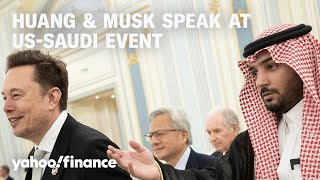 20251:25:46
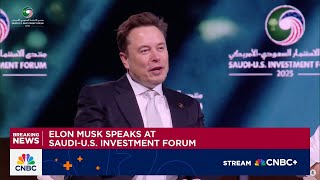 20257:57