每年 5.3 万亿美元。这笔钱没有人真的掏出来过,账本上根本找不到这个科目,可它每天都在影响每一个人的生活。
马斯克把它叫做一笔巨大的、隐形的碳排放补贴。
2016 年,他在旧金山的一场活动上,对着满屋子的地球科学家、工程师和研究生聊了近两个小时。话题从碳税跳到火星,从电池回收跳到《银河系漫游指南》。现场有人问技术细节,有人问教育该怎么改,还有人问一个投资人拿着「尚未说明的新核能技术」找上门该怎么判断。
这场对话的信息密度很高,散着听容易漏掉底下那条连贯的线。下面按主题拆开。
日常决策靠类比,真正新的问题才值得从零推
主持人开场就问他:你总说要把问题拆到最基本的真理,再往上推,这个思维习惯具体怎么用?
马斯克的回答里藏着一条很实用的判断标准:类比推理是大脑的节能模式,第一性原理是稀缺模式,两者不能混着用。
他说,人过日常生活绝大部分时候靠类比,或者稍加变通地模仿别人已经做过的事。这是大脑的省力捷径,省下来的算力可以拿去干别的。但如果你要做一件真正新的事,尤其是反直觉的事,类比就不管用,因为参照系压根不存在,没东西可以模仿。
这时候只能做第一性原理分析:把事情拆到看上去最基本的真理,再一步一步往上推。
他也承认这很费脑子。你不可能对每件事都这么干,脑子会被榨干。但你要搞明白一件新事情,这条路基本是唯一的。
碳税:给文明修一条下水道
2015 年底巴黎气候大会刚结束,马斯克在那边和一群学生聊过可持续能源。主持人引用了他当时的一个比喻,这个比喻值得完整复述,因为它把整场碳定价争论的框架给换了。
马斯克说,碳循环的麻烦,类比一下就是不付垃圾清运费。
我们不该主张一个零垃圾的社会。零垃圾非常难做到。但重要的是,人们得为垃圾清运付钱。(马斯克)
争论的焦点从来不该是「人类能不能做到零排放」。这个目标不现实,也没必要。真正的问题是:这笔成本从来没有被计入价格,所以没有人有动力去减少它。
他给出的数字是,这相当于每年 5.3 万亿美元规模的、未被征税的负外部性。
接着他解释为什么价格这么要紧。价格本质上是信息,是引导劳动力和资源配置的主要信号。价格告诉你该做什么、什么东西应该比另一个东西更受偏爱。价格错了,经济里发生的就会是错误的事。
碳排放属于典型的公地悲剧:大气和海洋吸收二氧化碳的能力是公共资源,却不被定价,或者定价远低于它该有的水平。结果就是我们在制度上鼓励了错误的行为。
他打了个关于税制的类比。假如我们对水果蔬菜征重税,对香烟和酒精征轻税,这显然荒谬。而目前能源领域的税制结构,大致就是这么荒谬。他也没回避现实,承认有非常强大的力量在试图维持现状,因为现有格局里有人赚得盆满钵满。
他对巴黎气候大会的判断是:方向正确,会有一些进展,但没有应有的那么多,总体还是令人鼓舞。
政府干预通常制造价格扭曲,碳税是例外
这段是整场访谈里最反直觉的部分,值得单独拎出来。
马斯克一向不喜欢政府干预市场。但他明确说,碳税是个例外。
原话大意是:一般来说,政府干预经济会导致价格信号的扭曲被放大,但在这件事上,任何合理的碳税都会减少价格体系里的误差。
为什么?因为价格体系里本来就有一个巨大的错误摆在那儿:碳排放的成本没有计入。征税并不会往价格里新增误差,它修正的是本来就存在的误差。这项干预的作用是把倾斜的天平扶正,从而让市场重新开始正确地分配资源。
这个论证之所以有力,是因为它把碳税从「政府伸手干预市场」重新定义成了「修 bug」。对一个信奉市场的人来说,这个重新定义很难反驳。
中学生的 STEM 清单:软件、物理、经济学、批判性思维
主持人念了一条来自推特的问题,提问者 Regina Brinker 是初中 STEM 老师。
马斯克的排序很清楚:软件工程大概是人最该学的单一最大领域。此外他一贯推崇物理、通识经济学和批判性思维。
他特别展开讲了批判性思维,语气罕见地强调:这门课应该教得多得多。这听起来像句正确的废话,但他的理由很具体:
你需要直接告诉人们,怎么判断一件事该不该相信。(马斯克)
他说的就是教人识别常见的逻辑谬误类型,以及别人通常会用哪些方式骗你、你该怎么避开。主持人当场接话:这种课真该开。马斯克回:那咱们就开。
后面有人追问:你刚才列的那份清单里怎么没提地球科学?马斯克立刻补充,地球科学非常重要,这一点得说清楚。
他接着感慨了一件让他挺意外的事:人们对地球科学的了解少得惊人。连碳循环这种相当直白的东西都是如此。他说自己跟一些非常聪明、读过很多书的人聊过,对方居然不知道存在一个地表碳循环,也不知道把地下深处的碳挖出来、加进地表碳循环,会从根本上改变地表的化学平衡。对方的反应是:「哇,真的吗?」
马斯克说,是的,真的。他总结道:质量守恒对很多人来说并不是一件显而易见的事。你不能凭空造出新的碳,也不能让碳凭空消失。
该政府做还是该企业做,有一条清晰判据
主持人问了个很硬的问题:科研和创新里,公共部门和私人部门的分工在哪里?有重叠吗?还是各管一段?
马斯克给了一个相当清爽的判据。
一件事是「对所有人都有好处,但每份好处很小」,该公共部门做。因为这类事没法向每个人收 10 美元。比如你想搞明白地球、太阳系或者宇宙的性质,一个 30 亿美元的项目,平摊到全美每个人头上只要 10 块钱,算术上很划算,可你不可能真去挨家挨户收这 10 块。这种事交给公共部门效率更高。哈勃望远镜、火星探测任务都归这一类,而且大多数人会认同这些都是相当不错的东西。
一件事能形成经济闭环,该私人部门做。他举 SpaceX 的例子:大量发射通信和广播卫星,这个账算得过来,因为卫星上天之后,人们能听卫星广播、能看卫星电视。花钱的人和使用的人是同一批人。
但 SpaceX 同时也在替 NASA 执行空间站补给任务。这类任务的价值在于让人类更了解怎么在太空生活,好处散在所有人身上,收不回钱来,归公共部门。
超导超级对撞机被砍,是件令人难过的事
谈到科研经费,主持人提到一个现实:地球科学乃至很多科学领域的经费在持平甚至停滞,而其他国家在加大投入,机会又前所未有。
马斯克的态度很直接:他支持增加科研投入,公共部门和私人部门都该加,他自称是科学的重度支持者。
他举了两个对照案例。欧洲的大型强子对撞机是一项了不起的努力,做成了。而美国当年砍掉了超导超级对撞机(Superconducting Super Collider),他认为这是一件令人难过的事,是美国做过的一件挺可惜的决定。
他的结论毫不含糊:全世界都该增加科研经费。主持人顺势点出前排坐着美国国家科学基金会主任,马斯克笑着说她肯定在激烈地点头同意。
火星的意义:给文明买一张保险单
主持人提到他在《囧司徒每日秀》上说过火星是个「需要返修的星球」,然后问他:去火星要面对哪些挑战?
马斯克的回答顺序很有意思。他先讲为什么这件事重要,再讲技术。
他的哲学推演是这样的:宇宙中还有太多东西需要理解和学习,而这种理解的增长,大致和人类文明的规模与跨度成正比。人类文明如果只是单行星物种,那么终有一天会遭遇某次灭绝事件,可能来自人类自己,也可能来自自然界。这两类事件的概率都不为零,而时间足够长,概率就会趋近于一。如果人类是跨行星物种,文明存续的概率就大得多。
现在是地球历史上第一次,窗口打开了,人类有可能把生命延伸到另一颗行星。已经 45 亿年了,这是很长的时间。这个窗口可能开很久,但愿如此,但也可能只开很短一段时间。所以我认为明智的做法是,趁我们还能做的时候,让生命成为多行星的。(马斯克)
他还补充了另一层理由:这件事最终会带来海量的新科学,并且把人类理解宇宙本质的概率推到最高。他特别强调,这才是他认为这件事重要的真正原因,探索带来的科学增量,而不只是「留个备份」这么简单。
然后他话锋一转:而且我觉得这会是一场伟大的冒险。人早上醒来的时候,需要有值得期待的东西。它让人兴奋,让人受鼓舞。我们需要这样的东西。
主持人说自己年纪够大,还记得阿波罗登月那天,起床之后满脑子都是这件事,那种感觉就是「变化」。马斯克说,正是如此。
他大概率看不到火星城市自给自足
马斯克很坦诚:这件事会超级难,会花很长时间,他估计自己大概活不到看见火星殖民地自我维持的那一天。
但他说,如果目标是那个,中间有几个技术台阶必须迈过去。
第一是可重复使用火箭。如果能做到,进入太空的成本大概能降低两个数量级。他给了一个极具冲击力的对比:猎鹰 9 号(Falcon 9)的制造成本约 6000 万美元,而推进剂的成本只有大约 20 万美元。这就像给一架波音 747 加油,油钱相对于飞机本身几乎可以忽略。所以可复用这件事,带来的差别是数量级的。
第二是规模。需要真正巨大的火箭。
第三是在火星本地生产推进剂。从地球运燃料过去成本高到不可持续,只有在火星上就地取材,往返才可能变成常态。
他说,这三件事都能做到,就可以在火星上建立一个自我维持的文明。注意「自我维持」这四个字的分量:一座完全依赖地球补给的科考站,撑不起文明,只是插了根旗。
猎鹰 9 号:把 120 吨加速到步枪子弹的四倍
主持人提到猎鹰 9 号上次发射失败,下周就要再发一次,并问马斯克怎么看「失败中前进」这件事。
马斯克的回答很实在:当然更希望成功。但说真的,失败在情绪上是很创伤的。他补了一句:上次失败那天正好是他的生日,挺扫兴的。
然后他说,火箭本来就难。
他顺势讲了段物理。如果重力稍微轻一点,事情会容易得多。反过来,如果地球重力再强一点,用化学火箭基本就不可能了。G 值稍微变一点,效果就是「哇」。人类能靠化学火箭离开地球,某种程度上是运气。
接着他介绍了这次改进的几个点:
- 深度低温推进剂。把推进剂,特别是液氧,冷却到接近凝固点。液氧占推进剂的三分之二,深冷之后密度显著提高,同样体积能装更多质量。
- 推力更大。
- 改进的级间分离系统。
- 拉长了火箭上面级,装更多推进剂。
- 电子设备的一系列改进。
他说这次相比上一次是显著改进的火箭。
然后他解释可复用对一级助推器意味着什么。核心指标是能量转移:把动能加势能算在一起,看一级助推器向上面级转移了多少能量,以及这些能量作用在多大规模的质量上。
猎鹰 9 号的一级助推器,能向上面级传递每小时 8000 公里的速度。他用了一个所有人都能立刻理解的换算:突击步枪的子弹速度大约是每小时 2000 公里,所以这是子弹速度的四倍。
而且这个速度是传递到大约 120 吨的质量上的。也就是说,它在把 120 吨的东西加速到步枪子弹的四倍快。
主持人当场感慨:这就是把一件大家毫无概念的事,换算成一件大家能立刻被震到的事,是极佳的沟通方式。
意义这件事:少年时读《银河系漫游指南》
主持人问了最后一个问题:你之前说你可能一辈子都到不了火星。很多人都在做自己看不到结果的项目,你怎么想这件事?
马斯克的回答回到了他的少年时代。
他说,他小时候一直在想生命的意义是什么,为此相当沮丧。后来读了《银河系漫游指南》(The Hitchhiker's Guide to the Galaxy)。这本书的核心设定是:宇宙是答案,你只需要找出问题是什么。
他的结论是:如果我能帮忙把「问题」搞清楚,我就认为这件事有意义。
主持人接了一句:也许我们都需要一条巴别鱼,书里那种能翻译一切语言的生物。马斯克说,正是。
这一段解释了为什么他能接受「自己看不到结果」。在他这套框架里,把问题问对本身就是回报,答案什么时候来,跟做这件事的人没什么关系。
现场问答:核能、太阳能、电池
问答环节信息密度很高,按话题整理。
关于核裂变。提问者说《洛杉矶时报》头版报道了一批本地风投迷上某种尚未说明的新核能技术,文章承诺这种技术和三里岛、切尔诺贝利、福岛演示过的都不同,问他遇到这类邀约怎么判断。马斯克的判断是:核裂变本身没问题,设计得当的裂变系统是完全可以的,尤其是在不受自然灾害影响的地区。他举例法国大量使用裂变能,对法国来说很合理。但加州和日本就成问题,地震带上的核电站,风险模型不一样。
关于聚变。他明确认为这是可以解决的问题。他自己没直接做聚变,理由说得挺坦率:他认为来自天上那个巨大聚变反应堆、也就是太阳的「间接聚变」加上光伏,在经济上大概率是最优解。他还补了一条容易被忽略的条件:北半球高纬度地区有大量水电,这恰好解决了天黑或者隆冬时怎么发电的问题。他不想打击别人做聚变的积极性,也许他判断错了,但经济性会压倒性地偏向「间接聚变加光伏」,尤其再配合电池和横贯东西、纵贯南北的高压输电线路。
地球的电力需求有多小?他给了一个具体说法:满足全地球的用电需求,只需要相当小比例的地表面积。对美国来说,基本上一小块犹他州或者内华达州的面积,就能用太阳能供全美用电。一平方公里的太阳能功率大约是 1 吉瓦,这个量级乘以沙漠面积,账就出来了。
太阳能的翻倍速度能保持吗?提问者算了一笔账:太阳能装机大约每两年翻一倍,指数增长很猛,距离「一切都由太阳能供电」只差七次翻倍。马斯克判断这个速度大概率会放缓,但年增长率仍然会很高。他补了一个关键约束:当太阳能占电网比例达到某个程度,就必须加电池来做负载平衡、把电能缓存起来,否则白天发得多、晚上没得用,多出来的电只能弃掉。而太阳能加电池这两样,就足以彻底解决地球的全部电力问题。
电池回收。有人问光伏和电池自己的生产周期会不会带来污染。马斯克的回答很干脆:Tesla 目前所有电池包都在被回收,北美、欧洲、亚洲都有回收中心。他的类比很妙:电池包可以看成非常高品位的矿石,「挖电池包」比「挖石头」划算得多,所以回收在经济上天然成立。这也会显著降低生产成本。内华达的超级工厂(Gigafactory)会把回收环节直接建进去,长期还会用太阳能、风能和地热实现完全可持续供电。
电池技术的进步速度。他说超级工厂的思路是把规模经济做到极限,尽可能做最大的工厂。底层技术会有中等程度的改进,不算巨大,但也不小,而且会越来越好。他对电池的评价很高:这是当前最热的几个技术难题之一,因为它受到的约束太多了。能量密度、成本、寿命、安全、低温性能、充放倍率,每一条都卡着。太多非常聪明的人在这个问题上折戟,平均下来能量密度和经济性每年大约进步 5% 到 8%。不过他认为,仅靠规模经济,经济性这一块能改进得多得多。他鼓励所有对电池感兴趣的人去研究更好的电池:超级难,但必须解决。
交通全面电气化,不只是汽车
有人问:低碳能源转型的主要步骤是什么?有没有你还没在做、但觉得很有意思的技术方向?
马斯克的回答是:交通的全面电气化很重要,飞机和船也是如此,这两块的排放不好替代,但迟早要动。然后是供暖和制冷的电气化,热泵这类东西看上去不性感,装机量上去了省下来的碳相当可观。
核能也可能很有意思,但得看它怎么和太阳能竞争。
他给了一个判断标准,这条其实适用于所有人评估技术方向:任何一种能源的生产或消费方式,如果你把它外推到很久以后,世界依然是个好地方,那我们就该去做。
反过来也成立:外推之后世界变糟了,那这件事无论当下多划算,都不该做。这个标准朴素,却能过滤掉大量看起来很酷、长期有害的方向。
能源公平:互联网是最大的均衡器
有人问马斯克,他的公司怎么应对全球范围内的科学获取和能源获取的不平等。
他提到两件已经在做的事:Tesla 已经把专利全部开放。Solar City 更进一步,把技术开放给发展中国家,并且邀请这些国家的人来工厂实地看怎么做的。他说的思路是,让人亲眼看见流程,比给一份文档有用得多。
但他认为最大的均衡器是互联网。只要有一台一百美元的联网设备,你可以学到任何东西。你不必再跑去图书馆,原则上可以免费学到任何你想学的东西。他说这一点可能被谈论得太少了,这其实是当下这个时代相当了不起的一部分。
电动车对燃油车:就算电网全烧煤也赢
这段是全场技术含量最高的反驳,值得完整保留。
提问者的质疑很尖锐:电动车本身不解决温室气体问题,因为电还是靠煤和天然气发的,而这些电厂并不比汽油车更高效。
马斯克的回答是:即使电网完全由煤或天然气供电,电动车产生的二氧化碳仍然更少,哪怕把计算一直追溯到电厂烟囱那一步。
原因是质量体积的约束被解除了。发电厂不用背着一整套动力系统上路,所以可以把能量提取效率做得高得多。他举例:通用电气(GE)的天然气发电厂效率超过 60%,也就是说,源头的能量有 60% 被转化成了电。汽油车在整个行驶工况下的效率通常低于 20%。
差距为什么这么大?因为大型天然气轮机可以很重、很庞大,还可以把废热回收,推动蒸汽轮机再发一次电。地面交通工具背不动这套东西,只能把大部分能量以热的形式扔掉。效率的差距从结构上就定了。
所以即便把输电损耗和充电损耗都算进去,电动车仍然远远领先于汽油车。这个结论对任何源头燃料都成立,煤也好,别的也好。你总是会赢。
更何况电网并不是全靠化石燃料。水电、地热、太阳能、风能都在,而且前面那位提问者已经指出,太阳能的增长非常猛。可持续能源占电网的比例在持续上升,加上电池之后,这个速度会更快。
终点确定,唯一的问题是时间
访谈临近结束,马斯克讲了他在巴黎气候大会上最强调的一点,这也是整场对话的收束。
他说,走向可持续能源经济是确定的事。为什么?因为另一个选项是把地下所有碳基燃料挖出来烧掉,烧完之后你要么转向可持续能源经济,要么整个经济因为没能源而崩溃。终点只有一个。
我们确定会走向可持续能源经济。问题只是什么时候,以及到底有多少亿吨二氧化碳留在大气里、多少留在地下。(马斯克)
主持人接话:也就是说,唯一的问题是我们把 ppm 稳定在哪个数字。马斯克说,正是。
然后是那句收尾:
既然我们知道终点在哪里,那看起来我们应该尽快结束这场实验。为什么不呢?(马斯克)
这场访谈真正值得带走的东西
两个小时的对话散落在各个话题里,底下有一条线是连贯的:价格信号错了,行为就会错;行为错了,代价会以指数方式累积。碳是这样,能源是这样,就连「要不要让人类成为多行星物种」这个问题,本质上也是在为文明的长期存续买一份保险。
如果要把这场访谈变成可以立刻用起来的东西,下面这几条最实际:
- 遇到真正新的问题,别找类比。把问题拆到最基本的真理,然后一节一节往上推。日常决策可以靠类比省力,新问题不行。
- 判断一项技术值不值得做,把它外推到很久以后。外推之后世界依然是个好地方,那就去做。这个标准能过滤掉大量看起来很酷但长期有害的方向。
- 评估电动车和燃油车的环保性,别停在「电从哪来」这一层。就算电网全烧煤,电动车的全链条效率依然占优,因为发电厂摆脱了质量和体积约束。这个结论在辩论里非常好用,值得记住 60% 和 20% 这两个数字。
- 电池回收是门好生意,别当公益看。电池包是极高品位的矿石,「挖电池包」比「挖石头」划算。这条逻辑可以用来判断任何含贵金属的废弃物处理方向。
- 想推动碳定价,就用垃圾清运费的类比。没人主张零垃圾社会,但所有人都接受垃圾清运要付钱。争论一旦落到这个框架里,很多对立会自动消解。
- 如果你是老师或者家长,批判性思维要教得很具体。别停在「多想想」这种层面。直接告诉孩子有哪些常见的逻辑谬误、别人通常怎么骗你、你怎么识别。这门课完全可以教得跟数学一样精确。
- 如果你在选技术方向,优先考虑受约束极多、聪明人反复折戟的难题。电池就是典型:每年只进步 5% 到 8%,但一旦突破,撬动的是整个能源体系。难,恰恰是它值钱的原因。
最后留一句马斯克在访谈里说的:人早上醒来时,需要有值得期待的东西。他做火星,一部分原因就是想给这件事留个位置。这个理由本身,可能比所有技术论证都更值得记住。
0:00Thanks so much for joining us today. as I said in my YouTube in invitation to you, we think we are your peeps. Oh, great. in your so I'm going to ask some questions and then we will have some opportunity for questions from the audience. in your TED talk which I really enjoyed you said that discovery requires us to boil things down to their fundamental truths and reason up from there. So that's a mindset that you live every day for a lot of us. when we
0:37think about what could be we often get stopped by obstacles and what what the impediments are and you have clearly blown through those. So, how do you think about that and and how do you focus on getting by those obstacles? well, I'm a big believer in in the sort of science or physics framework of trying to analyze problems, particularly if if they're new. so if if something's new, then analogies don't don't work very well. because it's it's it's it's new. I mean, the way we get through daily life is mostly by analogy. or by sort of copying things with minor variations because it's a computational shortcut. but if you want to do something that's that's
1:25fundamentally new or particularly if it's counterintuitive then you have to do a first principles analysis and and you know take things from from the what appear to be as fundamental sort of simple fundamental truths and then reason up from there. and I mean that that requires a lot more sort of thinking and you can't you can't do that for everything but but if you're trying to figure out something new I think it's it's really the only way to go.
1:56So I mentioned that that I was in Paris and I know that you were there too and as I listened to presentations first there was a real sense of optimism at this cup that I don't think was there before but there was still an overwhelming sense of a lot of work that we have to do and I was struck by
2:20some comments that you made when you were talking to a group of students at the or bone and they were talking about sustainability and you said regarding the carbon cycle. This is analogous to not paying for garbage collection. It's not as though we should say in the case of garbage have a garbage-free society. It's very difficult to have a garbage free society but it's just important that people pay for the garbage collection. So we need to go from having an untaxed negative externality which is effectively a hidden carbon sub subsidy of enormous size 5.3 million trillion a year and we
3:02need to move away from this and have a carbon tax. So can you talk a little bit about that especially from the standpoint of being in private enterprise? Yeah, I mean essentially prices are just information. they they the primary information to allow for labor labor allocation. and I mean they sort of tell people what what to do and what thing should be favored over another thing. and and so when the prices are are wrong then the wrong thing happens in the economy. so when you have sort of a tragedy of the commons like the CO2 capacity of the oceans and atmosphere and it's it's unpriced or the price is is much lower than it than it should be then the wrong behavior
3:50happens. So effectively we're we're inenting bad behavior. and I mean I just talked about how analogies are imperfect but but you know it's kind of like if if we had a high taxes on on fruits and vegetables and low taxes on on cigarettes and alcohol that would that wouldn't make sense. U that that's sort of what we have right now with respect to energy. and and and we're very powerful forces trying to keep it that way. so now it will
4:29eventually correct but and and we are seeing some good movement in that direction with the Paris climate talks. It sounds like it's direct directionally correct and and there'll be some movement not as much as there should be but it it's it's encouraging. and I mean I think it's it's worth noting that like generally when when when the government interferes in the economy it's it's it's it's that usually results in a in a a pricing error increase.
5:01but in this case I think it would it would be it's hard to miss like any any sort of common tax would reduce the effect of error in the system of prices in the economy. Yeah. I'd like to shift directions. while we are a research community, we're also an education community and we have crowdsourced some questions for today's event and one of them comes from the education community. So this came to us on Twitter from Regina
5:37Brinker Brinker Science if you want to follow her. And she says, "I teach middle school STEM. What should students be learning to be prepared for and contribute to the future workforce? well, I think I mean software engineering is probably the single biggest area that that people should learn. and and I and I think I think I'm always sort of a fan of physics and general economics and
6:10critical thinking. I think those are we really should teach critical thinking a lot more because people Yeah. like I mean that may seem like a simple thing but it's it's just like you need to just tell people like this is how you know whether you should believe something or not.
6:35yeah, it's like you can you can tell how much everybody resonates with that here. I think I'm preaching to the converted here. Yeah. But, yeah, it's yeah, you know, just teaching people these are the general types of fallacies and this is how people will generally trick you and how to avoid being tricked and that kind of thing. It'd be really great.
6:55It would. It would. Let's do it. at the fall meeting here we also try to tr stress the importance of transdisciplinary research and how science informs other areas like policy and so forth. So another question we received from Twitter came from Lori Zielowski. She's at extra neutrons.
7:23who asked so you didn't mention geocscience in that list of things that people should know about? Sure. I do think geoscience is very important. Let me be clear. I Yeah. What do the engineers of the future need to know from geocciences and how can how do we influence that and work together?
7:46well I mean I think in general I think that it would be good in general for people to know about geosciences and to know how our actions as a civilization will will affect the future or and you know how we can positively affect it, how we might be negatively affecting it you know on the assumption that we want the future to be good we want to direct our actions to you know with respect to to geosciences to to a good outcome. so
8:16I, you know, generally it's it's it's sort of quite surprising how little actually people know about about geosciences. I mean, even like pretty straightforward stuff like the carbon cycle, you know, sort of I mean, I've had conversations with with with quite quite smart and well read people who who who don't understand that there's like a surface carbon cycle and and then but if you dig stuff up from deep underground and add it to the surface carbon cycle that that that fundamentally changes the chemical equilibrium of the of the surface of the earth. and they're like, "Wow, really?" Yeah. Yeah, definitely. and
8:56you know like there's just conservation of mass is not totally obvious to people. Okay. you know like you can't just create new carbon from nothing. you have and you can't get it fromwhere disappear. Yeah. It doesn't disappear. yeah exactly. So, you know, just like basic stuff like that will be, like great to educate people on.
9:26Terrific. I I we're sort of bouncing around, but I have some, you know, I we got great input from all of you when we ask for questions and I want to make sure we try to, touch on a lot of different topics. So I want to talk about the roles of the private and public sector in ensuring the advancement of scientific research and innovation and where do you see the
9:55roles of the private sector versus the public sector? Are there places where they overlap? Are they totally separate? Yeah, I I think the public sector is when when you have something that's kind of a small amount of good for the whole population or for you know the whole country or even the whole the whole world. but it would be really difficult to go and collect like $10 from everyone to understand you know more about the nature of the earth or the solar system or the universe.
10:26so you it's it's sort of it's not efficient to go to try and sort of you know collect sort of a if you if you've got say a you know a $3 billion project to go and get $10 from everyone in the United States, it's like it's it's better to do that by the public sector. and but then you know you have great things like like the Hubble and I think most people would say like you know that's that's quite a quite a good thing. or or the Mars missions so
10:57I think you know where where you have these things which are a small amount of good for for a lot of people it makes sense for the public sector to to you know for government to do that. where you can more concretely close the economic loop. that that's where the private sector makes sense. so for example at SpaceX we do a lot of launches of communications and broadcast satellites. and and then that that can sort of close the economic loop because then people can listen to XM radio or get Direct TV or something like that. and and that kind of makes sense. but then we'll also do missions for NASA to re resupply the space station. so we can sort of
11:43learn more about living in space and that makes sense as a as public sector thing. so I think that's the basic basic difference. So in that public sector not only geoscience but a lot of science is seeing very flat funding at a time when other nations are investing at a time when there's tremendous opportunity. how do you think that the private sector can help us turn that around and focus on you know what the benefits will be for society for u
12:20public sector investment in in research well I'm certainly a proponent of increasing investment in in science in general from you know both the public and private sector and you I'm super pro- science science. So I and it it is you know it's interesting to see like the large hatron collider you know that was that was really a great effort there there in Europe and you know but we sort of cancelled the superconducting super glider here in the US I thought that was that was sort of a sort of a sad thing that we did there you know I I really think we should we should increase funding for science absolutely you know across the world really right we have the director of the
13:13National Science Foundation in the front row here I'm sure she's in violent agreement yeah I mean definitely so you mentioned Mars and in your interview with Steven Colbear you said that Mars is a fixeruppper planet yeah exactly needs work but you've also been a proponent of coloniz izing Mars. what are some of the challenges that you think we would face in traveling to Mars? I know you're very interested in this. How do how do you think about that?
13:47Sure. well, I think first of all, I should say, you know, why do I think this is important? and and that's if if I sort of unpack the sort of philosophical basis for that as far as I'm concerned, it's the reason I came to that conclusion was that you know I think that we we don't there's there's so much more to understand and learn about the nature of the universe.
14:14and that understanding will will grow kind of proportionate to the scope and scale of of human civilization. and the probability of the probable lifespan of human civilization is is much greater if we are a multilanet species as opposed to a single planet species. if we're a single planet species then eventually there will be some extinction event either you know either from humans or or some natural thing. So so I think and and and now it's the first time in the history of Earth that the the windows opened where it's possible for us to extend life to another planet. I mean it's been 4 and a half billion years so it's a long time and and that that window may be open for
15:03a long time and hopefully it is but it may also be open for a short time and so I think the the wise move is to make life multilanetary while we can. and and and this ultimately is what will lead to a huge amount of of new science and ensure that that we have the highest probability of of understanding the nature of the universe. so that that's actually the the reason that I think it's important.
15:34and and I I also think it would be a a great adventure. and you know, there need to be things that people look forward to when you wake up in the morning. Like it's it's exciting and inspiring. and you know, we we need those things. Yeah. I'm old enough to remember the landing on the moon and getting up that day and thinking about that.
16:02and just u the change. Yeah. Exactly. Yeah. Yeah, good point. So, but but it it will be super hard to do this. and it will take a long time and I I suspect I probably won't live to see it become self- sustaining. but if if we are to aim for that objective, then you know there important technological steps that are needed to to get there. one of them, for example, being reusable rockets.
16:39if we have reusable rockets, we can reduce the the cost of of of access to space by probably two orders of magnitude. and I mean, it's worth noting that for the the Falcon 9, which is about a $60 million rocket to build, the the cost of the propellant is only about $200,000. So, you know, it's it's much like refueling like a 747 or something like that. so, it's it's really a massive difference if we can make reusability work. and then we also need scale. we need to have really big rockets. and and you need to do local propellant production on Mars.
17:26so, if we can do those things, then I think we can establish a self-sustaining civilization on Mars. So, I understand that you're going to be launching your newest rocket next week, right? And this is the first launch since the Falcon 9 back in June. And I've lost some scientific gear that was pretty expensive in the ocean. and I
17:52know what that feels like. Maybe not. Maybe I don't know how it scales, [Laughter] but you know, if this is successful, it's it's clearly historic. And how do you think about that issue of you know failing forward? Failing forward. well I think I think I'd much prefer a success board of course but but yeah it's it's quite emotionally traumatic actually. and yeah the the last flight which failed actually did so on my birthday which is really bit of a downer. yeah so yeah I mean it's it's
18:44rockets are hard to say. Yeah. the I mean if if gravity was just a little lighter, it would be much easier. actually if gravity was a little little stronger on Earth, it would be basically impossible to do with with chemical rockets. It's amazing how much gravity affects things. I mean like it's a small change in G and it's like wow. but you you can look at say the Saturn 5 which was like the size of the first time I think anyone's done it is deep deeply cryogenic propellant.
19:22So we're subcooling the the propellant particularly particularly the liquid oxygen because it's 2/3 liquid oxygen close to its freezing point which increases the density quite quite significantly. and and then the thrust is higher. with an improved stage separation system. We stretched the upper stage of the rocket to add more propellant to that and there are a number of other improvements in electronics. So it's I think a significantly improved rocket from the the last one. and then I should say like what is important about reusability as far as the boost age is concerned.
20:04what the the key sort of figure of merit is is is the transfer transfer energy. so if you take the potential energy and the kinetic energy and say how much has been transferred to the the output stage by the boost stage and and and what's the mass that so basically yeah basically kinetic energy and potential energy transfer that that's the thing that that's the figure of merit. so the the boost stage of Falcon 9 is is capable of of transfer of
20:38a transfer of velocity to the alpha stage of 8,000 km an hour. So it's really just pretty fast. Y a bullet from an assault rifle, it goes at 2,000 km an hour. So it's four times faster than a bullet from an assault rifle. that's a transfer velocity at roughly 100 kilometers. and the the to a mass of about 120
21:03tons. So, it's accelerating 120 tons to four times faster than a than a bullet. I loved the way that you just compared something that people wouldn't have any conception of to something that they would and that they would be really impressed by. I mean, was that amazing communication?
21:26That was terrific. yeah. I wanted to ask you one last question and then we're going to throw things open for the the audience. When you talked about Mars, you said, "I don't think I'll ever get there." Well, and yeah, what can you talk a little about, you know, a lot of us get involved in projects that we don't know if we'll see the realization? Yeah.
21:57And can you talk a little bit about how you think about that and and trading off, you know, I get to do it versus it'll come later? well, you know, going back to the sort of underlying my underlying sort of philosophical rationale for doing it in the first, you know, doing in the first place. the you know I basically I sort of was thinking about this when I when I was a kid and trying to find some meaning in life like what's the meaning of life you know and I I quite sort of sad
22:35about it actually when I was a teenager and and then I read the the Hedgehog's Guide to the Galaxy. Mhm. which basically said like the the real the real you know basically the universe is the answer and you just need to figure out the questions. So I think you know that that's if if I can help kind of figure out the questions then that I consider that to be meaningful.
23:08Absolutely. And maybe we can all use a babble fish as well. Right. Exactly. Okay. now it's time for you and I'm going to go we're going to alternate between questions from the audience and questions from the the No, Joan, we're not we we won't Okay, just the audience. Okay. so it's your
23:38turn. Questions for Elon. please come to the microphones that are in the in the aisles and there's somebody at this microphone. Go ahead. Thank you very much for appearing today. two weeks ago, the Los Angeles Times featured prominently on its front page a story in which it described many self-described venture capitalists from this area who were enamored by a new and as yet unspecified technique of nuclear power generation. It did not it was promised in the article the technique was different than those demonstrated at three-mile island, Chernobyl, and Fukushima. the I'd like to ask if
24:17you had what your critical thinking skills would be when approached by people offering you to invest or become involved in new and undefined nuclear power techniques. Do you know what they're talking about? And two, what do you see as the future for nuclear power in our efforts to restore the earth to the conditions that it might have existed more closely at the start of the anthroposine?
24:43Sure. well, I I I actually am I I I mean, I'm I think there's nothing wrong with nuclear power, whether fision or fusion. I think if if a properly designed vision power system is is actually fine, particularly if it's in a an area that's not subject to natural disasters. so, you know, for example, France has a lot of fision power. and that can make that I think makes a lot of sense for them. but but for California, it's more questionable. or Japan. so then
25:20then then then fusion I I definitely think fusion is a solvable problem. the the the reason I sort of h haven't done anything in direct fusion is that I I currently think and I may be wrong about this that indirect fusion from the the the big fusion explosion in the sky called the sun is you know and you know having
25:51photovoltaics is is probably going to make the most sense economically. and in the in the nor in the high high latitudes in the north nor northern hemisphere you tend to have a lot of hydro power. So that that that really helps solve the you know how do you make power when it's dark problem or or in the middle of winter type thing. So I don't want to discourage people from pursuing fusion but personally I I think the economics are going to favor indirect fusion of vol photovoltaics
26:30at least in to to an overwhelming degree particularly when combined with batteries and high voltage lines running east west and north south I mean you can completely solve earth's all the power needed on earth with a with a fairly small percentage of the surface area. I mean for the United States, you could take basically little a corner of Utah or Nevada and power the entire United States with solar power. So I I think that's that's mostly how it will get solved.
27:08The next this is a bit of a followup on that. solar power has been doubling basically every two years and we all know that exponential growth is a powerful thing. So we're only what seven doublings away from everything being powered by solar power. And do you think that that doubling rate will will keep pace? I mean I I think it'll probably slow down.
27:34but but it's still going to be a high percentage growth rate every year. once you reach a certain percentage of solar into the grid, you really need to add batteries in order to load level. and and kind of cache power. but but solar combined with with batteries really I mean you kind of like I said you can completely solve all of Earth's power with just those those two things.
28:04great. Is that Victor? You know it's worth it's worth noting. I think probably people are aware of this but you know you get it's there's one gawatt per square kilometer of solar energy solar power right I'm Victor Zakos massive fan of your work particularly fighting the carbon pollution and actually follow up on this battery question we tend to start understanding how powerful the carbon pollution is but battery related technology technology and photo voltex has its own production cycle. I was wondering if you could maybe share your thoughts on what the consequences and maybe a remediation recycling of that would be.
28:47Yeah. Well, all of the battery packs for Tesla are currently recycled. so the recycling centers in North America and Europe and and Asia. and and it kind of makes sense because you can just think of the battery packs as really high quality ore. it's way better to mine a battery pack than rocks.
29:08so, so it kind of makes sense to to recycle them economically. yeah. and and that obviously reduces the the cost of of production quite a bit. for the gigafactory that that we're building in Nevada, that will have recycling built in. So there, you know, it'll we completely sort of you know, close that cycle. and it will be in long term fully sustainably powered. So solar, wind, and geothermal. yeah,
29:44and the the far microphone. Hi, I'm Jim Croll from Arizona State University. I was listening to Dr. Dr. Chris Mccay, another advocate of humans to Mars. And he was talking about when we do go to Mars, if we find life either currently there or extinct, we should re consider removing human presence so we can allow that life to thrive. I was wondering what your thoughts on that were.
30:13Well, I it really doesn't seem like there's any life on on Mars. I mean, if there on the surface at least, we're not seeing any sign of that. I think if we do find some sign of it then for sure we need to understand you know what it is and and trying to I think try to ensure that we we don't extinguish it of I mean that's that's important but I think I think the reality is that there there isn't any life on the surface of Mars. there may be
30:47microbial life deep underground where it's sort of shielded from radiation and and and from the cold. and yeah, so that that's that's a possibility, but in in that case, I think anything we do on the surface is really not going to have a big impact on the subterranean life. yeah. So, okay.
31:12Thank you. over here again. Hi. with a decision coming out of COP 21 just a few days ago, with the world now appearing to be on track to decarbonize the energy system, renewable energy and of course storage is going to become increasingly important and likely the development will accelerate.
31:33I'm really interested in what Tesla's doing on batteries that will help smooth the intermittency of the renewable generation and would really like to hear your discussion of where you see Tesla going on battery storage for renewables and generally the whole issue of storage for renewables.
31:50Yeah. Well, definitely this battery technology is super important to sustainable energy. what what we're doing with the the the big factory in that we're building in Nevada is just really trying to take economies of scale to the limit. so it's like the biggest factory we could conceive of in order to to maximize economies of scale. and then
32:19obviously there's the underlying technology itself. which there there'll be I would say moderate improvements in the underlying technology. not not giant but not not small but kind of medium. but but then over time I would expect those those technology improvements to get better and better. and from Tesla standpoint we're always interested in trying to figure out how to how to make it better. I I do think that batteries are one of the hottest technology problems out there.
32:50because there's so many constraints on creating a useful battery. it's it's really I mean so many super smart people have broken their pick on improving batteries. so so it usually ends up being on average like about a 5 to 8% improvement per year in energy density and economics. although I think we'll be able to improve the economic element a lot more just by the economies of scale. but I anyone who's interested in in doing batteries I'd certainly encourage them to to research better batteries. It's it's a super hard problem and a critical one to solve.
33:34Great. what do you think are the main steps in a lowcarbon energy transition? And in that vein, what technologies out there? What technological developments do you find very interesting that you're not already working on? Things that aren't batteries or electric vehicles, but that you think are cool areas for people to go into.
33:59Well, I think electrification of transport in general is important. so aircraft and and boats that that that's pretty important. and and then heating and cooling, electrification of that. yeah, I mean I think I mean the nuclear stuff could be could be quite interesting. but it would just have to sort of see how it competes against solar.
34:32but but yeah and any anything which which any form of energy generation or consumption which if you extrapolate into the future goes on for a very long time and still has the world being good. I think we should just do that. Yeah. Over here. Good morning. Fuchsia Hoover from Purdue University. my question pertains to
35:00science access and energy within the global context. and I was wondering how you see any or all of your your companies and ventures trying to address the the inequity of science access or access to energy or or what types of things that you're hoping to do within that context to try and really expand those resources and make it accessible to everyone.
35:31Sure. Well, I mean as was mentioned earlier Tesla has just made all the patents open. and Solar City is actually going even a step further than that which is they're making the technology available to developing countries and and they're offering to have people come from those countries and actually sit in the factory and see how it's done. So I think you know trying to be helpful in that respect.
36:11and but but I I do think that you know the the internet is a great equalizer of access to information. the you know this is this is maybe not talked about as much as it should be but you can learn anything if you have a $100 internet device. You can just learn anything. It's which is amazing compared to the past. you don't need you don't need access to a library. I mean a principle you could just you could learn whatever you want for free really.
36:45I think that's that's a pretty great part of the future that we're in right now. Indeed. In the end. Hi Heiho Park from Sandia National Labs. Tesla has done a great job creating an infrastructure for electric cars in the country so far, but I don't think electric cars themselves solve greenhouse greenhouse gas problems because we're still generating greenhouse gases from coal and natural power plant natural gas power plants which are not as efficient as gasoline cars. So how did you originally envision the future source of electricity and how do you envision it now?
37:25Yeah, actually it's it's worth noting that even if the grid was completely powered by you know coal or natural gas electric cars would still generate less CO2 even when you extract I when you take it all the way to the power plant level the the reason for that is that when you're not constrained by mass and volume you can make the the efficiency of energy extraction much better in a power plant than you can in a car. so if you take say like natural gas power
38:04plant from from GE, it's it's over 60% efficient. so take the source energy 60% efficient in in generating electricity. So it's really good. whereas typically a gasoline powered car over the drive cycle will be less than 20% efficient. and and that that's because you you know the the big natural gas turbine is it it can be really heavy. It can be really bulky.
38:32and you can take the the waste heat and then run a steam turbine and you know get even more energy out. So your efficiency is just fundamentally much better. And so even when you take into account the transmission losses and the charging losses, you're still way far ahead with electric cars than you are with gasoline cars. So even you can take this do this with any source fuel, coal, anything. you're just you're just always going to win even if everything's powered by by CO2 sources.
39:08then then of course everything isn't powered by CO2 sources. you have hydro geothermal solar wind and as was pointed out by one of the earlier questioners the growth of solar is very dramatic. so the you know the percentage of the grid that is sustainable energy is increasing over time. and then particularly when we add batteries to the mix that will that will further increase the rate. So I think I think we're we're on a we're headed in a positive direction. It's just a question of how long it will take to get there. In fact, like one of the things I really emphasized in the Paris talk was that it it is a certainty
39:59that we will move to a sustainable energy economy. because the alternative would be would be to to mine all of the carbon based fuels from the ground, burn them and then you either move to a sustainable economy or the entire economy collapses because then it doesn't have any energy. So we know for sure that we'll move to a sustainable energy economy. The question is just when and and h how many you know billions of tons of of CO2 are in the atmosphere versus in the ground, right?
40:33That that's really the only question is is what what what ppm number will we you know stabilize it. Yeah, exactly. so you know so so g given that we know where we'll end up which is a sustainable energy economy it seems like we should we should terminate this experiment as soon as possible.
40:57Why not right? I'm sorry but we don't have time for any more questions. when I was walking in, one of my friends was telling me how excited he was to be here. And I wrote down what he said because I think it's something we all share. He said, "It's such a rare thing to see a person devote themselves to coming up with real solutions to the biggest problems and then doing it." Thank you so much. Thanks for having me.
资源与出处
- 视频在 YouTube 收看
- 档案silicon-valley.tech 档案页本页视频与文稿数据来自 Elon Musk Archive
- 精读本篇精读 Markdown 版
相关视频
同频道、同主题或相邻年份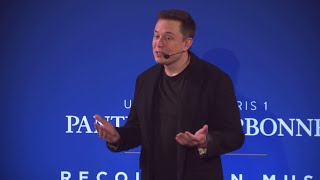 201554:46
 201551:52
 201740:55